


Amazon CEO Andy Jassy Explained Why Semiconductor Sales Could Keep Climbing for Years to Come. Here's My Favorite AI Chipmaker Right Now.
Key Points
Even if hyperscalers' spending growth slows, semiconductor sales could rise at a fast pace.
Nvidia and Broadcom have seen sales explode as they provide key chips for the largest AI data centers.
This company is even better positioned to provide sustainable earnings growth well into the future.
- These 10 stocks could mint the next wave of millionaires ›
Semiconductor companies have been among the biggest beneficiaries of the massive AI data center build-out over the last few years. Companies like Nvidia (NASDAQ: NVDA) and Broadcom (NASDAQ: AVGO) are at the center of the industry, with their leading AI accelerator chips. Other chipmakers specializing in memory or networking chips have also seen profits soar and their stock prices rise.
And the incredible growth could continue for years to come. PwC expects total capital expenditures for data centers to climb from $800 billion this year to $1.8 trillion by 2050. More importantly, it's how that spending will be allocated that makes that estimate so bullish for semiconductor stocks. Amazon (NASDAQ: AMZN) CEO Andy Jassy explained on the company's most recent earnings call that spending will shift toward more semiconductors, suggesting there's a lot of room for revenue growth in semiconductor stocks.
Missed Nvidia in 2009? This Rare Signal Is Flashing Again. In 2009, a "Double Down" signal flashed for a little-known chipmaker called Nvidia. For the first time in years, that same "Total Conviction" signal is flashing for a company 1/100th the size of Nvidia. Continue »
But Nvidia and Broadcom might not be the best semiconductor stocks right now. Another industry giant could be an even better opportunity to play the long-term growth potential in chips.
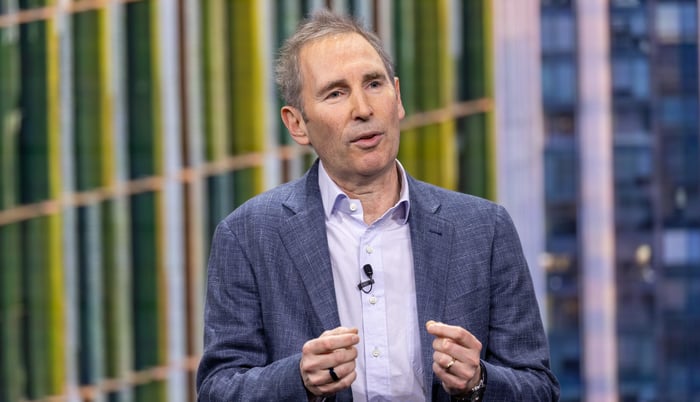
Image source: Amazon.com.
The big shift coming in AI data center spending
When you dig under the hood of hyperscalers' massive capital expenditure budgets, there are two core components: the data center buildings and the servers and networking equipment inside them. As Jassy points out, "these have different capital cycles." Data centers depreciate much more slowly than the server racks full of GPUs.
"For our data centers, which have 30-plus-year useful lives, we should get at least five to six generations of server economics," Jassy told analysts during Amazon's second-quarter earnings call. "This means in the short term, when demand is necessitating so many data centers being built simultaneously in advance of when we can start monetizing them, we'll spend a lot of capex and encounter free cash flow headwinds until these data centers come online, can be monetized, and we get a few years into these servers being utilized."
In other words, once a data center is built, Amazon doesn't have to build the data center again. However, it does have to periodically refresh the chips inside of it. As a result, over time, more and more of its capital expenditures will go toward semiconductors. The same is true at all the other hyperscalers.
In fact, Microsoft (NASDAQ: MSFT) CFO Amy Hood said she's already seeing the shift happen for the company's competing Azure cloud computing business. "You've seen our capex really pivot toward what I would call and do call short-lived assets," she said on Microsoft's fourth-quarter earnings call. She noted roughly two-thirds of Microsoft's capex currently goes toward GPUs, CPUs, and other equipment for data centers.
PwC's estimates suggest a significant slowdown in spending at some point over the next decade. But if chips make up a significantly larger portion of the budget in the future, the growth in semiconductor spending can climb at a relatively high pace. That bodes well for one semiconductor stock in particular.
My favorite AI chipmaker right now
Nvidia's leading GPU systems are very likely to retain a significant portion of AI spending well into the future. It's establishing partnerships and even providing funding to ensure its chips continue to find their way into big data centers. That said, there's a growing push toward custom silicon among the hyperscalers. Jassy noted that it's bringing more of its own Trainium chips into its data centers than Nvidia chips this year during Amazon's first-quarter earnings call.
Meanwhile, Broadcom is experiencing tremendous growth for its AI business, which includes its partnership co-developing and engineering Alphabet's (NASDAQ: GOOG) (NASDAQ: GOOGL) popular TPU chips. The company recently reported quarterly AI-related revenue growth of 221% with expectations for that number to accelerate next quarter.
But the semiconductor company best positioned to benefit over the long run is Taiwan Semiconductor Manufacturing (NYSE: TSM). The largest contract chip manufacturer in the world works with Nvidia, Broadcom, and almost every other fabless chip designer in the world. It benefits from both its scale and its leading technology, creating a virtuous cycle that's only strengthening amid the AI build-out.
Taiwan Semiconductor Manufacturing, or TSMC as it's known, has grown its market share of third-party chip manufacturing to 73%. That provides huge amounts of revenue ($143 billion over the past 12 months) with which it can reinvest in research and development and additional manufacturing capacity. That allows it to maintain its leading technological capabilities in designing the world's most advanced chips for AI data centers while supplying the capacity hyperscalers demand. That, in turn, ensures it wins more contracts with Nvidia, Broadcom, and everyone else in the future.
No matter which chips hyperscalers decide to put in their data centers, it's very likely they'll be manufactured by TSMC. The stock trades for less than 25 times earnings, despite expectations for revenue growth of around 25% per year and potential for even better earnings growth. That makes it a great buying opportunity with a long runway for growth from here.
Don’t miss this second chance at a potentially lucrative opportunity
Ever feel like you missed the boat in buying the most successful stocks? Then you’ll want to hear this.
On rare occasions, our expert team of analysts issues a “Double Down” stock recommendation for companies that they think are about to pop. If you’re worried you’ve already missed your chance to invest, now is the best time to buy before it’s too late. And the numbers speak for themselves:
- Nvidia: if you invested $1,000 when we doubled down in 2009, you’d have $598,219!*
- Apple: if you invested $1,000 when we doubled down in 2008, you’d have $61,037!*
- Netflix: if you invested $1,000 when we doubled down in 2004, you’d have $421,997!*
Right now, we’re issuing “Double Down” alerts for three incredible companies, available when you join Stock Advisor, and there may not be another chance like this anytime soon.
See the 3 stocks »
*Stock Advisor returns as of September 9, 2026.
Adam Levy has positions in Alphabet, Amazon, Microsoft, and Taiwan Semiconductor Manufacturing. The Motley Fool has positions in and recommends Alphabet, Amazon, Broadcom, Microsoft, Nvidia, and Taiwan Semiconductor Manufacturing. The Motley Fool has a disclosure policy.
Recommended Articles


