


The 10 Best Crypto APIs for Trading Bots in 2026
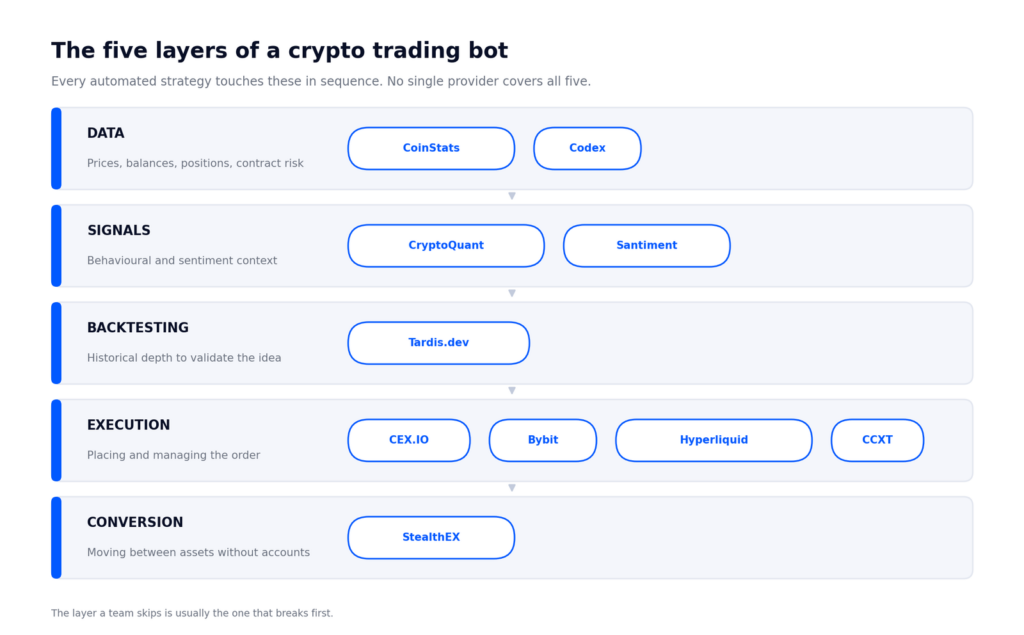
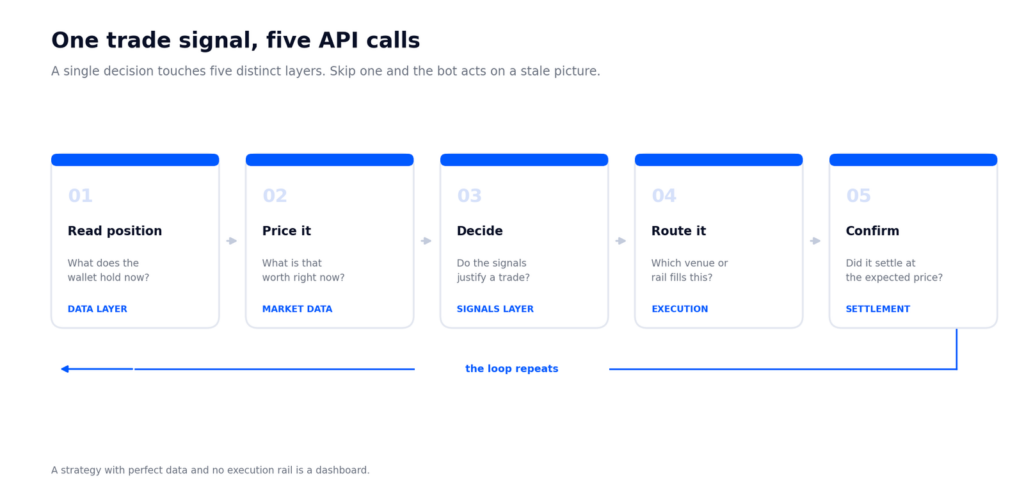
A trading bot is a chain of dependencies. It reads a position, prices it, decides, places an order, and confirms settlement. Every one of those steps is an API call, and a failure at any single point produces the same outcome: a strategy acting on a picture of the market that is no longer true. Choosing the best crypto API for trading bots is therefore less about finding the provider with the longest feature list and more about making sure every link in that chain has something dependable behind it.
This guide breaks down ten APIs that automated systems actually run on, organised by the job each one does rather than by brand recognition. It covers the data layer that generates signals, the behavioural metrics that add context beyond candles, the historical archives that make a backtest meaningful, and the execution rails that turn a decision into a filled order. For a broader look at general-purpose providers, our roundup of the 12 best crypto API providers covers the wider field. This list is narrower on purpose, and each entry earns its place by what it contributes to an automated strategy.
How We Selected These APIs
Ten providers made this list out of a much longer starting field. Four tests decided which ones stayed.
It had to serve an automated system rather than a dashboard. Plenty of excellent crypto APIs are built for human analysts reading charts. A bot has different requirements: machine-readable responses, documented rate limits, predictable latency, and a schema stable enough that an update does not silently break a running strategy. Providers whose value depends on a visual interface were set aside regardless of data quality.
It had to be live and actively maintained. Every provider was checked for recent releases, current documentation, and a functioning pricing page. This matters more in this category than most, because API businesses fail quietly. A provider can keep a homepage online for a year after the product stopped shipping, and several well-known names were dropped at this stage for stale documentation or acquisition notices rather than for any weakness in the underlying data.
Pricing had to be publicly available. Providers that route all commercial access through a sales conversation were excluded, even where the data is genuinely excellent. The reasoning is practical: a team cannot size a bot’s running costs against a quote it has to request, and a comparison table with half its cells reading “contact sales” is not a comparison. Every entry below has a free tier or a published entry price, and often both.
It had to own a distinct layer. Where two providers did substantially the same job, the stronger one took the slot. The aim was a list that maps onto how bots are actually assembled rather than ten variations on a price feed.
Two categories were left out deliberately. Pure RPC and node providers solve a different problem, supplying raw chain access and transaction broadcasting rather than interpreted data, and they belong in an infrastructure comparison rather than this one. General-purpose market data aggregators aimed at portfolio apps and analytics dashboards are covered in our broader roundup instead.
Pricing, free-tier limits, and capabilities were verified against each provider’s own documentation and pricing pages in August 2026. Where a figure was not published, it is described as such rather than estimated.
What a Trading Bot Actually Needs From an API
Bot requirements differ from the requirements of a dashboard or a portfolio app, and the differences are worth naming before comparing providers.
- Position awareness, not just prices. A strategy that cannot see its own holdings will misprice risk regardless of how fast it executes. Balances, open positions, and profit-and-loss are inputs, not reporting.
- Historical depth that supports a real backtest. Daily candles are enough to check an idea. Tick-level order book data is what separates a strategy that survives live conditions from one that only worked on paper.
- Predictable running costs. Bots poll continuously. Credit models, rate limits, and free-tier ceilings determine what a strategy costs to operate, and that number is easy to underestimate during development.
- An execution path. Reading the market is half the job. The other half needs a venue, a swap rail, or both.
- Agent-ready access. By 2026, most serious providers ship a Model Context Protocol server, and several now publish skills that let a coding agent discover and query the schema without custom middleware. That has moved from novelty to baseline expectation.
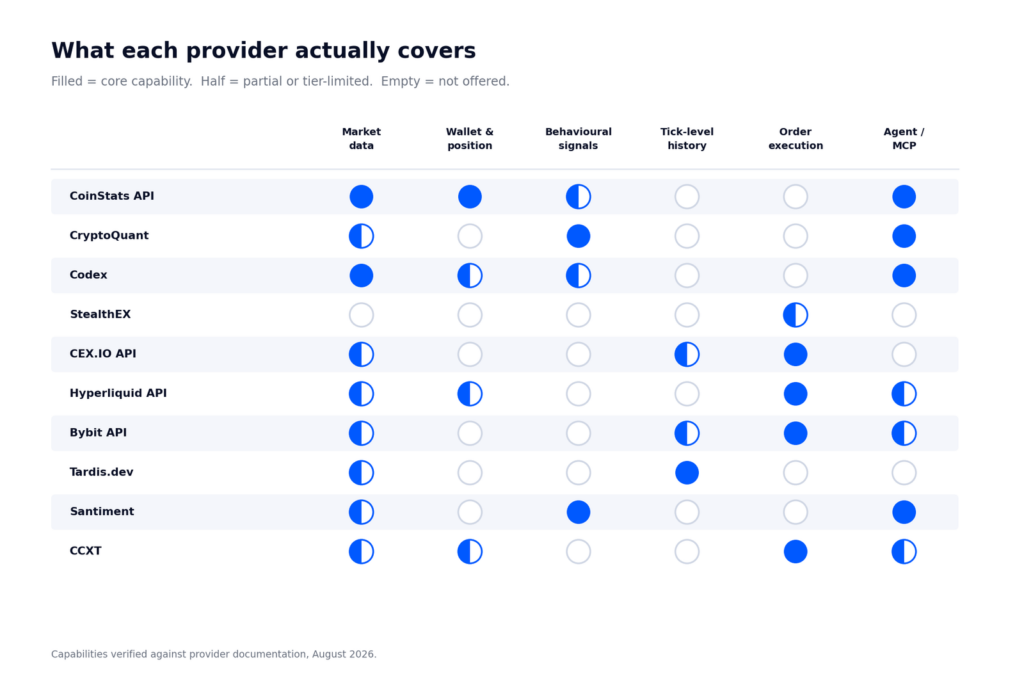
No single provider covers all of it, which is why the strongest production stacks combine two or three. Developer community roundups such as this comparison of crypto APIs for developers reach much the same conclusion: match the API to the layer, then combine.
CoinStats API
CoinStats’ crypto API is the most complete data layer available to bot builders in 2026, and the pick for teams that want one integration rather than five. Rather than specialising in price feeds or on-chain analytics alone, it consolidates market data, wallet balances, DeFi positions, portfolio analytics, and token security behind a single key, running on the infrastructure that already serves the CoinStats app and its 1 million monthly users.
Key Strengths and Use Cases
- Market data for signals: Prices, market caps, volumes, and OHLCV charts across 100,000+ coins from 200+ exchanges including Binance, Coinbase, and Hyperliquid, with roughly ten years of history.
- Position awareness across 120+ blockchains: One wallet call returns balances, transaction history, and DeFi positions auto-detected across 10,000+ protocols on Solana, EVM chains, and Bitcoin.
- Token security before the trade: Token Risks screening scores contracts for honeypots and exploits using the Hexens Glider engine, and it is available on the free tier.
- Agent-native access: An MCP server exposes 20+ tools through one OAuth URL, and x402 support lets agents pay per request in USDC on Base with no account or key.
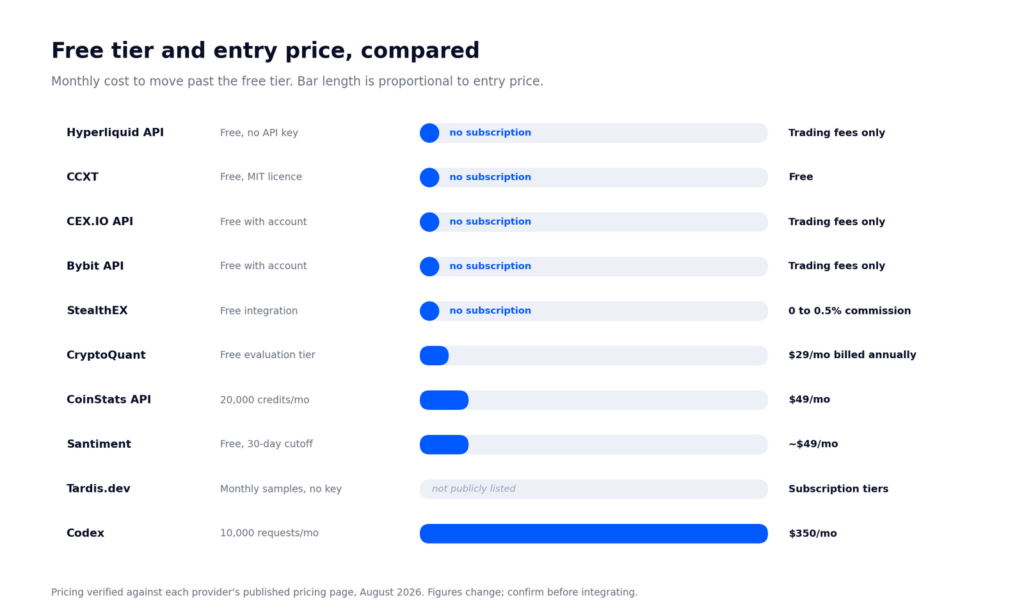
Pricing is credit-based and unusually transparent about what each call costs. Basic market data runs 1 to 2 credits, historical charts 3 to 5, and comprehensive DeFi queries 400. The free plan includes 20,000 credits monthly with commercial use permitted, and Starter is $49 per month for 1 million credits.
Limitations and Considerations
CoinStats is a data API, not an execution API, so it pairs with an exchange or swap API for the trading half of the loop. That separation is a security feature, since the data layer never touches trading keys. There is no raw RPC access and no WebSocket feed either, which rules out mempool reads and sub-millisecond market making. Its own roundup of the best crypto APIs for trading and AI agents is reasonably candid about where the specialists win.
Our Take: For most bots and agents this is the strongest first integration here, and the only entry covering four layers at once. Market data plus position context plus contract risk from one schema is a combination no specialist on this list matches.
CryptoQuant
CryptoQuant occupies a layer price feeds cannot reach. Active since 2018 and built for institutional desks and proprietary trading firms, it turns raw blockchain activity into behavioural metrics that arrive ready to trade against. Where a market data API tells a bot what an asset costs, CryptoQuant tells it who is moving coins and in what direction.
Key Features & User Experience
Metrics are grouped by family rather than by chain, which suits research workflows: exchange flows, miner flows, inter-entity flows, flow indicators such as MPI and whale ratio, market indicators, and network indicators including NVT.
- Data Coverage: Bitcoin, Ethereum, XRP Ledger, TRON, stablecoins, and major ERC-20 assets, with the deepest coverage on Bitcoin. Entity labels identify which exchange or mining pool sits behind a flow.
- Pricing & Access: A free evaluation tier is available. Paid plans start at $29 per month billed annually, rising to $99 and then $799, with API entitlements gated by tier.
- Use Cases: Behaviour-driven strategies, risk overlays that cut exposure as leverage builds, alerting systems, and research agents.
The agent tooling is better than the platform’s reputation suggests. CryptoQuant runs an MCP server reachable with a single URL, publishes machine-readable documentation, and exposes its full metric catalogue as structured JSON, so an AI research agent can discover and query metrics without a hand-written adapter.
One timing constraint matters for automated use. End-of-day exchange and miner flow data becomes available from 00:00 UTC and can take up to an hour to settle, because block confirmation is sequential. That makes CryptoQuant a context layer for sizing and risk rather than an intraday entry trigger.
Codex
Codex delivers enriched blockchain data through a single GraphQL API, and its defining characteristic is speed of coverage. Tokens and pairs are indexed the moment they are created on-chain, which matters for trading products where a listing appearing several minutes late is simply a missed trade.
Key Features & User Experience
Data freshness is sub-second, backed by a 99.9% uptime record. The same infrastructure serves billions of requests per month for TradingView, Coinbase, MoonPay, and Uniswap, so it has been proven under genuine production trading load rather than in prototypes.
- Data Coverage: 89 million or more tokens and 700 million wallets across 80+ networks including Solana, Ethereum, and Base. Prices, OHLCV, and holder data, plus prediction market events, odds, and order books from Polymarket and Kalshi.
- Pricing & Access: The free plan includes 10,000 requests per month at 5 requests per second. Paid plans start at $350 per month for 1 million requests. Agent workloads can skip subscriptions and pay per query.
- Use Cases: Token screeners, trading terminals, wallet and portfolio apps, prediction market products, and autonomous agents.
Codex is one of the few data providers an agent can pay directly. Through the Machine Payments Protocol an agent queries the full API at $0.001 per request with no account, no API key, and no billing setup, using an HTTP request and a USDC micropayment. It also ships agent skills and an MCP server for documentation context.
The scope is on-chain and prediction market data. There are no centralised exchange order books, no execution, and no RPC access, so teams submitting transactions pair it with a node provider. For Solana stacks specifically, our guide to the best Solana APIs and node providers covers that layer.
StealthEX
StealthEX solves a problem data APIs cannot touch: converting one asset into another inside an automated flow without asking anyone to open an account. It is a privacy-focused instant exchange API, fully non-custodial, and end users never create a StealthEX account. Standard volumes require no mandatory KYC, with risk-based screening applied only to flagged transactions.
Key Features & User Experience
The REST API supports both fixed and floating rates, a meaningful distinction for automated systems. Floating rates match market price at execution, while fixed rates lock the receive amount in advance so a strategy knows exactly what it will end up holding.
- Data Coverage: More than 2,000 coins and tokens across a wide range of networks, with settlement typically completing in 5 to 30 minutes.
- Pricing & Access: Integration is free with no monthly commitment. Partners set a commission between 0 and 0.5 percent, and revenue share applies to routed volume.
- Use Cases: Telegram bots, wallets, DEX aggregators, treasury conversion scripts, and privacy-minded conversion flows.
The commercial model deserves attention from anyone building a product rather than a personal script. Because integration costs nothing and partners set their own commission, the swap step becomes a revenue line rather than a cost centre, which changes the economics of running a free consumer-facing bot.
The trade-off is scope and speed. StealthEX provides no market data or analytics, so pricing and signal generation come from elsewhere in the stack. Settlement runs in minutes rather than milliseconds, which rules out latency-sensitive arbitrage and makes it a fit for rebalancing and user-facing conversion instead.
CEX.IO API
CEX.IO API is a centralised exchange API aimed at teams building bots, arbitrage strategies, and execution tools, and its most useful feature is one many retail-focused exchanges still do not offer: a genuine sandbox environment. Running a strategy end to end against a test environment before pointing it at live funds is the difference between finding a logic error in staging and finding it in a filled order.
Key Features & User Experience
Transport covers REST and WebSocket, with FIX available for institutional integrations. REST handles order management cleanly while WebSocket suits real-time data, and the WebSocket interface delivers roughly three times more information per request than the REST equivalent.
- Data Coverage: Order book, market depth, trade history, and OHLCV, available as live streams and historical pulls.
- Pricing & Access: API access is free with a CEX.IO account. Standard exchange trading fees apply to executed orders.
- Use Cases: Algorithmic traders and bots running against CEX.IO’s order book, plus teams wanting a testable execution path before committing capital.
The sandbox changes development workflow rather than simply adding a feature. Strategies can be validated against realistic order flow, error handling exercised against real API responses, and rate-limit behaviour observed without burning a live allocation. Teams that skip this step usually discover their edge cases during a volatile session.
The limitation is scope. This is a single-venue API, so market coverage, cross-exchange arbitrage detection, and on-chain data all require additional sources. Most production stacks pair a venue API like this one with a broader data layer that watches the wider market and hands the venue a decision.
Hyperliquid API
Hyperliquid runs a fully on-chain central limit order book on its own Layer 1, and the practical consequence is that everything visible in the interface is available programmatically, with no permissioning, no KYC, and no API key registration form. That combination of centralised-exchange ergonomics and permissionless access has made it one of the most interesting execution venues of 2026.
Key Features & User Experience
Reading and writing are cleanly separated. All market and account data, including mid prices, order books, funding history, positions, and fills, is publicly readable with no signature at all. Anything that changes state requires a signed request.
- Data Coverage: Perpetual and spot markets with full order book depth, funding rates, open interest, and per-address positions and fills. WebSocket streaming supports up to 1,000 subscriptions per IP.
- Pricing & Access: Free. No subscription, no API key purchase, and no approval process, with standard trading fees on execution.
- Use Cases: Perpetuals market making, funding rate strategies, copy trading, liquidation monitoring, and agents operating with self-custody.
Authentication uses EIP-712 typed-data signing rather than API keys, which is an adjustment coming from a centralised exchange background. The recommended pattern for bots is a dedicated agent wallet: a hot key with trade-only permissions that cannot withdraw funds and can be revoked instantly.
Rate limiting deserves planning. Requests draw on 1,200 weight units per minute, and each address accumulates one additional request per USDC traded since inception from a starting buffer of 10,000. Active traders rarely hit limits while systems scraping many wallets hit them early. A full testnet mirrors mainnet, though the chain ID differs, so a working testnet signer fails on mainnet until updated.
Bybit API
Bybit provides the deepest liquidity of any venue on this list, and its unified API consolidates spot, perpetual futures, and options behind a single authentication model. For derivatives-first strategies where fill quality and slippage do more damage than latency, that depth is the argument.
Key Features & User Experience
The unified structure is a practical benefit rather than a marketing one. A strategy trading spot and perpetuals together needs one integration, one credential set, and one error-handling path, which reduces both the initial build and the ongoing maintenance surface.
- Data Coverage: Order books, trade streams, klines, funding rates, and open interest across spot, USDT and inverse perpetuals, and options, plus balances, open orders, and trade history.
- Pricing & Access: Free with an account. Rate limits scale with account tier and standard trading fees apply on execution. A testnet is available for validating strategies before deployment.
- Use Cases: Derivatives bots, market-making systems, funding rate arbitrage, and strategies where execution quality on size is the binding constraint.
Bybit also has mature third-party library coverage, which lowers integration cost considerably for teams that would rather not hand-roll authentication and rate-limit handling. Availability varies by jurisdiction and should be confirmed before building.
The constraint is familiar for any venue API. It executes well but does not tell a strategy what to trade, and it has no visibility into on-chain activity or wallet positions held outside the exchange. That read layer comes from a separate provider, and keeping the two apart with separate credentials remains the safer architecture.
Tardis.dev
Tardis.dev exists for one job and does it better than anything else here: giving a strategy a realistic picture of what actually happened in the market, tick by tick, so a backtest means something. Most backtests run on OHLCV candles, and most therefore flatter the strategy. Candles hide the spread, hide the depth available at the moment of the trade, and hide the fact that during a volatile minute the exchange was publishing delayed and batched updates.
Key Features & User Experience
The archive is sourced by recording exchanges’ real-time WebSocket feeds, preserving the highest granularity each venue publishes. That includes tick-level L2 and L3 order book updates that a standard REST feed never exposes, alongside trades, quotes, funding, open interest, liquidations, and options chains.
- Data Coverage: More than 50 exchanges and over 50,000 instruments across derivatives and spot venues, plus Polymarket prediction market history. Data ships in exchange-native format via the replay API and in normalised CSV datasets.
- Pricing & Access: Subscription tiers are differentiated for solo traders, academic users, professionals, and businesses. First-day-of-month CSV datasets download with no API key at all, so evaluation costs nothing.
- Use Cases: Strategy backtesting, market microstructure research, liquidity analysis, and execution modelling.
One design decision is easy to mistake for a flaw. Raw data is not corrected after the fact, so it retains connection drops, publishing delays, duplicated trades, and occasionally crossed books. That is deliberate, because it reflects exactly what a live client would have received at that moment.
The limitation is scope. Tardis.dev is an archive and replay service, so it generates no signals, holds no wallet context, and executes nothing. It earns its place when execution quality is the edge, and it is the wrong purchase when it is not.
Santiment
Santiment blends three data types that rarely appear together in one schema: on-chain behaviour, social sentiment, and developer activity. That last one is the genuine differentiator, because almost no other provider tracks how much work is actually being committed to a project’s repositories. For a bot, that answers questions price data cannot, such as whether development has quietly stalled on an asset the strategy holds.
Key Features & User Experience
SanAPI uses GraphQL exclusively, a decision the team defends on the grounds that it lets clients request exactly the fields they need and batch queries together. For teams building REST-first, it is an adjustment.
- Data Coverage: The top 3,000 assets by market capitalisation across Bitcoin, Ethereum, XRP Ledger, BNB Chain, Cardano, Polygon, Avalanche, Optimism, and Arbitrum. On-chain metrics, social volume, weighted sentiment, development activity, and pricing.
- Pricing & Access: The free plan gives full access to free metrics plus one year of restricted metrics, though the most recent 30 days are cut off. Pro runs roughly $49 per month, and Max is required for real-time unrestricted access.
- Use Cases: Quantitative research, behaviour-driven strategies, alerting systems, and AI analysis agents.
The tooling suits research workflows. The Python client returns pandas DataFrames directly, so metrics land in a backtest without a parsing layer, and Santiment runs an MCP connector plus published agent skills including one focused on social trends.
Two constraints shape how it fits a bot. The 30-day cutoff means free-tier data supports research but cannot drive a live signal, and reaching real-time requires the top tier. There is also no WebSocket for external developers, with metrics updating on cadences from ten minutes to daily.
CCXT
CCXT is the outlier here because it is not a hosted service at all. It is an open-source library under the MIT licence providing one unified interface across more than 100 centralised exchanges, and it has been the connectivity backbone of crypto trading software since 2017. The value is standardisation: order books, balances, trade history, and order placement follow one schema regardless of venue, so adding an exchange becomes a configuration change rather than a new integration.
Key Features & User Experience
The library ships in seven languages including TypeScript, Python, Go, and Java, and implements both REST and WebSocket surfaces. Public market data works immediately after installation with no account, while live trading needs keys obtained from each exchange directly.
- Data Coverage: More than 100 exchanges, and as of 2026 also prediction markets including Polymarket, Kalshi, Limitless, Myriad, and Hyperliquid through the same unified methods.
- Pricing & Access: Free under the MIT licence for commercial and personal use. CCXT Pro, which adds WebSocket streaming, is a paid product built on top. An optional 1 basis point builder fee applies on some exchanges and can be disabled in code.
- Use Cases: Multi-exchange arbitrage, backtesting rigs, custom terminals, and strategies routing across several venues.
The 2026 additions matter for agent-driven systems. CCXT now publishes installable skills for coding agents, so an AI agent can set up exchange connectivity without a developer writing the boilerplate. Combined with prediction market coverage, one library now reaches an unusually wide slice of the tradeable universe.
The trade-off is operational rather than technical. There is no service level agreement, no hosted infrastructure, and no support desk. Keys, rate limits, retries, and uptime are the developer’s responsibility, and reliability depends on each exchange’s own API behaving.
Top 10 Crypto APIs for Trading Bots Compared
| Provider | Layer | Free tier | Paid entry | Agent support |
| CoinStats API | Market data, wallet, DeFi, token security | 20,000 credits/mo, commercial use | ~$49/mo | MCP server + x402 |
| CryptoQuant | On-chain flow and behavioural signals | Yes, evaluation tier | From $29/mo annually | MCP server + llms.txt |
| Codex | Real-time on-chain and prediction markets | 10,000 requests/mo at 5 rps | $350/mo | Agent skills + MPP payments |
| StealthEX | Non-custodial swap rails | Free integration | Revenue share, 0 to 0.5% | No |
| CEX.IO API | Exchange execution with sandbox | Free with account | Trading fees only | No |
| Hyperliquid API | On-chain perpetuals execution | Free, no key required | Trading fees only | Community SDKs |
| Bybit API | Centralised derivatives execution | Free with account | Trading fees only | Third-party SDKs |
| Tardis.dev | Tick-level historical archive | Monthly CSV samples, no key | Subscription tiers | No |
| Santiment | On-chain, social, and dev activity | Free with 30-day cutoff | ~$49/mo | MCP connector + agent skills |
| CCXT | Multi-exchange connectivity library | Free, MIT licence | Free | Installable agent skills |
Choosing the Right API for Your Bot
The most common mistake in this category is starting from a provider and working backwards to a strategy. The better order is to write down what the bot does, break that into the calls it will make, and then find something reliable behind each one.
A Practical Framework
- What does the bot actually decide, and on what evidence? A strategy trading new token launches needs listings indexed within seconds and contract risk screening before entry. A funding rate strategy needs open interest and rates, and cares very little about token discovery. These are different providers, and the answer determines everything downstream.
- Does it need to see its own positions? If the strategy sizes based on current exposure, it needs a wallet or portfolio layer, not just a price feed. Bots that trade blind to their own holdings misprice risk in exactly the conditions where risk matters most.
- How good does the backtest need to be? Candle data is adequate for checking whether an idea has any merit. If the strategy depends on spread capture, queue position, or execution quality, tick-level order book history is not optional, and a backtest without it will overstate performance.
- What is the real monthly cost at production volume? Map expected request mix against published per-call costs before committing. Credit-based models vary enormously by call type, and the difference between a well-shaped and a careless request pattern can be an order of magnitude.
- Where does execution happen, and is it isolated? Data and execution should sit in separate systems with separate credentials. A data integration that cannot place orders cannot cause a loss if it is compromised, and that separation costs nothing to design in at the start.
Building the Stack
Most production systems converge on a similar shape. One broad data API handles the read side, covering prices, positions, and risk screening. One execution venue or swap rail handles the write side. Specialist layers get added only when the strategy genuinely demands them: tick-level history when execution quality is the edge, behavioural or sentiment metrics when the strategy trades on flows rather than price, and one of the best RPC node providers when the bot needs to broadcast transactions itself.
For most builds, CoinStats API is the sensible starting point on the read side, because it covers four layers that would otherwise be four vendors and reconciliation work. Pair it with whichever execution path matches the strategy: CEX.IO or Bybit for centralised order books, Hyperliquid for on-chain perpetuals, StealthEX for conversion without accounts. Add Codex when listing speed decides the trade, Tardis.dev when the backtest has to be honest, and CryptoQuant or Santiment when the signal comes from behaviour rather than price.
The layer teams skip is usually the one that breaks first. A strategy with perfect data and no execution rail is a dashboard, and a strategy with flawless execution and stale data is an expensive way to be wrong quickly. The stack that works is the one where every step in the loop has an API behind it that will still answer when markets are busy.
Pricing, free-tier limits, and features were verified in August 2026 and can change. Confirm current details on each provider’s official pricing and documentation pages before integrating.
Recommended Articles


