


Pound Sterling awaits the Fed's two-strike inflation test
- GBP/USD churned flat on Wednesday near 1.3550, waiting for the data that will shape next week's policy calls.
- US (United States) inflation prints on Thursday and Friday, and will set the table for a potential Fed hike on September 16.
- The Bank of England meets a day later and is widely expected to hold.
The real tension weighing on GBP/USD is a rate parity that masks a divergence. Both central banks sit at 3.75%. Federal Reserve (Fed) Chair Warsh's Jackson Hole speech two weeks back opened the door to a hike, with markets now pricing in over 60% odds that the Fed raises a quarter point on the 16th. The Bank of England's MPC (Monetary Policy Committee) voted 6–3 to hold at its July 30 meeting, with three members preferring a move to 4%. The BoE (Bank of England) faces the same energy shock that is pushing inflation toward 3.2% this year. The difference is that Fed Chair Kevin Warsh reads the inflation problem as unresolved. The BoE's split vote reads as exhaustion.
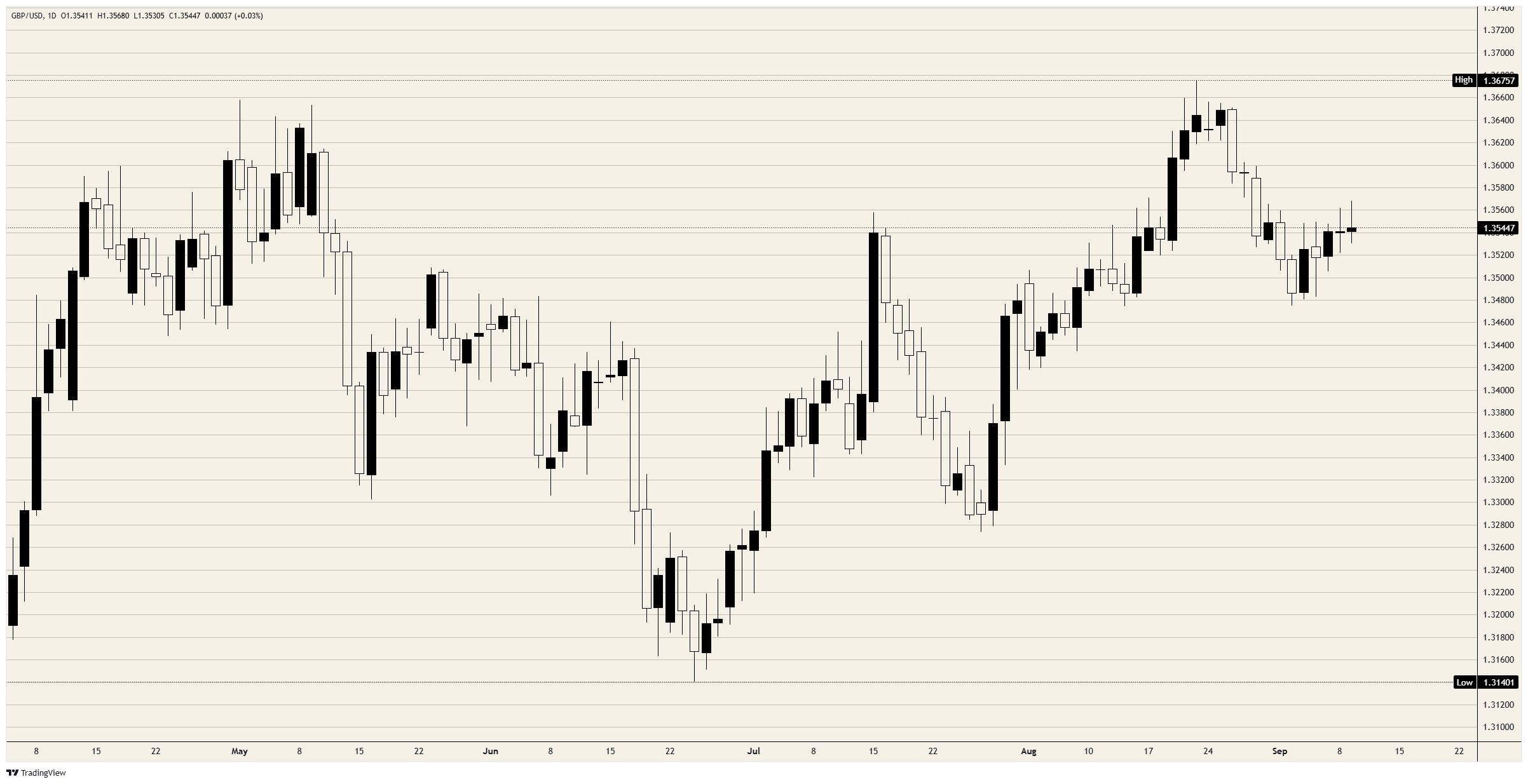
Cable's chart confirms the indecision. A rally from 1.3400 in early August ran out of gas near 1.3675 on August 21. The pair has ground lower for two weeks. The 1.3550 handle is the middle of August's range and sits as session-level support on Wednesday. Stochastic RSI is oversold but rolling over, a sign that the selling impulse has lost momentum. The 50-day and 200-day exponential moving averages cluster around 1.3550 and 1.3400, establishing two technical tiers. Resistance is 1.3650.
What moves Cable right now
Thursday's US Producer Price Index (PPI) and US Consumer Price Index (CPI) on Friday are the last two inflation reads before September 16. Core PPI is expected at 0.3% MoM and 3.3% YoY. Core CPI comes in at 0.2% MoM and 3.4% YoY expected. Both sit above the prior month. A hotter print extends Warsh's case for a hike and bids the Dollar higher. A softer print lets the market reprice rate cuts back in, and Sterling rallies with it.
The calendar also carries the usual noise: Initial Jobless Claims on Thursday at 205K expected, Existing Home Sales Thursday, and this week's UK Purchasing Managers Index (PMI) reading on Friday. The UK's own CPI print is due Friday, expected at 2.6% YoY, and it lands on the same day as the Fed (Federal Reserve) decision cascade. The BoE's own decision announcement comes September 17 at noon GMT (Greenwich Mean Time). Timing is the tell: UK inflation lands before the Bank of England decision, so a hot reading pushes the hawkish minority's case for a 4% hike at the MPC (Monetary Policy Committee) vote.
The trade setup
Resistance: 1.3650. Support: 1.3475, then 1.3400.
Cable breaks below 1.3475 on any CPI or PPI surprise higher, targeting 1.3400 and opening the door to a retest of August's 1.3350 low if the Fed raises and Cable round-trips. The invalidation is a break above 1.3650 on a softer inflation read and Fed pause repricing, which shifts the technical bias toward the 1.3675 August high and the 1.3700 handle.
GBP/USD daily chart
Pound Sterling FAQs
The Pound Sterling (GBP) is the oldest currency in the world (886 AD) and the official currency of the United Kingdom. It is the fourth most traded unit for foreign exchange (FX) in the world, accounting for 12% of all transactions, averaging $630 billion a day, according to 2022 data. Its key trading pairs are GBP/USD, also known as ‘Cable’, which accounts for 11% of FX, GBP/JPY, or the ‘Dragon’ as it is known by traders (3%), and EUR/GBP (2%). The Pound Sterling is issued by the Bank of England (BoE).
The single most important factor influencing the value of the Pound Sterling is monetary policy decided by the Bank of England. The BoE bases its decisions on whether it has achieved its primary goal of “price stability” – a steady inflation rate of around 2%. Its primary tool for achieving this is the adjustment of interest rates. When inflation is too high, the BoE will try to rein it in by raising interest rates, making it more expensive for people and businesses to access credit. This is generally positive for GBP, as higher interest rates make the UK a more attractive place for global investors to park their money. When inflation falls too low it is a sign economic growth is slowing. In this scenario, the BoE will consider lowering interest rates to cheapen credit so businesses will borrow more to invest in growth-generating projects.
Data releases gauge the health of the economy and can impact the value of the Pound Sterling. Indicators such as GDP, Manufacturing and Services PMIs, and employment can all influence the direction of the GBP. A strong economy is good for Sterling. Not only does it attract more foreign investment but it may encourage the BoE to put up interest rates, which will directly strengthen GBP. Otherwise, if economic data is weak, the Pound Sterling is likely to fall.
Another significant data release for the Pound Sterling is the Trade Balance. This indicator measures the difference between what a country earns from its exports and what it spends on imports over a given period. If a country produces highly sought-after exports, its currency will benefit purely from the extra demand created from foreign buyers seeking to purchase these goods. Therefore, a positive net Trade Balance strengthens a currency and vice versa for a negative balance.
Recommended Articles


