


Experts agree: Faster BoJ tightening prospects fuel Japanese Yen’s remarkable surge
- The Japanese Yen outperforms this week on hopes of a rapid BoJ rate-hike cycle.
- A BoJ 25 bps interest rate hike at the policy meeting next week has been almost priced in.
- Financial markets have also seen increasing BoJ 50 bps rate-hike prospects next week.
The Japanese Yen (JPY) trades firmly against its major currency peers this week. The USD/JPY pair is down 0.63% in the European trading session on Wednesday and 1.85% so far this week at around 153.00.
Market experts think expectations that the Bank of Japan (BoJ) approaching a faster policy normalization cycle than previously estimated are the key reason behind significant strength in the Japanese currency.
Yen outlook firms as markets price in rapid BoJ tightening cycle
Commerzbank observes that the recent firming in the Yen is underpinned by a notably hawkish shift in market expectations for BoJ policy. According to the bank, “an interest rate hike next week is now priced in at roughly 96%, and the market expects further hikes to follow quickly thereafter,” reinforcing the view that investors are bracing for a more rapid normalization of Japanese rates.
Analysts at MUFG observe that the Japanese Yen’s strength is driven by “likely positioning adjustments ahead of upcoming risk events, coupled with ongoing market pricing on a faster pace of monetary policy tightening by the Bank of Japan.” They add that “a 25bps hike at the BOJ’s 18 September meeting has already been largely priced in, while attention is shifting towards the BOJ’s communication about the broader path of rate hikes at subsequent meetings.”
Strategists at HSBC note that markets are increasingly pricing a quicker normalisation of Japanese monetary policy, with investors now expecting the Bank of Japan “to tighten policy faster than it has done in recent years.” They point out that “overnight index swaps imply around 75bps of cumulative hikes by April 2027 and even assign meaningful odds of a hike at the 18 September meeting, which stands out as unusual.” HSBC argues that these repricings “suggest investors anticipate a change in how the BoJ responds to inflation and growth risks.”
Meanwhile, a note from Rabobank states that market chatter around the prospect that the BoJ “might even think about a 50bps hike” has also intensified, a move that would be especially significant given it “would be the first such move since 1989, when it was still in a bubble”.
USD/JPY Technical Analysis
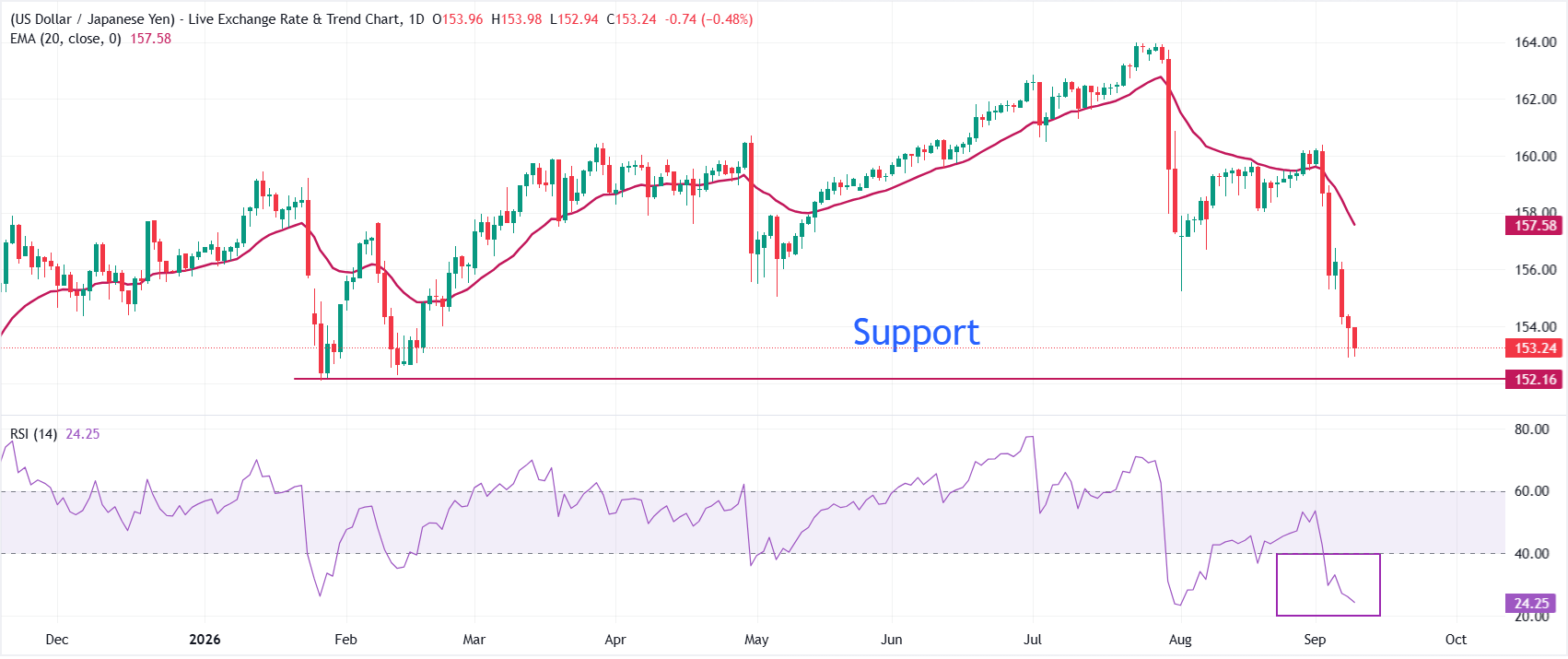
Bias: On the daily chart, USD/JPY trades at 153.24, maintaining a bearish near-term tone as spot holds well beneath the 20-day Exponential Moving Average (EMA) at 157.58. The location of price below this key dynamic barrier suggests rallies are likely to be sold while downside pressure persists.
Momentum: The 14-day Relative Strength Index (RSI) is hovering near oversold territory around 24, hinting that while the pair is stretched on the downside, sellers still retain control unless price can reclaim levels closer to the 20-day EMA.
Resistance: On the topside, initial resistance is seen near the August 3 low at 155.23, followed by the 20-day EMA at 157.58.
Support: Looking down, the Year-to-Date (YTD) low at 152.10 appears as key support zone.
(The technical analysis of this story was written with the help of an AI tool. Know more.)
Bank of Japan FAQs
The Bank of Japan (BoJ) is the Japanese central bank, which sets monetary policy in the country. Its mandate is to issue banknotes and carry out currency and monetary control to ensure price stability, which means an inflation target of around 2%.
The Bank of Japan embarked in an ultra-loose monetary policy in 2013 in order to stimulate the economy and fuel inflation amid a low-inflationary environment. The bank’s policy is based on Quantitative and Qualitative Easing (QQE), or printing notes to buy assets such as government or corporate bonds to provide liquidity. In 2016, the bank doubled down on its strategy and further loosened policy by first introducing negative interest rates and then directly controlling the yield of its 10-year government bonds. In March 2024, the BoJ lifted interest rates, effectively retreating from the ultra-loose monetary policy stance.
The Bank’s massive stimulus caused the Yen to depreciate against its main currency peers. This process exacerbated in 2022 and 2023 due to an increasing policy divergence between the Bank of Japan and other main central banks, which opted to increase interest rates sharply to fight decades-high levels of inflation. The BoJ’s policy led to a widening differential with other currencies, dragging down the value of the Yen. This trend partly reversed in 2024, when the BoJ decided to abandon its ultra-loose policy stance.
A weaker Yen and the spike in global energy prices led to an increase in Japanese inflation, which exceeded the BoJ’s 2% target. The prospect of rising salaries in the country – a key element fuelling inflation – also contributed to the move.
Recommended Articles


