


Nvidia's Biggest Jensen Huang Problem Was Hiding in Plain Sight
Key Points
Nvidia CEO Jensen Huang resigned after a scandal involving extramarital affairs and possible Chinese espionage.
A bigger scandal might be that Nvidia had no succession plan.
Other companies have replaced their charismatic founder-CEOs and gone on to reach new heights.
- Motley Fool Issues Rare "Total Conviction" Buy Alert ›
Jensen Huang has resigned as CEO of Nvidia (NASDAQ:NVDA) after reports that he was involved in multiple extramarital affairs, including one with an alleged Chinese spy. This is a complex and still-evolving situation with possible implications for the overall health of the artificial intelligence (AI) boom.
Jensen Huang became a charismatic, famous face of the AI industry, with his signature leather jackets. He co-founded Nvidia 33 years ago and built it into a $4 trillion semiconductor giant that has become indispensable to the wider AI ecosystem. Investors are questioning whether Huang's departure will permanently damage Nvidia, or even cause long-lasting harm to the AI industry.
Missed Nvidia in 2009? This Rare Signal Is Flashing Again. In 2009, a "Double Down" signal flashed for a little-known chipmaker called Nvidia. For the first time in years, that same "Total Conviction" signal is flashing for a company 1/100th the size of Nvidia. Continue »
Let's look at the broad outlines of the Jensen Huang situation, what his resignation might mean for investors, and why the real problem with Huang's leadership had its roots in something more mundane than infidelity and espionage.
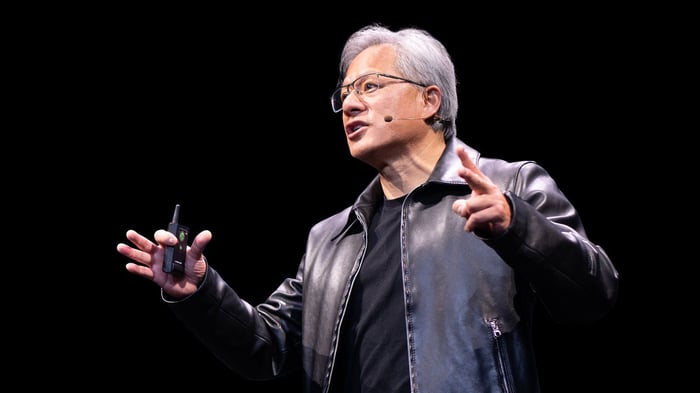
Jensen Huang. Image source: Nvidia.
Beyond the salacious details
Jensen Huang's resignation has captured so much media attention in part because infidelity and a potential Chinese espionage angle make good copy.
But aside from Huang's shortcomings as a husband and the important issue of whether Nvidia's best chips were illegally routed to China by a spy, the Jensen Huang scandal is also about something more mundane. It comes down to corporate governance.
Nvidia had no CEO succession plan
Huang was a co-founder of Nvidia and had been CEO for 33 years, and he and the company's board of directors seemed to think that he would be CEO forever. Nvidia had no CEO succession plan. Huang and the board had not designated an heir apparent to succeed him. They had not established a talent pipeline of high-level executives who would be groomed to eventually take over the top job.
Way too much was depending on one person. This is not a responsible way to run a small family-owned business, let alone a $4 trillion company. It's a failure of corporate governance and of Huang's leadership as CEO. It's better to have a few good CEO candidates lined up than to have to suddenly scramble to replace the company's top leader, especially during a time of crisis. But Nvidia will have to try.
Can Nvidia replace Jensen Huang?
Nvidia's culture was unique, with a flat management structure that largely revolved around Huang. He reportedly had about 60 direct reports and was closely involved with managing and approving their everyday work. The company's culture was built around his style of leadership and decision-making.
In the short run, Nvidia shareholders might suffer from Huang’s departure. As I write this, the company's share price is down about 11% since Nov. 6, the last trading day before Nov. 8, when Huang issued a statement admitting infidelity and apologizing to his family and his employees.
On Nov. 12, when the company announced its CEO transition — putting then-CFO Colette Kress in the corner office — the share price plummeted about 13%, but then recovered most of those losses by the end of the trading day.
Nvidia's stock has been under pressure even without the scandal. The company's shares are down about 11% in the past year and have lost about 30.5% of their value since a record high on Oct. 6.
But in the long run, Nvidia investors might be fine without Huang leading the company. Kress, has agreed to serve as interim CEO, and the Nvidia board has appointed a chair of the board for the first time ever. The company has a strong underlying business model as one of the most in-demand suppliers of semiconductors to the AI industry. Nvidia is due to report quarterly earnings tomorrow, which should give insight into the overall health of the business, despite the loss of Huang as CEO.
Other prominent companies have lost charismatic founder-CEOs who were widely believed to be indispensable and have gone on to new heights. Apple(NASDAQ:AAPL) replaced Steve Jobs with Tim Cook, who stepped down this year. Amazon(NASDAQ:AMZN) replaced Jeff Bezos with Andy Jassy. Both companies went on to deliver excellent returns for shareholders.
Nvidia's now-former CEO was one of the most important people and respected voices driving the future of AI. It is shocking to see him resign in a sensational scandal. But for long-term investors who believe in Nvidia's indispensable role in the AI industry, Huang's resignation doesn't have to be a bearish signal for the stock. Nvidia without Jensen Huang might still be worth buying.
Should you buy stock in Nvidia right now?
Before you buy stock in Nvidia, consider this:
The Motley Fool Stock Advisor analyst team just identified what they believe are the 10 best stocks for investors to buy now… and Nvidia wasn’t one of them. The 10 stocks that made the cut could produce monster returns in the coming years.
Consider when Netflix made this list on December 17, 2004... if you invested $1,000 at the time of our recommendation, you’d have $335,171!* Or when Nvidia made this list on April 15, 2005... if you invested $1,000 at the time of our recommendation, you’d have $1,000,640!*
Now, it’s worth noting Stock Advisor’s total average return is 823% — a market-crushing outperformance compared to 208% for the S&P 500. Don't miss the latest top 10 list, available with Stock Advisor, and join an investing community built by individual investors for individual investors.
See the 10 stocks »
*Stock Advisor returns as of November 16, 2026.
Ben Gran has no position in any of the stocks mentioned. The Motley Fool has positions in and recommends Amazon, Apple, and Nvidia. The Motley Fool has a disclosure policy.
Recommended Articles


