


US October Retail Sales Preview: Will US Consumer Spending Cool? Fed December Rate Hike Expectations Face Another Test
TradingKey - On November 17, Eastern Time, the U.S. will release the latest retail sales data for October. Against the backdrop of inflation heating up again recently and significantly rising expectations for a Federal Reserve rate hike in December, this data will serve as a key basis for the market to gauge U.S. consumer resilience and whether the economy can withstand higher interest rates.
Retail Sales Growth May Slow, but US Consumer Remains Resilient
In terms of market expectations, consensus estimates project headline retail sales to rise by about 0.2% month-over-month in October, down significantly from 0.8% in September, while retail sales excluding autos are expected to increase by roughly 0.4%.
Looking at the September data, U.S. retail sales came in significantly stronger than expected, with headline sales climbing 0.8% month-over-month to $745 billion, while the August increase was also revised upward to 1.3%. However, September's gains were supported by factors such as rising gasoline prices and increased dining spending; therefore, a modest pullback in October does not signal a rapid deterioration in consumer spending.
RBC Economics expects headline retail sales to grow by just 0.1% in October, dragged down primarily by a slowdown in auto sales, though spending excluding autos and gasoline is still forecast to rise by 0.3%, indicating that consumer fundamentals retain some support. RBC notes that food services, healthcare and personal care, and online spending continued to perform strongly, while categories such as groceries, building materials, and general merchandise were more noticeably impacted by rising prices and diminished real purchasing power.
From the perspective of spending composition, online shopping, dining, and certain service-related expenditures remained resilient. High-frequency data from the National Retail Federation also showed that retail sales excluding autos and gasoline continued to post positive growth in October. Meanwhile, with the holiday shopping season approaching, early promotions could provide some support for online and general merchandise spending. Therefore, if headline retail sales show only modest growth while control group sales maintain an increase of around 0.3%-0.4%, the market is more likely to interpret this as a normal moderation in consumer spending growth rather than a significant deterioration in demand.
However, this data also needs to be evaluated in the context of inflation. Retail sales measure nominal sales and do not adjust for price changes. With October CPI rising 0.4% month-over-month and core CPI up 0.3%, part of the sales growth may stem from higher prices for goods and services rather than increases in real consumption volume. Therefore, rather than headline retail sales, the market may focus more closely on control group sales and spending excluding autos and gasoline to assess whether real consumer demand remains resilient.
For the Federal Reserve, if both headline retail sales and control group data come in significantly above expectations, it would indicate that high interest rates and elevated prices have not yet noticeably dampened household spending and that the U.S. economy remains resilient, further expanding room for the Fed to continue raising interest rates. Conversely, if headline sales hover near zero growth or even contract while control group spending also falls noticeably short of expectations, it could suggest that high interest rates are gradually transmitting to consumer demand, potentially leading markets to dial back expectations for further rate hikes.
How Will Retail Sales Impact the Trajectory of US Stocks, the Dollar, and Gold?
Regarding U.S. equities, excessively strong retail sales may not be an outright positive for the current market. If headline retail sales significantly exceed the 0.2% forecast while control group consumption remains robust, it would signal continued support for the U.S. economy and corporate revenues. However, it could also reinforce expectations that the Federal Reserve will continue raising interest rates in December or even next year, driving U.S. Treasury yields higher and putting pressure on high-valuation sectors such as the Nasdaq, AI, and semiconductors. A moderate increase in the data would be more favorable for expectations of 'an economy remaining resilient without requiring more aggressive rate hikes.' If sales drop noticeably, U.S. stocks might benefit in the short term from cooling rate-hike expectations, but consumer, retail, and cyclical sectors could face downward pressure on earnings forecasts. The market has recently demonstrated strong sensitivity to high interest rates.
For the U.S. dollar, if October retail sales are significantly stronger than expected, the dollar may continue to find support. Robust consumption suggests that the U.S. economy can withstand higher interest rate levels and would also reinforce market expectations of further monetary tightening by the Federal Reserve. Currently, the U.S. Dollar Index has climbed to around 103.5, its highest level since April 2025. If the sales figures fall short of expectations, especially if the control group unexpectedly declines, it could push U.S. Treasury yields and rate-hike expectations lower, leaving room for a near-term correction in the dollar. However, with inflation still notably high, a single weak consumption reading may not be enough to reverse the dollar's prevailing strength.
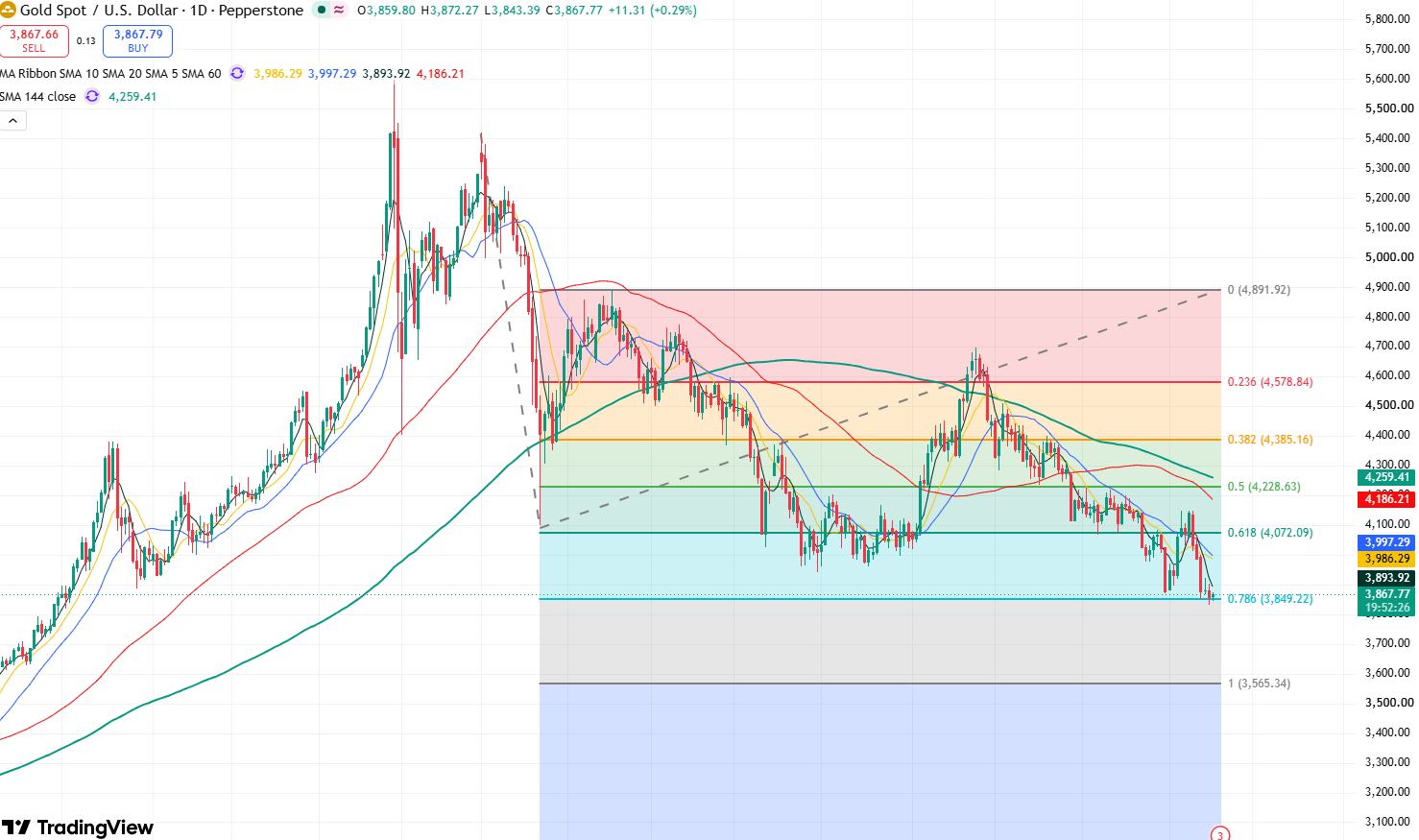
Gold Price Daily Chart, Source: TradingView
Regarding gold (XAUUSD), if consumption is significantly stronger than expected and Fed rate-hike expectations heat up further, gains in the U.S. dollar and Treasury yields could continue to weigh on gold, potentially pushing prices further down toward $3,800 or even lower. Spot gold has recently dropped to around $3,850 and briefly touched a near one-year low of $3,832.70, with high interest rates and a strong dollar acting as the primary headwinds. If retail sales are significantly weaker than expected and the market lowers expectations for subsequent rate hikes, a pullback in the dollar and yields could help gold stage a corrective rebound, with prices poised to climb back toward the $4,000 threshold.
Recommended Articles


