


Prediction: Broadcom Will Be a $4.5 Trillion Company by 2030
Key Points
Broadcom anticipates phenomenal growth in its AI revenue over the next couple of fiscal years.
The company can sustain its impressive growth momentum through 2030, driven by healthy growth in custom AI chips and networking components.
Broadcom's attractive valuation and earnings growth potential suggest it could become a multibagger by 2030.
- 10 stocks we like better than Broadcom ›
Broadcom (NASDAQ: AVGO) is one of the most important companies in the artificial intelligence (AI) infrastructure space, designing custom processors and networking components for major hyperscalers and pure-play AI companies.
The company's growth trajectory has improved remarkably in recent years, and its strong financial performance has been handsomely rewarded on the stock market. Broadcom stock has appreciated 265% over the past three years, outpacing the 222% jump in the PHLX Semiconductor Sector index. This impressive rally has made Broadcom one of the world's largest companies.
Missed AI’s "Act 1"? Act 2 Could Be 15x Bigger. Most investors think they missed the AI boat because they didn't buy Nvidia in 2005. But according to our analysts, we’re only at the end of "Act 1"—the R&D phase. "Act 2" is the global rollout. Continue »
Broadcom currently has a market cap of just over $1.5 trillion, making it the 10th-largest company globally. However, I won't be surprised to see Broadcom becoming significantly larger by the end of the decade. Let's look at the reasons why this semiconductor stock could triple from current levels and achieve a $4.5 trillion market cap by 2030.
Image source: The Motley Fool.
Broadcom is benefiting from two major catalysts
Broadcom designs custom AI processors tailored to perform specific tasks for Alphabet's Google, Meta Platforms, Anthropic, OpenAI, and a couple of other customers. These customers have been ramping up deployment of Broadcom's custom processors to reduce the total cost of ownership (TCO) and energy consumption in their AI data centers.
Broadcom's custom AI processors have an advantage over general-purpose computing chips, such as graphics processing units (GPUs), because they are purpose-built for specific tasks. As a result, the power consumption of custom AI chips is reportedly just 10% of what a GPU consumes, and they are reportedly three times faster at performing the task they are designed for.
Not surprisingly, shipments of Broadcom's custom AI processors, which the company calls XPUs, increased by 3.5x year over year in the third quarter of fiscal 2026. On the other hand, Broadcom also designs networking components, such as Ethernet switches and high-speed optical interconnects. The company is experiencing exponential growth in this segment as well, with its AI-focused networking revenue jumping by 2.5x year over year in fiscal Q3.
It is easy to see why that's the case. Optical networking is emerging as the next big bottleneck in the AI infrastructure space. That's because AI has created the need to transfer enormous data sets quickly and seamlessly between data centers and chip clusters with low latency, ensuring training and inference workloads can run without hiccups.
Goldman Sachs estimates that the optical networking market could grow from $15 billion this year to $154 billion in 2028. So, Broadcom's networking business seems primed for terrific growth, while the company's dominance in custom AI chips should ensure that its AI revenue grows at an incredible pace. Broadcom reportedly controls 60% of the custom AI processor market, according to Counterpoint Research.
So, it is easy to see why the company is extremely bullish about its growth prospects through fiscal 2028.
Here's how Broadcom could reach a $4.5 trillion market cap
Broadcom's revenue in fiscal 2026 (which is about to end in early November) is expected to increase by 66% from the prior year to $106 billion. The company anticipates that its AI revenue will increase by 186% in fiscal 2026 to $58 billion.
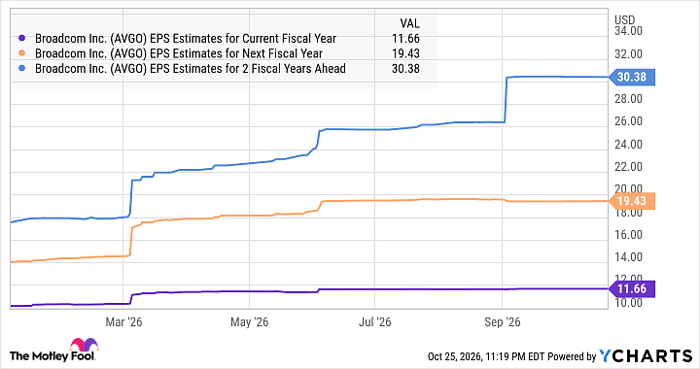
Looking ahead, Broadcom sees its AI revenue doubling in both fiscal 2027 and 2028. Specifically, the company anticipates $230 billion in AI revenue in fiscal 2028. The impressive growth in AI revenue will supercharge Broadcom's bottom-line growth as well. Analysts are expecting a 71% jump in Broadcom's earnings per share in fiscal 2026 to $11.66.
The following chart shows that Broadcom's EPS could exceed $30.00 in fiscal 2028, in line with the company's expectations.
Data by YCharts
So, Broadcom's EPS is on track to grow by 61% a year over the next two fiscal years. Assuming it can clock even 30% annual earnings growth in fiscal years 2029 and 2030, its EPS could reach $51.36 after four years (using fiscal 2028's projected EPS of $30.39 as the base). Broadcom trades at 17 times forward earnings, a slight discount to the tech-laden Nasdaq-100 index's forward earnings multiple of 21.5.
Broadcom stock could jump to $1,027, assuming it trades at 20 times earnings in 2030 and its EPS reaches $51.36. That's just over 3x of where this AI stock is right now. So, Broadcom has the potential to indeed cross a $4.5 trillion market cap by the end of the decade, suggesting that it isn't too late for investors to buy this stock even after the terrific gains it has clocked over the past three years.
Should you buy stock in Broadcom right now?
Before you buy stock in Broadcom, consider this:
The Motley Fool Stock Advisor analyst team just identified what they believe are the 10 best stocks for investors to buy now… and Broadcom wasn’t one of them. The 10 stocks that made the cut could produce monster returns in the coming years.
Consider when Netflix made this list on December 17, 2004... if you invested $1,000 at the time of our recommendation, you’d have $355,124!* Or when Nvidia made this list on April 15, 2005... if you invested $1,000 at the time of our recommendation, you’d have $1,296,254!*
Now, it’s worth noting Stock Advisor’s total average return is 901% — a market-crushing outperformance compared to 210% for the S&P 500. Don't miss the latest top 10 list, available with Stock Advisor, and join an investing community built by individual investors for individual investors.
See the 10 stocks »
*Stock Advisor returns as of October 26, 2026.
Harsh Chauhan has no position in any of the stocks mentioned. The Motley Fool has positions in and recommends Alphabet, Broadcom, Goldman Sachs Group, and Meta Platforms. The Motley Fool has a disclosure policy.
Recommended Articles


