


Meta's AI bill just hit $145 billion — and it issued a new share class to pay for it

Mitrade Insights — Meta closed October 21 at $697.52, up 0.47%, having traded between $689.68 and $713.22 on the day. Then the extended session did the real work: the stock was marked at $713.00 at 22:05 ET, about 2.2% above the close, having been up as much as 5% earlier in the after-hours tape. That is the market's verdict on a quarter where revenue beat, guidance beat, and the reported profit line was knocked down by legal charges — and where the spending plan got bigger, not smaller.
1. Four lines that matter
Revenue and EPS: a beat with an asterisk. Revenue was $64.60 billion against a consensus of $63.37 billion, up 26% from $51.2 billion a year earlier. GAAP earnings per share were $3.83 against $3.56 expected — but would have been $7.40 excluding legal charges tied to the company's teen mental health settlement. Q4 revenue guidance of $73-76 billion came in above the $73.73 billion consensus.
The cash line is where the story gets uncomfortable. Meta reported a free cash flow deficit of $2.12 billion in the third quarter, against positive free cash flow of $10.63 billion a year earlier. That single line is the real reason the company is reaching for equity.
Capex: the number that actually matters. Full-year 2026 capital expenditure guidance was raised to $135-145 billion from $130-145 billion; consensus had been $138.27 billion. And consensus for 2027 now sits around $196 billion. The AI build-out is still accelerating, not plateauing.
The capital structure move. Meta will issue a new class of non-voting Class C stock in January 2027, distributed to all shareholders as a one-for-one stock dividend — a structure that, in the company's words, effectively results in a two-for-one split. The stated purpose is to fund acquisitions and retain top talent while keeping Zuckerberg in control: with the new shares he can sell 20% of his stake right away, and the remaining 80% are "stapled" — sellable only if he sells or converts an equal amount of his voting shares. Zuckerberg had told Meta's board he might leave California, where a wealth tax could cost him billions; he is staying for eight years. Read it plainly: this is a financing structure for a spending plan, not a retail sweetener.
The model is the product. The company shipped Muse and Muse Wonder this quarter — its first frontier models — and told shareholders it is "delivering personal superintelligence for everyone." September was Meta's best month on Wall Street since 2022 on that story.
2. The AI trade is being sorted, and the market is doing the sorting
| Name | Oct 21 close | After hours | What the tape is pricing |
|---|---|---|---|
| META | $697.52 (+0.47%) | ~$713.00 (+2.2%) | Capex financed, guidance ahead of consensus, AI payoff still optional |
| NFLX | $65.04 (-5.31%) | — | Guidance missed; the market punished the guide, not the quarter |
| TSLA | — | more than -3% | EPS $0.48 vs $0.43 and revenue $28.05bn vs $27.9bn, but auto revenue fell |
| NVDA | $221.97 (+2.54%) | — | The picks-and-shovels leg of the trade is still being bid |
| INTC | $92.96 (+1.27%) | — | Ohio fab construction milestone — at least five years behind schedule |
The pattern is the story. Meta spends the most and was rewarded; Netflix was profitable and was sold. That is not a change of heart about AI demand — it is a change of mind about who gets to spend, and who has to be funded by it.
3. Levels: what the after-hours quote actually says
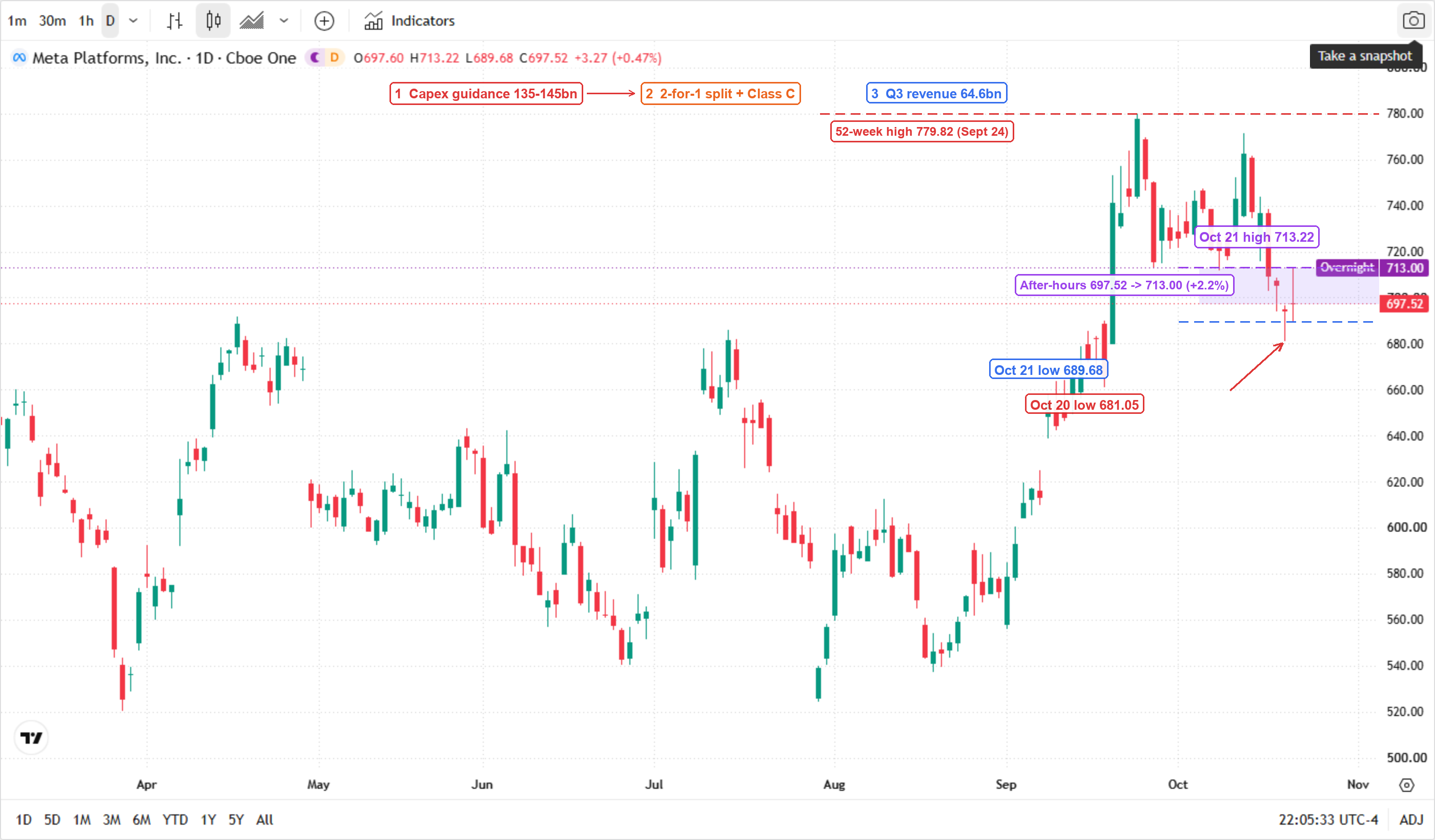
* Chart source: TradingView official chart screenshot, data source Cboe One (Meta Platforms).
The after-hours mark of $713.00 puts the stock back at the top of its October range, and still 8.6% below the $779.82 September high. Below that, the October 20 low of $681.05 is the line that matters for anyone who thinks the capex guide is a ceiling rather than a floor.
4. The bull case and the bear case
The bull case. Revenue compounding at 26% with guidance above consensus; Q4 revenue guided $73-76 billion against a $73.73 billion consensus; the spending plan is now financed rather than questioned, which removes the "how do you fund $145 billion" question from the table for now; and the Muse traction is the first product-level evidence that the capex buys something. On that reading, the after-hours bid is a re-rating, and the September high is the next reference point rather than a ceiling.
The bear case. More than half of this quarter's reported profit went to settlements — GAAP EPS of $3.83 against $7.40 ex-charges is a real reduction in cash earnings, not an accounting footnote. Capex guidance was raised, and the 2027 consensus of $196 billion means the spend is compounding faster than the revenue guidance implies. The new Class C carries no vote, so the equity funding this build-out comes without shareholders getting a say in how it is spent. And the stock has been stuck in a 690-720 range for a month: the after-hours strength is worth roughly one week of range, not a new high.
The bottom line: the market has stopped asking whether Meta can sell and started asking who pays for the build-out. Meta answered by creating a class of equity with no vote attached to it. That answer keeps the capex funded, and it also means the next debate is not about AI demand but about capital allocation — and that debate, not the guidance, is what the December quarter will settle.
Read more
Before making any trading decisions, it is important to equip yourself with sufficient fundamental knowledge, have a comprehensive understanding of market trends, be aware of risks and hidden costs, carefully consider investment targets, level of experience, risk appetite, and seek professional advice if necessary.
Furthermore, the content of this article is solely the author's personal opinion and does not necessarily constitute investment advice. The content of this article is for reference purposes only, and readers should not use this article as a basis for any investment decisions.
Investors should not rely on this information as a substitute for independent judgment or make decisions solely based on this information. It does not constitute any trading activity and does not guarantee any profits in trading.
If you have any inquiries regarding the data, information, or content related to Mitrade in this article, please contact us via email: insights@mitrade.com. The Mitrade team will carefully review the content to continue improving the quality of the article.


