


Crude Oil Price Forecast: Brent Drops From Near Six-Month High and Falls Below $110, Can Middle East Supply Risks Limit Losses?
TradingKey - During Monday's Asian trading session, international crude oil prices fell significantly from near six-month highs. Brent crude (UKOIL) futures fell 2.02% to $109.45 per barrel; US WTI crude (USOIL) futures dropped 2.32% to $101.05 per barrel. Following last week's rapid surge, some funds chose to take profits, while the market also began to re-evaluate whether the geopolitical conflict has actually had a sufficiently severe impact on physical supply.
Last Friday, news of the Houthi militia attacking Saudi Arabian airports and oil facilities temporarily drove up the risk premium in the crude oil market significantly. Brent crude settled that day at $116.72 per barrel, the highest closing level since April 29, recording a weekly gain of about 6%; WTI crude settled at $103.27, up about 2.3% for the week.
Over the weekend, tensions in the Middle East showed no clear signs of easing. The Houthi militia claimed responsibility for attacks on Saudi airports and energy facilities, after which Saudi Arabia stated it had successfully intercepted a new wave of missiles and drones. Although the major airport damaged earlier has partially resumed operations, the Houthis still threatened to launch further attacks, making it difficult for the market to fully eliminate concerns over Saudi crude oil production, export facilities, and regional shipping safety.
Saudi Arabia is one of the world's most important crude oil exporters. Even if current output has not seen a significant drop, as long as refineries, pipelines, ports, or airports face ongoing threats, oil prices are likely to continue pricing in a higher geopolitical premium. The situation in the Red Sea also warrants attention; the Houthis' push toward the Bab el-Mandeb Strait poses greater uncertainty for the critical waterway connecting the Red Sea to the Gulf of Aden.
In addition, US President Trump stated that between reaching a deal with Tehran and taking tougher action, "the moment of decision is approaching." This statement heightened market fears that the US-Iran conflict could escalate again. Meanwhile, Iran stated that as long as rationality prevails, the US will not launch new attacks, reflecting that both sides still have room to prevent the situation from spiraling out of control.
Supply disruptions outside the Middle East are also increasing. Libya's National Oil Corporation stated that pipeline valves connecting the Hamada and Tahala oil fields to the port of Zawiya were shut off, leading to production cuts at the relevant oil fields. While a single event has a limited impact on global supply, simultaneous supply disruptions across multiple regions amidst high Middle East risks tend to amplify market fears of shortages.
Source: TradingView
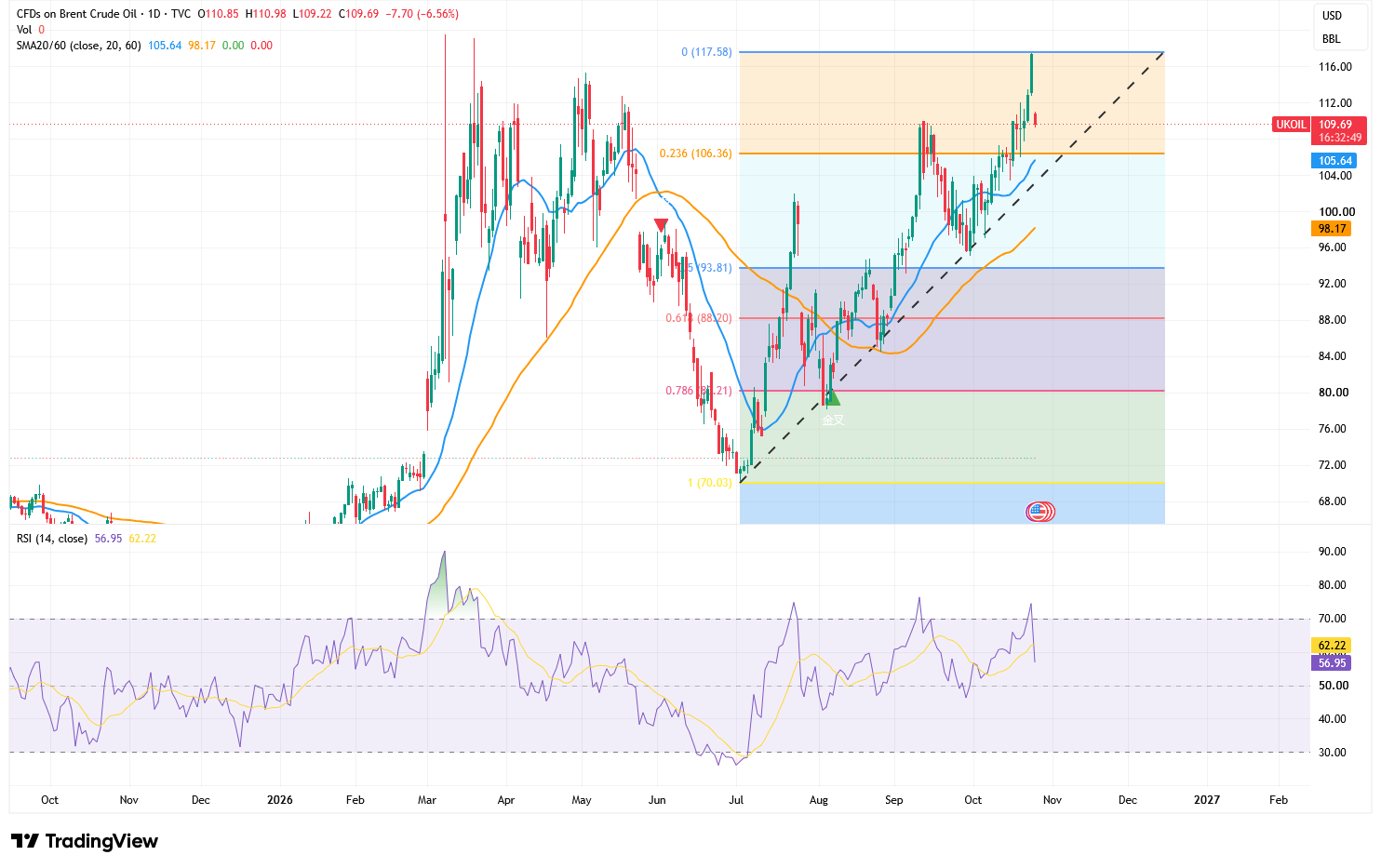
Looking at the daily chart, Brent crude pulled back rapidly after touching $117 and was last trading at $109.69, indicating that the geopolitical risk premium has cooled down noticeably as short-term profit-taking concentrated.
However, oil prices remain above the 20-day moving average of $105.64 and the 60-day moving average of $98.17, and the ascending trendline has not been effectively broken. Therefore, the current move can still be regarded as a technical pullback after a rapid surge, with the medium-term bullish structure remaining intact for now.
On the downside, initial focus is on the 23.6% Fibonacci pullback level of $106.36, which creates support confluence with the 20-day moving average at $105.64. If Middle East supply risks persist and help oil prices hold above $105–$106, Brent may stabilize in this region and subsequently retest $110 as well as $112–$113; a further breakout would leave the previous high of $117.58 as the primary resistance.
The RSI has retreated from high levels to 56.95 and fallen below its signal line at 62.22, indicating that upward momentum has cooled significantly; however, the indicator remains above 50 and has not yet entered a bear-dominated zone. If oil prices close below $105 and the ascending trendline on the daily chart, the correction could further extend toward $100 and the 60-day moving average at $98.17; losing $98 again would point downside risk toward $93.81.
Recommended Articles


