


Brent tops $113 on Saudi supply risk — but the diesel line in the EIA report is the tell


Mitrade Insights — Brent crude's December contract settled at $113.17 a barrel on October 22, up $4.35, or 4.00% — the highest close since May 4 — after trading as high as $114.02, another 0.75% above the settlement. The immediate trigger was supply risk out of Saudi Arabia: the kingdom said crude production was unaffected, but refined-product shipments were restricted. The same session's EIA report told a more complicated story. Commercial crude stocks fell 3.06 million barrels and gasoline fell 2.95 million, while distillates — the diesel pool — built 1.68 million barrels, a 1.6% weekly increase. Crude is pricing a supply shock; the product market is pricing relief. One of those two has to give.
What the EIA report actually said
The headline draw looks bullish, and it is not wrong. Commercial crude inventories fell 3.06 million barrels, gasoline stocks fell 2.95 million, and the Strategic Petroleum Reserve slipped another 0.3 million. US crude output dropped 410,000 barrels a day, a 3.2% weekly decline that tightens the domestic balance at the margin.
The composition matters more than the headline. Distillate inventories rose 1.68 million barrels to about 104 million, and even after that build they sit near the bottom of their 30-year seasonal range. In other words, the crude and gasoline draws are consistent with barrels moving through refineries and offshore rather than with a sudden acceleration in US end-user demand. The one product that was supposed to be tight — diesel — got looser by 1.6% in a single week.
That is not a bearish report. It is a report that removes the easiest argument for buying crude at the highest price since early May.
Why diesel is the tell
Saudi Arabia's restriction applies to refined-product shipments, not to crude production. That distinction decides where the squeeze lands: crude is pricing the risk, while the product market is pricing the barrels that are actually not moving. Diesel is the marginal barrel of the complex — it sets the refinery margin, and the refinery margin is what pulls crude when the physical market is genuinely short.
Here is the problem for the bulls. With distillate stocks near 30-year lows, the system has no buffer, which is exactly why a 4% session can happen on a headline. But the same low base cuts both ways: a single weekly build of 1.68 million barrels, or 1.6%, is nowhere near enough to rebuild a buffer — yet it is enough to show that the marginal tightness stopped worsening.
If distillates draw again next week, the physical market is confirming the risk premium, and $113 becomes a floor. If they build for a second week, the premium starts to look like a headline trade rather than a barrel shortage.
The chart: 108.8 is the line that matters
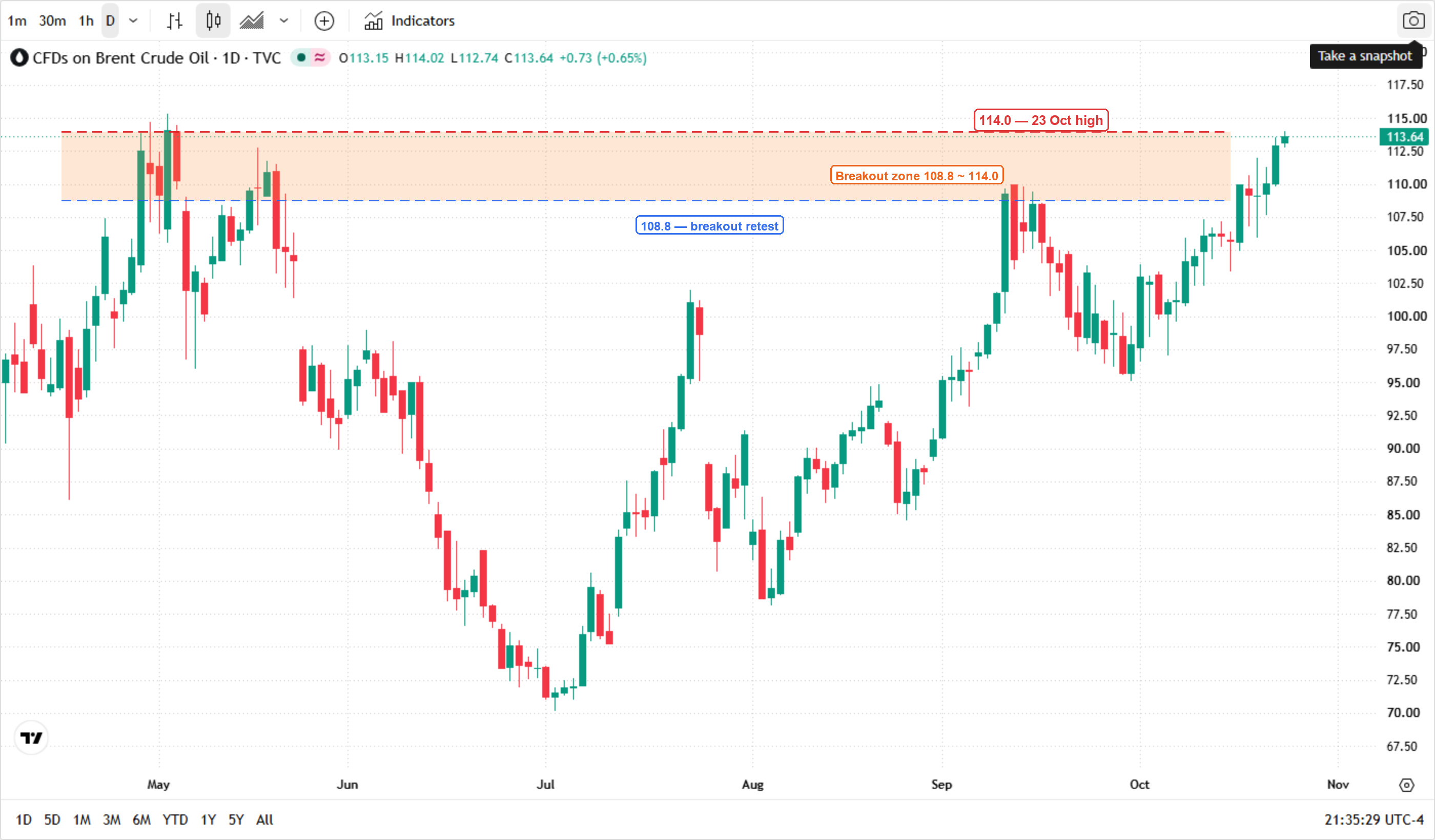
* Image source: TradingView (TVC:UKOIL, Brent crude CFD).
Brent is up 61% from its July low of 70.25 and 18.9% from the October 1 low of 95.21. The October breakout cleared the September highs around 108.8 and the market is now testing 114.0, with the May peak of 119.32 as the next reference — 5.4% above the settlement. A daily close back below 108.8 would undo the breakout, a 3.9% drop from here, and open 103.9, a further 4.5%.
The spread is also worth watching. WTI settled at $99.47, up 2.39%, leaving the Brent-WTI gap at $13.70 — 12.1% of the Brent price. A widening gap says the risk premium is being paid for seaborne Brent barrels specifically; a narrowing gap says the shock is being priced as global rather than regional.
Two scenarios
Bull case — distillates draw, Brent holds 108.8. If next week's EIA report shows distillate stocks falling again and Brent closes above 114.0, the October breakout is confirmed and the path runs to 119.3, with 120.0 as the round-number test — 5.4% above the current settlement. In that case the 4.00% session of October 22 is a repricing, not an overshoot.
Bear case — distillates build again, 108.8 fails. A second weekly build, combined with any sign that Saudi product flows are normalising, would remove the physical anchor. Brent would first retest 108.8, a 3.9% drop from $113.17, and a close below it puts 103.9 — another 4.5% — back in play. The 1.68 million-barrel build would then be read as the first crack rather than noise.
The bottom line: crude is trading the headline, diesel is trading the barrels. Watch the distillate line in Wednesday's EIA report, not the headline draw.
Read more
Before making any trading decisions, it is important to equip yourself with sufficient fundamental knowledge, have a comprehensive understanding of market trends, be aware of risks and hidden costs, carefully consider investment targets, level of experience, risk appetite, and seek professional advice if necessary.
Furthermore, the content of this article is solely the author's personal opinion and does not necessarily constitute investment advice. The content of this article is for reference purposes only, and readers should not use this article as a basis for any investment decisions.
Investors should not rely on this information as a substitute for independent judgment or make decisions solely based on this information. It does not constitute any trading activity and does not guarantee any profits in trading.
If you have any inquiries regarding the data, information, or content related to Mitrade in this article, please contact us via email: insights@mitrade.com. The Mitrade team will carefully review the content to continue improving the quality of the article.


