


U.S. Power Demand Is Set to Jump 20% by 2030. Here's What It Means for Energy Stocks.
Key Points
U.S. electricity demand could surge 20% by 2030, driven by AI data centers, electrification, and manufacturing growth.
Regulated utilities offer stability, while independent power producers offer upside as electricity prices rise.
Equipment manufacturers such as GE Vernova and Bloom Energy offer another avenue for growth as demand for power equipment grows.
- Motley Fool Issues Rare "Total Conviction" Buy Alert ›
After two decades of sluggish growth, U.S. electricity demand appears to be approaching a major inflection point. Rabobank research projects that power consumption could climb 20% by 2030 -- a dramatic shift for a grid accustomed to nearly flat annual growth of around 0.5%.
For investors, surging power demand shifts focus to the energy sector, from steady utility providers to power generators and companies supplying critical grid equipment. Here are the stocks that stand to benefit from rising electricity demand.
Missed Nvidia in 2009? This Rare Signal Is Flashing Again. In 2009, a "Double Down" signal flashed for a little-known chipmaker called Nvidia. For the first time in years, that same "Total Conviction" signal is flashing for a company 1/100th the size of Nvidia. Continue »
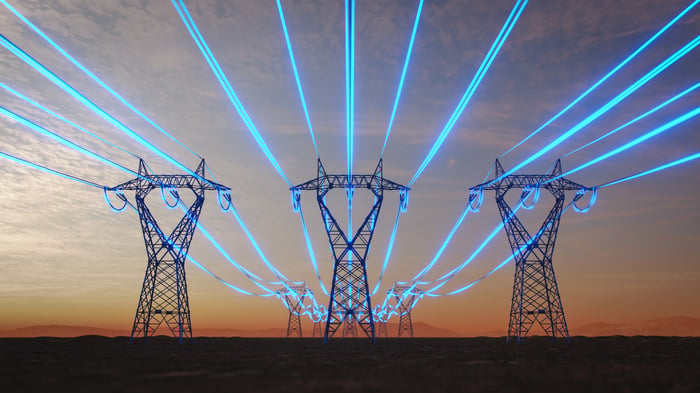
Image source: Getty Images.
What's driving such strong power demand
Growing demand from AI hyperscalers, the electrification of the power grid (think electric vehicles), and the reindustrialization of manufacturing could drive strong growth in U.S. electricity demand over the next decade.
Growing power demand will ripple through the economy. Regulated utilities should benefit from surging peak demand, which will encourage investment in substations, high-voltage lines, and power plants. As these utilities invest more in infrastructure, their earnings should grow as their rate base expands.
Regulated utilities, especially those in the fast-growing regions with data centers, should see solid growth. Companies like Dominion Energy (NYSE: D), Southern Company (NYSE: SO), and American Electric Power (NASDAQ: AEP) stand to benefit. Regulated utilities offer less upside exposure to rising power demand, but their stability makes them ideal for conservative investors or those seeking reliable dividends.
Independent power producers capture more upside compared to regulated utilities
Beyond regulated utilities are independent power producers. These companies own power-producing assets, such as nuclear power plants, and sell electricity to companies through long-term power purchase agreements and into spot markets. Because they aren't regulated utilities, they can capture more upside from rising electricity prices.
Companies like Constellation Energy (NASDAQ: CEG), Vistra (NYSE: VST), and Talen Energy (NASDAQ: TLN) are all merchant power producers that have locked in long-term agreements with hyperscalers. Earlier this month, Constellation signed a 20-year power purchase agreement with Alphabet. It also has deals with Amazon, Microsoft, and Walmart. Amazon also has PPA agreements with Vistra and Talen.
Don't overlook power equipment manufacturers
Finally, power equipment providers are seeing historical demand for their products. These companies benefit because they can get data centers powered and operating in months, not years.
GE Vernova (NYSE: GEV), which manufactures gas turbines and other power equipment, has a massive backlog of over $176 billion. Meanwhile, the narrative around Bloom Energy (NYSE: BE) has shifted dramatically in recent years, as the company has seen incredibly strong demand for its solid-oxide fuel cells.
These companies offer diversified upside from the growing demand for power
Power demand is set to grow rapidly over the next decade, and the market is rewarding companies that can meet that demand quickly. If you're a conservative investor seeking income while still getting in on the trend, regulated utilities like Southern Company offer stable upside.
If you're more aggressive and don't mind the risk, independent power producers like Constellation and Vistra are appealing, and both are down 30% and 22% over the past year. If you want to play the power boom from the equipment angle, manufacturers like GE Vernova and Bloom Energy offer another attractive way to capture upside from the growing need for power.
Should you buy stock in Dominion Energy right now?
Before you buy stock in Dominion Energy, consider this:
The Motley Fool Stock Advisor analyst team just identified what they believe are the 10 best stocks for investors to buy now… and Dominion Energy wasn’t one of them. The 10 stocks that made the cut could produce monster returns in the coming years.
Consider when Netflix made this list on December 17, 2004... if you invested $1,000 at the time of our recommendation, you’d have $361,596!* Or when Nvidia made this list on April 15, 2005... if you invested $1,000 at the time of our recommendation, you’d have $1,303,935!*
Now, it’s worth noting Stock Advisor’s total average return is 910% — a market-crushing outperformance compared to 211% for the S&P 500. Don't miss the latest top 10 list, available with Stock Advisor, and join an investing community built by individual investors for individual investors.
See the 10 stocks »
*Stock Advisor returns as of October 24, 2026.
Courtney Carlsen has positions in Alphabet, Bloom Energy, Constellation Energy, GE Vernova, Microsoft, and Vistra. The Motley Fool has positions in and recommends Alphabet, Amazon, Bloom Energy, Constellation Energy, GE Vernova, Microsoft, Talen Energy, Vistra, and Walmart. The Motley Fool recommends Dominion Energy. The Motley Fool has a disclosure policy.
Recommended Articles


