


Billionaire Ken Griffin Says We May Be in a Bubble. Here’s What History Says Happens Next.
Key Points
Ken Griffin said in a Bloomberg interview that we’re “almost certainly” in a bubble.
The dot-com bubble can offer us valuable insight into such situations and what may follow.
- Motley Fool Issues Rare "Total Conviction" Buy Alert ›
Artificial intelligence (AI) stocks have driven stock market gains over the past several years amid excitement about this technology's potential. Some of these companies, such as chip designer Nvidia and cloud services provider Alphabet, have already started reaping the rewards. Demand for their AI products and services has supercharged revenue growth and their stock performance.
But the AI story isn't over, and to support ongoing growth, major investment is needed. And that's exactly why tech giants Alphabet, Amazon, Microsoft, and Meta Platforms aim to spend more than $700 billion on the infrastructure ramp-up this year. Those plans have sparked concern among investors, though, with the idea that the revenue opportunity may not justify such spending levels.
Missed AI’s "Act 1"? Act 2 Could Be 15x Bigger. Most investors think they missed the AI boat because they didn't buy Nvidia in 2005. But according to our analysts, we’re only at the end of "Act 1"—the R&D phase. "Act 2" is the global rollout. Continue »
In fact, some investors have even questioned whether a bubble may have formed. And one of those investors is Ken Griffin, founder and chief of Citadel. We're "almost certainly" in an AI bubble, the billionaire said in an interview with Bloomberg.
Let's take a closer look at Griffin's comments and check out what history says happens next.

Ken Griffin. Image source: Getty Images.
The early chapters of the AI story
First, though, let's page through the earlier chapters of the AI story. Over the past few years, companies have focused on training models, and this has created growth for all of the players involved, from chip designers and AI labs to the cloud service providers that offer customers access to these models.
Since many of these players are heavily weighted in the S&P 500, they helped lead the index to multiple record highs and a gain of nearly 100% since the start of 2023. Investors aimed to get in early on current and potential AI winners since the technology may be a game changer. It may streamline many processes, supercharge innovation, and, thanks to all of this and more, AI could significantly boost corporate earnings. Both the developers and users of AI may see earnings climb as this technology evolves and is used on a widespread basis.
Today, though, some investors worry that an AI bubble has formed, as stocks trade at record high levels. We can see, below, through the S&P 500 Shiller CAPE ratio, an inflation-adjusted view of stock prices relative to earnings, that stocks are trading near a peak.
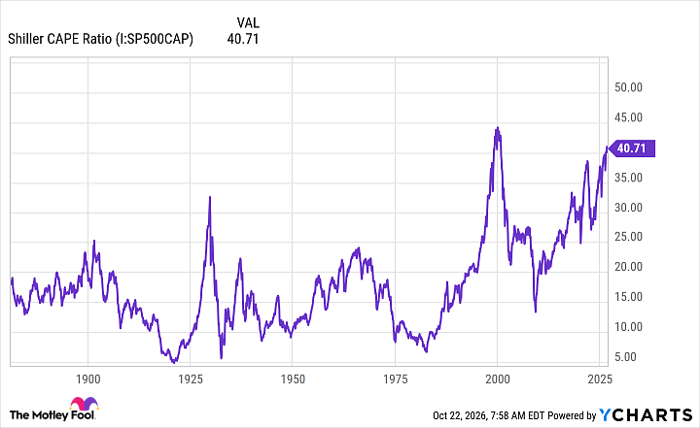
Shiller CAPE Ratio data by YCharts
"There's almost certainly bubbles within this moment in time," Griffin told Bloomberg this week. "And any radical transformation of our economy is generally intertwined with a bubble."
Using history as a guide
This idea of economic transformation is key and allows us to use history as a guide. The last tech bubble was back in 2000, with the famous dot-com bubble. We can see the pattern in the chart below.
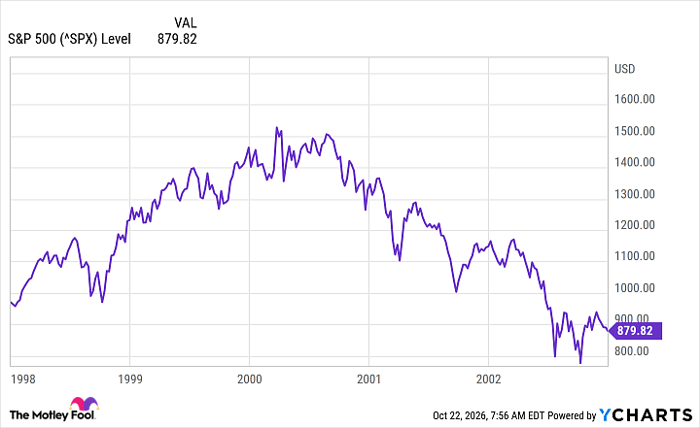
^SPX data by YCharts
Now, if we look at the index including those times all the way to today, we see that the dot-com bubble looks like a small event, and the S&P 500's performance over time clearly compensated -- and the index went on to soar well above even its highest dot-com bubble levels.
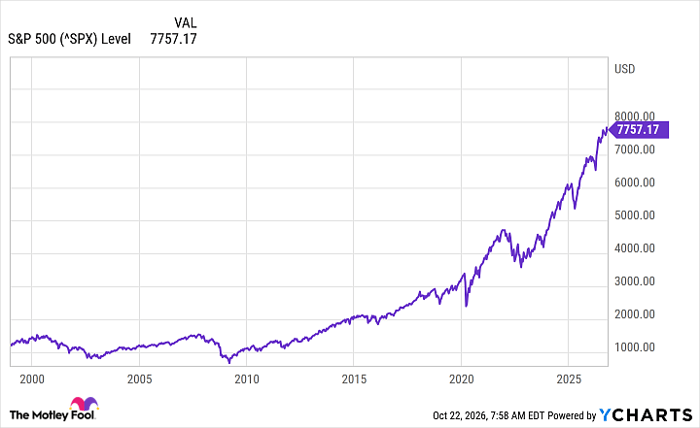
^SPX data by YCharts
Griffin's comments in the Bloomberg interview support this, as he says, referring to bubbles, that "the companies that are on the other side of that bubble are the market leaders for decades to come."
So, history is telling us two things about what happens next. If the market follows historical patterns, it may indeed decline in the coming weeks or months. But the good news is that it's always gone on to gain over the long run -- and so have quality stocks, even those involved in the particular bubble. For example, e-commerce giant Amazon, trading at about $5 per share during the dot-com bubble, crashed to less than $1 after the bubble burst. Today, the stock trades for more than $260.
What does this mean for investors? Even if a downturn or crash lies ahead, this is a temporary event, and the index and quality stocks will recover and gain. The best thing you can do is take a long-term view and hold on through market downturns -- your patience may be greatly rewarded over time.
Should you buy stock in S&P 500 Index right now?
Before you buy stock in S&P 500 Index, consider this:
The Motley Fool Stock Advisor analyst team just identified what they believe are the 10 best stocks for investors to buy now… and S&P 500 Index wasn’t one of them. The 10 stocks that made the cut could produce monster returns in the coming years.
Consider when Netflix made this list on December 17, 2004... if you invested $1,000 at the time of our recommendation, you’d have $361,596!* Or when Nvidia made this list on April 15, 2005... if you invested $1,000 at the time of our recommendation, you’d have $1,303,935!*
Now, it’s worth noting Stock Advisor’s total average return is 910% — a market-crushing outperformance compared to 211% for the S&P 500. Don't miss the latest top 10 list, available with Stock Advisor, and join an investing community built by individual investors for individual investors.
See the 10 stocks »
*Stock Advisor returns as of October 24, 2026.
Adria Cimino has positions in Amazon. The Motley Fool has positions in and recommends Alphabet, Amazon, Meta Platforms, Microsoft, and Nvidia. The Motley Fool has a disclosure policy.
Recommended Articles


