


President Donald Trump Pledged Not to Touch Social Security, but He's Indirectly Dug a $169 Billion Hole for America's Top Retirement Program
Key Points
Up to 90% of retirees rely on their Social Security income, in some capacity, to make ends meet.
Sweeping Social Security benefit cuts for retired workers and survivors of deceased workers are an estimated six years away.
While President Trump’s flagship “Big, Beautiful Bill” is helping some taxpayers retain more of their income, it’s detrimental to Social Security’s financial well-being.
- Motley Fool Issues Rare "Total Conviction" Buy Alert ›
For a majority of Social Security's 55 million retired-worker beneficiaries, their monthly payout is foundational to their financial well-being. A quarter-century of annual surveys by Gallup show that up to 90% of retirees rely on their Social Security income, in some capacity, to make ends meet.
Unfortunately, America's leading retirement program isn't on the best financial footing, and frankly hasn't been for decades. Though Social Security is in no danger of going bankrupt or halting benefits, its structural deficiencies have created the real possibility of sweeping benefit cuts in as little as six years.
Missed Nvidia in 2009? This Rare Signal Is Flashing Again. In 2009, a "Double Down" signal flashed for a little-known chipmaker called Nvidia. For the first time in years, that same "Total Conviction" signal is flashing for a company 1/100th the size of Nvidia. Continue »

President Trump indirectly broke his Social Security promise. Image source: Official White House Photo by Joyce N. Boghosian.
President Donald Trump, like several other presidents before him, has pledged to not touch Social Security. Most presidents tend to avoid the issue since it's a touchy subject with voters. But thanks to one of Trump's flagship policies, he's not only indirectly impacted Social Security, but he's dug an even deeper hole for this top retirement program.
Sweeping Social Security benefit cuts are an estimated six years away
Every year since the first retired-worker check was mailed in 1940, the Social Security Board of Trustees has released an annual report detailing how the program generates income and where those dollars are spent.
However, the real value of the annual Trustees Report lies in its projections. The Trustees account for a laundry list of variables to decipher how financially "healthy" Social Security is over the next 75 years (i.e., the long term). Since 1985, every report has cautioned about a long-term unfunded obligation. As of the latest report, Social Security's funding shortfall has reached an estimated $29.3 trillion through 2100.
While this is a daunting figure, it's not the scariest aspect of Social Security's financial outlook.
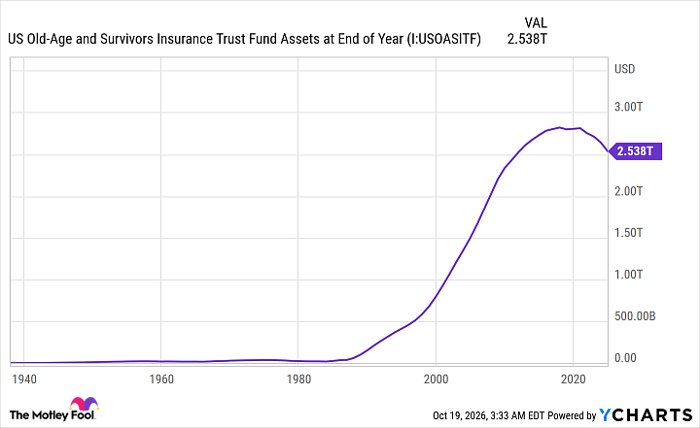
US Old-Age and Survivors Insurance Trust Fund Assets at End of Year data by YCharts.
According to the 2026 Trustees Report, the Old-Age and Survivors Insurance trust fund (OASI) -- this is the trust fund that doles out monthly benefits to retired workers and survivors of deceased workers -- is projected to exhaust its asset reserves by the fourth quarter of 2032. These asset reserves represent the excess income collected since inception that's invested in special-issue, interest-bearing government bonds, as required by law.
Although the OASI doesn't require a dime in its asset reserves to continue doling out benefits, the sustainability of the existing payout schedule, including annual cost-of-living adjustments, is very much in question. The 2026 Trustees Report estimates that sweeping benefit cuts of 22% will be necessary for retired workers and survivors of deceased workers in six years.

Image source: Getty Images.
President Trump indirectly broke his Social Security promise -- and there are steep consequences
While Donald Trump hasn't proposed any direct changes to Social Security or its payout schedule, the president's flagship tax and spending law of his second non-consecutive term, the "Big, Beautiful Bill," or BBB, has indirectly put America's top retirement program in a bind.
For some Americans, the BBB has helped them retain more of their income. In addition to making the personal income tax bracket cuts from the Tax Cuts and Jobs Act (signed into law in December 2017) permanent, the BBB introduced a series of temporary tax breaks designed to reward working Americans and seniors. These temporary tax breaks run from calendar years 2025 through 2028 and include:
- The senior deduction: Increases the standard deduction for eligible seniors aged 65 and up by $6,000 (or $12,000 if filing jointly).
- No tax on tips: Allows eligible workers to deduct up to $25,000 in annual tips.
- No tax on overtime: Provides eligible workers with a partial deduction on their overtime pay up to $12,500 (or $25,000 if filing jointly).
But for Social Security, Trump's flagship law is a detriment to its financial health.
Shortly after the BBB was signed into law on July 4, 2025, Sen. Ron Wyden (D-OR) sent a request to the Social Security Administration's Office of the Actuary (OACT) to estimate the financial impact of this legislation. In early August, Wyden received a response.
According to the OACT, the Big, Beautiful Bill is projected to increase costs for Social Security's trust funds by $168.6 billion from 2025 through 2034. This eye-popping deficit is primarily a function of less income being subject to the 12.4% payroll tax on earned income (i.e., Social Security's primary funding source), courtesy of these temporary tax breaks.
In the grand scheme of things, President Trump's BBB widening Social Security's funding shortfall by $169 billion over 10 years is relative peanuts. The bulk of Social Security's estimated $29.3 trillion long-term unfunded obligation stems from a series of ongoing demographic shifts. This includes:
- The retirement of baby boomers
- An increase in longevity, spanning multiple decades
- A historically low U.S. birth rate
- A decline in net legal migration into the U.S.
- Rising income inequality
Nevertheless, President Trump's Big, Beautiful Bill isn't helping matters. His flagship law has indirectly dug a $169 billion hole for Social Security and shifted the OASI's projected asset reserve exhaustion date forward by one quarter (from the first quarter of 2033 to the fourth quarter of 2032).
The $23,760 Social Security bonus most retirees completely overlook
If you're like most Americans, you're a few years (or more) behind on your retirement savings. But a handful of little-known "Social Security secrets" could help ensure a boost in your retirement income.
One easy trick could pay you as much as $23,760 more... each year! Once you learn how to maximize your Social Security benefits, we think you could retire confidently with the peace of mind we're all after. Join Stock Advisor to learn more about these strategies.
View the "Social Security secrets" »
The Motley Fool has a disclosure policy.
Recommended Articles


