


TSMC Q3 Earnings Preview: Can Profit Hit a Record High for a Sixth Straight Quarter? Wall Street's Highest Target Price Is $665
TradingKey - TSMC (TSM) will report its third-quarter 2026 financial results on October 15 and hold an investor conference at 2:00 p.m. Beijing time on the same day. The company has already disclosed its quarterly revenue, and the market will next focus on net profit, gross margin, fourth-quarter guidance, as well as capital expenditure and capacity planning for 2027.
TSMC's third-quarter revenue reached NT$1.494 trillion, or approximately $46.7 billion, up about 51% year-over-year and setting a new single-quarter record high. This beat market expectations of NT$1.46 trillion and exceeded the upper end of the company's prior guidance of $44.6 billion to $45.8 billion, indicating that demand for AI chips, advanced processes, and high-end packaging remains strong.
As a core foundry partner for Nvidia (NVDA), Apple (AAPL), AMD (AMD), and multiple cloud computing companies, TSMC is viewed as a crucial window into global AI infrastructure demand.
Net Profit Set to Hit Record High for Sixth Straight Quarter
According to analyst consensus compiled by LSEG SmartEstimate, TSMC's third-quarter net profit is likely to increase by approximately 65% year-over-year to NT$746.3 billion (around $23.4 billion). FactSet's forecast is relatively conservative, projecting net profit of around NT$731.8 billion, up 62% year-over-year.
Whichever forecast is used, as long as third-quarter net profit surpasses the previous record of NT$706.56 billion, TSMC will set a new quarterly profit high for the sixth consecutive quarter and achieve its 11th consecutive quarter of profit growth.
Profit growth was mainly driven by advanced-node capacity utilization remaining high. Nvidia (NVDA) Rubin GPUs, AMD (AMD) MI400, Amazon (AMZN) cloud service AWS Trainium3, and Google parent Alphabet (GOOGL) next-generation TPUs, among other products, sequentially entered mass production, continuously occupying 3nm and 5nm capacity. Meanwhile, Apple (AAPL) new mobile processors and AMD (AMD) Venice server CPUs began driving the 2nm capacity ramp.
Bank of America expects that the revenue contribution from the 2nm node could rise from approximately 3% in the second quarter to around 11% in the third quarter, and further increase to about 18% in the fourth quarter. If this assessment is validated by the earnings report, it will mean that the commercialization pace of 2nm is significantly faster than previous market expectations.
2nm Ramp Drives Revenue as Gross Margin Still Faces Cost Pressure
Although revenue performance was strong, gross margin could be a metric more likely to trigger stock price volatility in this earnings report.
TSMC previously projected its third-quarter gross margin to be 65% to 67% and its operating margin to be 56% to 58%. BofA expects the gross margin to be around 67%, while HSBC's forecast stands at 66.9%, both near the upper end of the company's guidance.
Favorable factors include gradually diminishing depreciation pressure from 3nm, sustained high capacity utilization for advanced nodes, and a rising share of high-performance computing products. However, with 2nm in the early stage of mass production, yield ramp-ups and equipment depreciation could dilute the gross margin by 3 to 4 percentage points; production costs at overseas fabs such as Arizona will also continue to weigh on overall margins.
Therefore, revenue beating expectations does not necessarily mean gross margin will rise sharply in tandem. If the third-quarter gross margin reaches around 67% and fourth-quarter guidance remains above 66%, it indicates that TSMC can still absorb the costs of new process nodes and overseas expansion through product mix optimization and pricing power.
Wall Street Average Price Target at $553
TSMC's continuous upward revisions to its capital expenditure reflect management's ongoing confidence in future demand. The company has raised its 2026 capex guidance to $60 billion to $64 billion, with funds mainly allocated toward 3nm expansion, 2nm mass production, A16 equipment installation, and CoWoS advanced packaging. Bank of America expects 2026 capex to reach approximately $63 billion and potentially rise to $83 billion in 2027.
High investments mean TSMC is building out capacity ahead of time for the next wave of AI computing demand, though this will also increase pressure on depreciation and free cash flow. Investors need to watch whether management will raise capex further and whether the new investments can be supported by sufficient customer orders.
Wall Street as a whole remains bullish on TSMC. According to TipRanks, among the 8 analysts covering the stock over the past three months, 7 have assigned a Buy rating. Its 12-month average price target is $553, with a high forecast of $665 and a low forecast of $440.
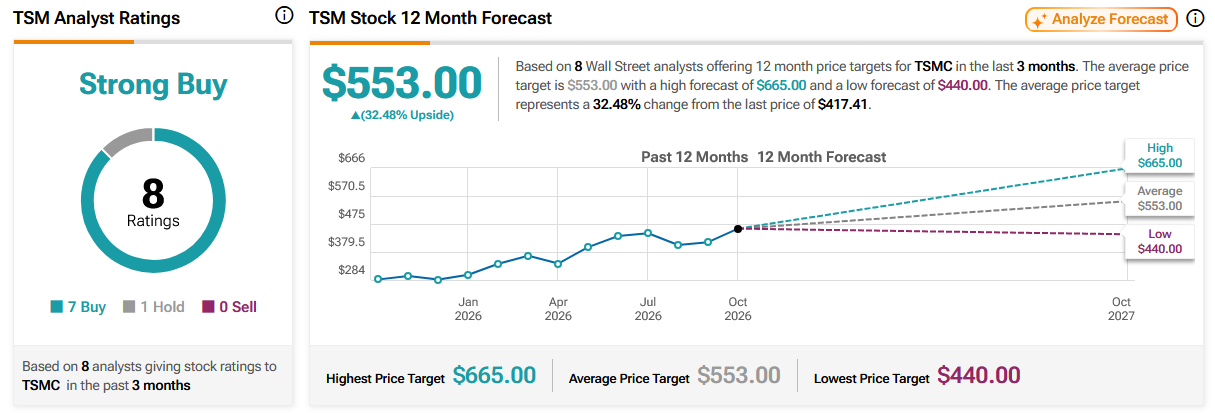
Source: TipRanks
Bank of America also recently raised its price target on TSMC's ADR from $590 to $620 while maintaining a Buy rating. Its core rationale is that the accelerated 2nm ramp-up, the migration of AI products to 3nm, and wafer price increases in 2027 will continue to drive upward revisions to earnings forecasts.
Recommended Articles


