


McDonald's Stock Price Forecast: AI Pricing Tool Faces Antitrust Lawsuit, Can MCD Hold $230?
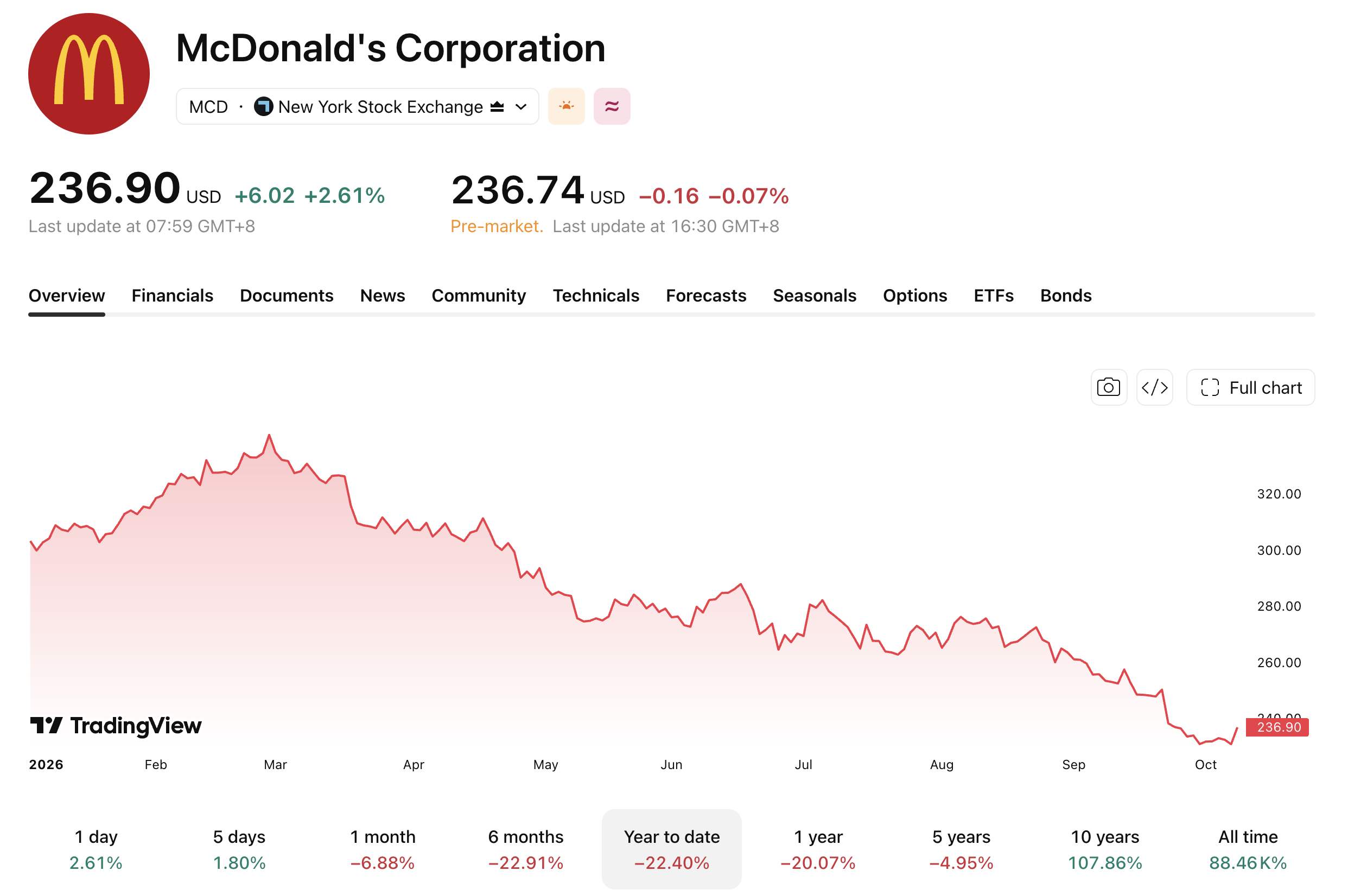
TradingKey - On October 8 ET, McDonald's (MCD) closed up 2.61% at $236.90, down 30.68% from its 52-week high of $341.75 set on March 2.
[Source: TradingView]
Following the announcement of its NEXT plan in September, McDonald's stock remains near its low for the year. The market is assessing whether U.S. customer traffic can recover and if franchisee support, restaurant remodels, and technology investments can improve operational efficiency. Meanwhile, recent antitrust lawsuits facing its AI pricing recommendation system add new legal uncertainty.
US Business Growth Slows as Return on $8.5 Billion Investment Remains Unproven
McDonald's second-quarter revenue grew 3.7% year-over-year to $7.1 billion, with adjusted earnings per share reaching $3.38. Global same-store sales increased 1.3%, including a 0.8% rise in the U.S. market, which trailed the 2.5% growth recorded in the same period last year.
Management attributed the weaker-than-expected performance in the U.S. business to inconsistent store-level execution, insufficient marketing effectiveness, and a reduction in digital promotions. The company subsequently appointed Skye Anderson as President of U.S. Business and increased low-priced value meals and personalized offers to improve customer traffic and order volume.
Under its NEXT plan, McDonald's will provide franchisees with approximately $8.5 billion in cumulative support by 2036 through rent reductions, capital assistance, and other means. Of this, about $5 billion is scheduled to be invested by 2030, primarily for restaurant modernization, technology deployment, and operational improvements.
The company plans to increase its market share in the chicken and beverage categories by 1.5 percentage points each by 2030, raise its adjusted operating margin to the low-to-mid 50% range, and achieve an efficiency gain of approximately 250 basis points at the restaurant level. According to company estimates, this translates to an average annual cash flow increase of roughly $100,000 per U.S. store, with a payback period of about four years for franchisees after completing matching investments.
U.S. same-store sales, customer traffic trends, and per-store cash flow will be the primary metrics for evaluating the effectiveness of the NEXT plan.
AI Pricing Recommendation Systems Face Antitrust Lawsuits
On October 2, a consumer filed a proposed nationwide class-action lawsuit against McDonald's in an Illinois federal court. The plaintiff alleges that McDonald's AI pricing recommendation system aggregates non-public sales data from franchise locations, potentially enabling competing franchisees to coordinate prices, in violation of U.S. antitrust laws.
McDonald's denied the allegations, stating that the system only provides operational information and pricing recommendations, does not automatically set or coordinate prices, and that menu prices remain independently determined by franchisees.
The case remains in its early stages, and the court has not yet ruled on the allegations or on class certification. The plaintiff seeks damages and an order prohibiting McDonald's from enforcing arrangements that could restrict competition. The impact of the lawsuit on the company's financial condition and operations cannot be determined at this time.
MCD Technical Analysis: $229-$230 Becomes Key Support Zone
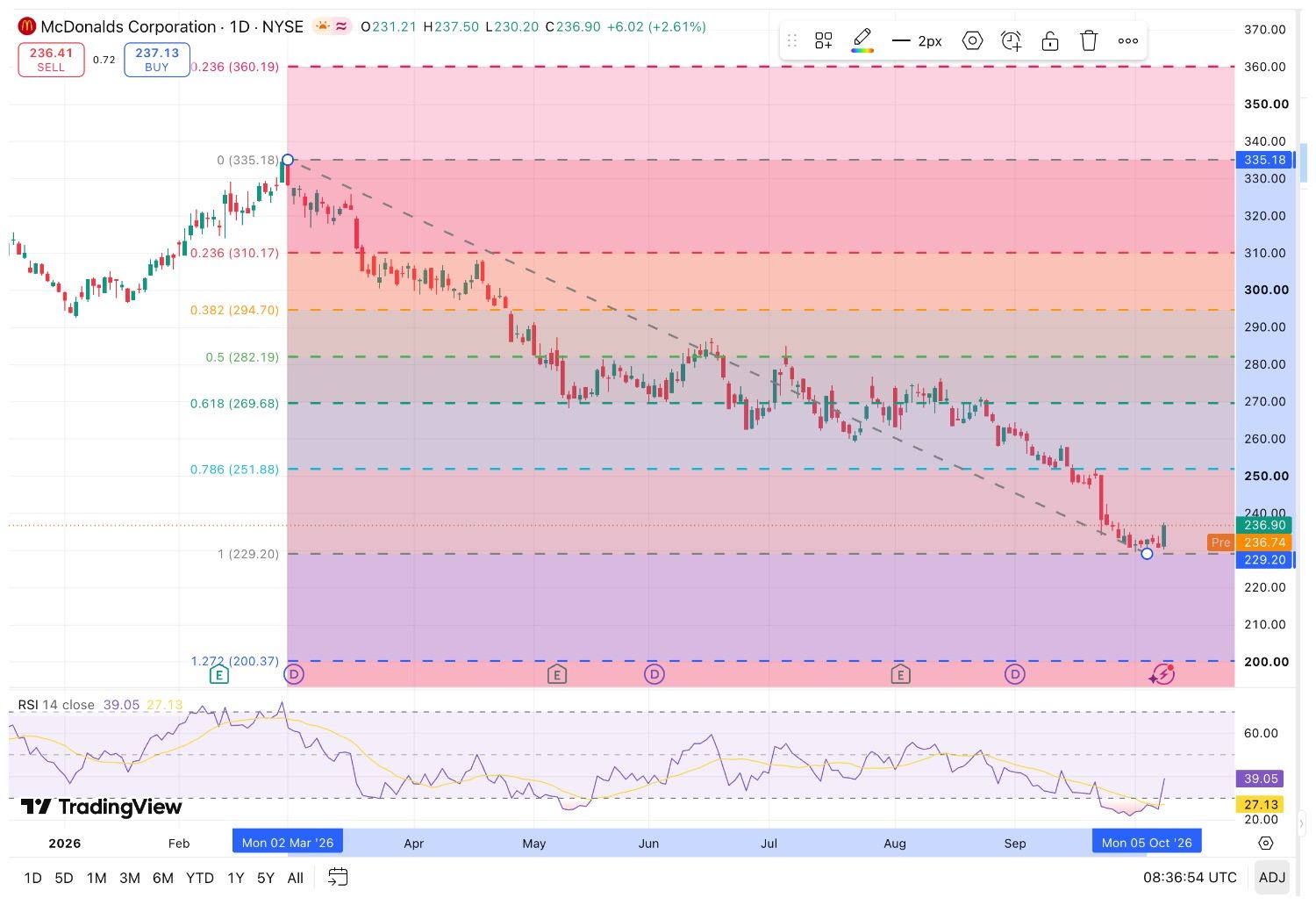
Based on the dividend-adjusted intraday high of approximately $335.18 on March 2 to the low of $229.20 on October 5, the Fibonacci retracement levels of 0.236, 0.382, 0.500, and 0.618 are roughly $254.21, $269.68, $282.19, and $294.69, respectively.
[Source: TradingView]
As of the close on October 8, MCD's 14-day RSI was around 39, remaining in weak territory, but has exited the oversold zone below 30. The stock price remains below its 20-day, 50-day, and 200-day moving averages, indicating that the medium-term downward structure has not yet reversed.
On the upside, $240–$242 is the primary resistance zone. If the stock holds firmly on a daily closing basis, attention can shift to $250 and $254–$256; following a breakout, the next resistance level is near $269–$270.
On the downside, $229–$230 is a key near-term support zone. If the closing price falls below $229.20, the stock will set a new low for the current correction, with the next level to watch at the $220 psychological mark.
Recommended Articles


