


Had You Bought This Vanguard ETF at the Start of January, You'd be Obliterating the S&P 500 in 2026
Key Points
The U.S. is home to 13 public companies worth $1 trillion or more, and six of them are in the information technology sector.
They include Nvidia, Microsoft, Micron Technology, and Broadcom, which are at the heart of the artificial intelligence revolution.
The Vanguard Information Technology ETF exclusively invests in stocks from the information technology sector, and it's crushing the S&P 500 this year.
- 10 stocks we like better than Vanguard Information Technology ETF ›
The S&P 500 (SNPINDEX: ^GSPC) has climbed by 12.2% so far in 2026 (as of Sept. 28), so it's already pacing ahead of its average annual return of 10.7% dating back to its inception in 1957. But had an investor bought the Vanguard Information Technology ETF (NYSEMKT: VGT) on Jan. 1 instead, they would be sitting on a much larger gain of 32.7% this year.
The exchange-traded fund (ETF) exclusively invests in stocks from the information technology sector, which is home to many of the trillion-dollar powerhouses at the heart of the artificial intelligence (AI) revolution. Many of those stocks are outperforming the broader market by a wide margin this year, contributing to the strong returns in the Vanguard ETF.
Missed AI’s "Act 1"? Act 2 Could Be 15x Bigger. Most investors think they missed the AI boat because they didn't buy Nvidia in 2005. But according to our analysts, we’re only at the end of "Act 1"—the R&D phase. "Act 2" is the global rollout. Continue »
Will the momentum continue, or is the tech sector about to cool off?

Image source: Getty Images.
Six trillion-dollar stocks make up half the value of this ETF
The U.S. is home to 13 public companies with valuations of $1 trillion or more, and six of them are in the information technology sector.
- Nvidia: $5.5 trillion.
- Apple: $4.9 trillion.
- Microsoft: $3.8 trillion.
- Broadcom: $1.6 trillion.
- Micron Technology: $1.2 trillion.
- Advanced Micro Devices: $1 trillion.
The Vanguard Information Technology ETF holds 318 stocks, but the above six are its largest positions, with a dominant combined portfolio weighting of 56.6%.
|
Stock |
Vanguard ETF Portfolio Weighting |
|---|---|
|
1. Nvidia |
17.73% |
|
2. Apple |
15.79% |
|
3. Microsoft |
11.51% |
|
4. Broadcom |
4.52% |
|
5. Micron Technology |
4.18% |
|
6. Advanced Micro Devices |
2.95% |
Data source: Vanguard. Portfolio weightings are accurate as of Aug. 31, 2026, and are subject to change.
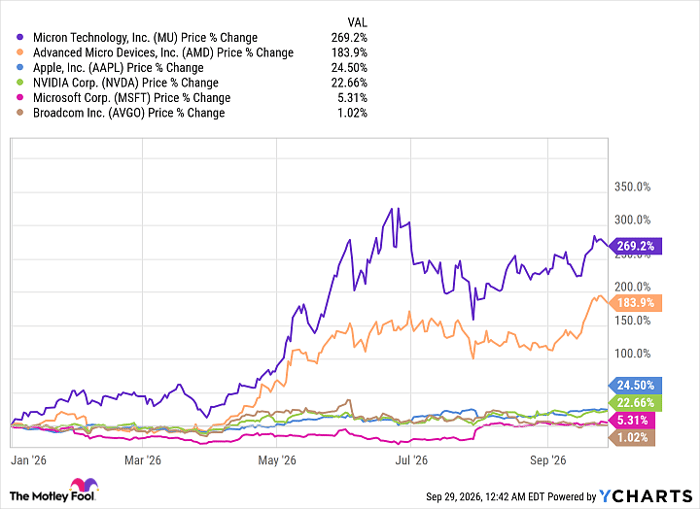
Four of those stocks have outperformed the S&P 500 so far this year -- and two by a very wide margin -- which is a key reason why the Vanguard ETF is handily beating the index.
MU data by YCharts
Nvidia chief executive Jensen Huang recently said he expects data center chip sales to double next year thanks to ongoing demand from the AI industry. AMD CEO Lisa Su also predicts her company's data center revenue to more than double next year. Simply put, the AI infrastructure spending boom is unlikely to slow any time soon, which should support further gains in semiconductor stocks.
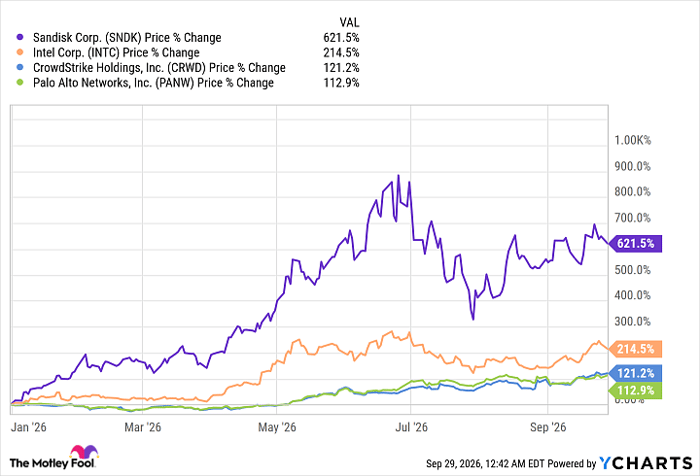
I also want to highlight Sandisk, Intel, CrowdStrike, and Palo Alto Networks which have each more than doubled in value so far this year. They are among the top 20 positions in the Vanguard ETF, so they have also made a big contribution to its overall return.
SNDK data by YCharts
Is there still time to buy the Vanguard Information Technology ETF?
This Vanguard ETF has produced a compound annual return of 14.9% since it launched in 2004, trouncing the 10.8% annual return in the S&P 500 over the same period. Simply put, it has an excellent track record against the broader market, so it looks like a no-brainer investment from that perspective.
However, it would be unwise for investors to park all of their money in an ETF that solely invests in the tech sector, because any disruption to the ongoing AI boom will spark some serious volatility. There are certainly some risks appearing; for example, lawmakers in more than a dozen U.S. states have introduced legislation to temporarily ban the construction of further data centers while they weigh the social, environmental, and economic impacts.
Moreover, a recent survey by UBS Group found that 60% of businesses are routing some AI workloads to cheaper, more efficient models instead of those from mainstream developers like OpenAI. These models typically consume less computing power, so this effort to reduce costs could result in lower demand for data center chips and components in the future. That would be bad news for many of the semiconductor stocks in the Vanguard ETF.
With all of that in mind, diversification might be the key to yielding robust long-term returns. Owning the Vanguard Information Technology ETF as part of a portfolio of other ETFs and individual stocks will give investors an opportunity to benefit from its ability to beat the market, while keeping the potential risks in check.
Should you buy stock in Vanguard Information Technology ETF right now?
Before you buy stock in Vanguard Information Technology ETF, consider this:
The Motley Fool Stock Advisor analyst team just identified what they believe are the 10 best stocks for investors to buy now… and Vanguard Information Technology ETF wasn’t one of them. The 10 stocks that made the cut could produce monster returns in the coming years.
Consider when Netflix made this list on December 17, 2004... if you invested $1,000 at the time of our recommendation, you’d have $375,240!* Or when Nvidia made this list on April 15, 2005... if you invested $1,000 at the time of our recommendation, you’d have $1,403,292!*
Now, it’s worth noting Stock Advisor’s total average return is 933% — a market-crushing outperformance compared to 211% for the S&P 500. Don't miss the latest top 10 list, available with Stock Advisor, and join an investing community built by individual investors for individual investors.
See the 10 stocks »
*Stock Advisor returns as of October 1, 2026.
Anthony Di Pizio has no position in any of the stocks mentioned. The Motley Fool has positions in and recommends Advanced Micro Devices, Apple, Broadcom, CrowdStrike, Intel, Micron Technology, Microsoft, and Nvidia. The Motley Fool recommends Palo Alto Networks. The Motley Fool has a disclosure policy.
Recommended Articles


