


Is Cameco Stock a Buy Now?
Key Points
Cameco’s stock trades 35% below its all-time high.
But it still looks pricey relative to its near-term growth potential.
- 10 stocks we like better than Cameco ›
Cameco (NYSE: CCJ), a Canada-based company, mined about 15% of the world's uranium in 2025. That makes it the second-largest uranium miner after Kazakhstan's Kazatomprom. It's also a bellwether and linchpin of the nuclear energy market.
Cameco, like its industry peers, struggled for about a decade after the 2011 Fukushima disaster prompted many countries to throttle or halt their nuclear projects. But over the past few years, the nuclear energy industry recovered -- thanks to new decarbonization initiatives, safer nuclear technologies, and the growth of the power-hungry cloud infrastructure and AI markets.
Missed AI’s "Act 1"? Act 2 Could Be 15x Bigger. Most investors think they missed the AI boat because they didn't buy Nvidia in 2005. But according to our analysts, we’re only at the end of "Act 1"—the R&D phase. "Act 2" is the global rollout. Continue »
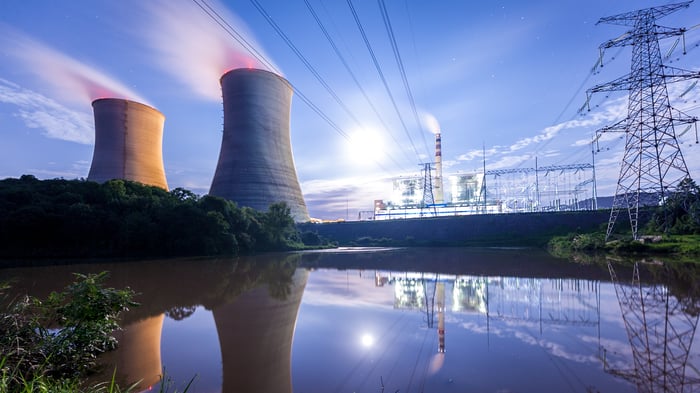
Image source: Getty Images.
The spot price of uranium sank from a record high of $136 per pound in June 2007 to just $18 per pound in Nov. 2016. But by the end of this August, it had risen back to $89.68 per pound. Cameco's stock also reached a record high of $134.09 per share on Jan. 28, 2026. Today, Cameco's stock trades at about $87. Let's see why it retreated from its record highs, and if that pullback represents a good long-term play on the resurgent nuclear energy market.
What does Cameco do?
Cameco operates uranium mines and mills in Canada, the U.S., and Kazakhstan. Instead of selling its uranium on the open market at its current spot prices (which would expose it to more volatility), Cameco locks most of its clients into long-term, partly fixed-price contracts.
Most of those contracts were signed when uranium prices were lower. Therefore, Cameco doesn't benefit as much from rising uranium prices as its spot-price competitors do. But when uranium prices decline, the price floors from those contracts limit its losses.
To further reduce its exposure to the volatile uranium mining market, Cameco doubled its stake in Global Laser Enrichment (GLE) -- its uranium enrichment joint venture with Silex (OTC: SILXY) -- from 24% to 49% in 2021. By integrating GLE's laser-based uranium enrichment capabilities into its core mining business, Cameco could gradually become a "one-stop shop" for mining, converting, and selling enriched uranium.
In 2023, Cameco partnered with Brookfield Asset Management (NYSE: BAM) to acquire Westinghouse Electric, one of the world's leading nuclear technology companies. That 49% stake makes it a more diversified play on building and powering nuclear power plants.
Why did Cameco's stock pull back from its record highs?
Cameco is hedged against uranium's wild price swings. But after hitting the mid-$90s in January, uranium's spot price pulled back, dragging down the entire sector. At the same time, the expenses from its Westinghouse acquisition throttled its near-term earnings growth.
When it hit its all-time high, Cameco traded at 118 times this year's earnings. Those high valuations set it up for a steep pullback as fears of interest rate hikes (and the Fed's recent rate hikes) compressed its valuations and drove investors toward safer investments.
Is it the right time to buy Cameco's stock?
Today, Cameco's stock still isn't cheap at 76 times this year's earnings. But from 2025 to 2028, analysts expect its EPS to grow at a 41% CAGR. Based on that rosy outlook, Cameco's stock looks a bit more reasonably valued (but still pricey) at 33 times its 2028 sales.
Cameco could struggle to maintain that higher valuation for a simple reason. The global nuclear energy market should keep expanding, but S&P Global only expects uranium's spot price to rise slightly to $98.70 per pound by the end of 2033.
That's because uranium's price will likely stabilize -- instead of skyrocketing as it did over the past decade -- as Cameco and its fellow miners restart their mines and produce more uranium. Cameco can lock its customers into higher rates by rolling them onto new contracts, but its upside potential could remain limited as long as uranium prices hold steady. Cameco might still be worth nibbling on, but I wouldn't accumulate a bigger position unless it gets cut in half.
Should you buy stock in Cameco right now?
Before you buy stock in Cameco, consider this:
The Motley Fool Stock Advisor analyst team just identified what they believe are the 10 best stocks for investors to buy now… and Cameco wasn’t one of them. The 10 stocks that made the cut could produce monster returns in the coming years.
Consider when Netflix made this list on December 17, 2004... if you invested $1,000 at the time of our recommendation, you’d have $379,123!* Or when Nvidia made this list on April 15, 2005... if you invested $1,000 at the time of our recommendation, you’d have $1,396,103!*
Now, it’s worth noting Stock Advisor’s total average return is 933% — a market-crushing outperformance compared to 212% for the S&P 500. Don't miss the latest top 10 list, available with Stock Advisor, and join an investing community built by individual investors for individual investors.
See the 10 stocks »
*Stock Advisor returns as of September 30, 2026.
Leo Sun has no position in any of the stocks mentioned. The Motley Fool has positions in and recommends Brookfield Asset Management, Cameco, and S&P Global. The Motley Fool has a disclosure policy.
Recommended Articles


