


Most Investors Are Wrong About Selling Netflix. Here's What I'd Do Instead.
Key Points
Investors have been concerned about weakening engagement at Netflix.
The company is still delivering solid growth on the top and bottom lines.
Netflix's business model can overcome temporary weakness with its content offering.
- 10 stocks we like better than Netflix ›
There's no doubt about it. Netflix (NASDAQ: NFLX) is struggling. Shares of the leading streamer are down 25% this year on signs of weak engagement, rising competition from YouTube, and an underwhelming slate of original content.
As the chart below shows, Netflix's 25% slide includes a surge in late February when it bowed out of its pursuit of Warner Bros. Discovery, yielding to a higher offer from Paramount Skydance.
Missed AI’s "Act 1"? Act 2 Could Be 15x Bigger. Most investors think they missed the AI boat because they didn't buy Nvidia in 2005. But according to our analysts, we’re only at the end of "Act 1"—the R&D phase. "Act 2" is the global rollout. Continue »
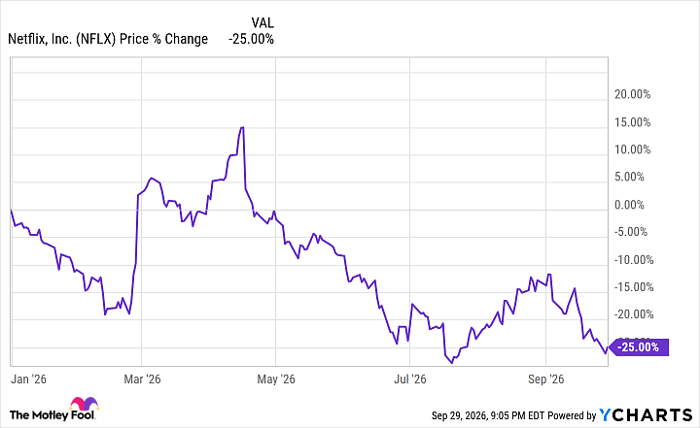
NFLX data by YCharts
Netflix even got a $2.8 billion breakup fee as part of WBD's decision to sell to Paramount instead, and the stock has still gotten crushed this year. Investors seem to think the company has lost its mojo and that the buzz is gone from its programming. Streaming is essentially turning into a commodity business, as they see it.
While plenty of investors have sold the stock this year due to those recent woes, I believe that's a mistake. Below, I'll explain why, and as a longtime Netflix shareholder, what it would take for me to sell my shares.

Image source: Getty Images.
Netflix is still a solid business
Just from reading the bearish headlines, you might get the sense that Netflix is now in decline. However, that's far from the case. In its second quarter, revenue grew 13.4% to $12.6 billion, and its operating margin was 33.4%. While that was down slightly from the 34.1% clip from the quarter a year ago, it still shows Netflix is pocketing 1 out of every 3 dollars it receives before interest and taxes, a profit margin almost any company would be happy with.
That margin is a credit to the strength of the company's business model. It's scaled its subscription business to more than 300 million subscribers worldwide and now has a robust advertising business to go with it. Netflix's operating margin should continue to expand as it adds subscribers since the incremental costs to distribute content to new subscribers are basically nothing, though that subscriber pays the same as all the other ones.
Netflix's third-quarter guidance calls for 11.7% growth in revenue to $12.9 billion and an operating margin of 33.2%, showing the company is still on the right track.
About the weakness in engagement
Netflix's hours watched rose 2% in the first half of 2026, which was an improvement from 1.5% growth in 2025. It's unclear if per-subscriber engagement is declining as the company no longer reports subscriber numbers. However, Wall Street analysts have predicted that per-subscriber engagement will fall in the second half of the year, meaning its customers are losing interest in the service.
While that's a troubling sign, it's worth remembering that engagement for a streaming service is variable, and that a couple of original hits and a stronger content slate may be all it needs to reaccelerate subscriber growth. In its most recent shareholder letter, Netflix acknowledged, "We know not all hours are equal," explaining that quality and variety are key components to engagement, in addition to quantity.
Netflix's efforts to add more live sports, for example, could do a lot to add and retain subscribers, even if it doesn't add up to that many hours.
What would make me sell Netflix
Excluding the breakup fee it got from Warner Bros. Discovery, Netflix trades at a price-to-earnings ratio of 26, about even with the S&P 500. That looks like a fair price to pay for a company growing its top line by double digits with superior profit margins.
For me to sell Netflix stock, its growth would have to slow meaningfully to mid-single-digits or below for several quarters. At this point, I believe the company is closer to an entertainment utility than a traditional consumer discretionary stock, and I think the business model can overcome even weak engagement. Netflix might not be Procter & Gamble, but even P&G is likely envious of Netflix's recurring revenue model, as its subscriptions help lock in customers.
Additionally, Netflix offers good value, and at-home entertainment tends to be recession-proof. I think it would take years of poor content choices to do lasting damage to the brand.
Overall, with its current growth rate and profit margin, Netflix looks closer to a buy than a sell at this price. The company has overcome plenty of obstacles before, and I expect to do the same with this one.
Should you buy stock in Netflix right now?
Before you buy stock in Netflix, consider this:
The Motley Fool Stock Advisor analyst team just identified what they believe are the 10 best stocks for investors to buy now… and Netflix wasn’t one of them. The 10 stocks that made the cut could produce monster returns in the coming years.
Consider when Netflix made this list on December 17, 2004... if you invested $1,000 at the time of our recommendation, you’d have $373,352!* Or when Nvidia made this list on April 15, 2005... if you invested $1,000 at the time of our recommendation, you’d have $1,406,241!*
Now, it’s worth noting Stock Advisor’s total average return is 933% — a market-crushing outperformance compared to 212% for the S&P 500. Don't miss the latest top 10 list, available with Stock Advisor, and join an investing community built by individual investors for individual investors.
See the 10 stocks »
*Stock Advisor returns as of September 29, 2026.
Jeremy Bowman has positions in Netflix. The Motley Fool has positions in and recommends Netflix and Warner Bros. Discovery. The Motley Fool has a disclosure policy.
Recommended Articles


