


If I Could Tell Every New Investor Just 1 Thing About the Stock Market Right Now, It's This
Key Points
Thanks to my dad, I've been investing since I was a teenager.
Over the decades I've been investing, I have seen both good times and very, very bad times.
- 10 stocks we like better than Vanguard S&P 500 ETF ›
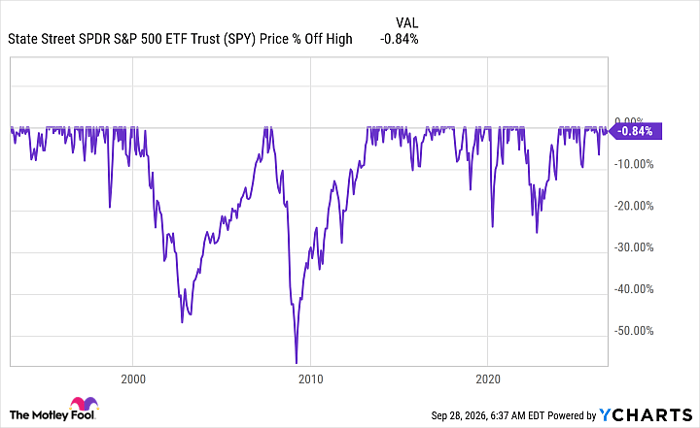
You can't explain to someone who doesn't have a child what it is like to have a child. You have to experience it for yourself to understand the joy (and frustration) of being a parent. The same is true of a bear market; until you live through a prolonged and deep downturn, you just can't understand the emotions you will live through. I know those emotions because I lived through the dot-com crash and the Great Recession. If I could tell every new investor just one thing right now, it would be "this too shall pass."
What goes up... comes back down
The reason I'd go with "this too shall pass" is that it applies to both bull and bear markets. Right now, the market is near all-time highs despite a host of very real risks, including geopolitical conflicts, inflation, and elevated debt levels. I didn't make that list up; Jamie Dimon, the CEO of JPMorgan Chase (NYSE: JPM), highlighted them during his discussion of the company's second-quarter earnings. Basically, I'm not going out on a limb when I suggest that investors should be worried that the current bull market is likely to end sooner rather than later.
Missed AI’s "Act 1"? Act 2 Could Be 15x Bigger. Most investors think they missed the AI boat because they didn't buy Nvidia in 2005. But according to our analysts, we’re only at the end of "Act 1"—the R&D phase. "Act 2" is the global rollout. Continue »

Image source: Getty Images.
And when the next bear market arrives, it could be pretty brutal. Why? Because the S&P 500 index (SNPINDEX: ^GSPC) is at valuation levels that it last visited ahead of the dot-com bubble bursting. If history is any guide, you should be prepared for as much as a 50% drop in the S&P 500 and likely even more for the tech-heavy Nasdaq.
SPY data by YCharts
But even then, there's a silver lining. Because, like all bull markets, bear markets eventually end, too. And history shows that the market not only recovers from bear markets, but goes on to reach even higher highs. This is why buying and holding, even if you just own an S&P 500 index fund like Vanguard S&P 500 ETF (NYSEMKT: VOO), can be such a powerful investment plan.
Think long-term and be prepared for short-term swings
The real goal is to have a plan and stick to it, understanding that the market will go both up and down over time, sometimes in dramatic and emotionally challenging ways. If you understand that the market swings from bull to bear, and back again, you can create an investment plan that will allow you to stick it out through the swings. For me, that's dividend investing with a value bias. For others, it is as simple as just buying the S&P 500. Whatever you do, however, remember that this too shall pass because no market in history has gone up or down forever.
Should you buy stock in Vanguard S&P 500 ETF right now?
Before you buy stock in Vanguard S&P 500 ETF, consider this:
The Motley Fool Stock Advisor analyst team just identified what they believe are the 10 best stocks for investors to buy now… and Vanguard S&P 500 ETF wasn’t one of them. The 10 stocks that made the cut could produce monster returns in the coming years.
Consider when Netflix made this list on December 17, 2004... if you invested $1,000 at the time of our recommendation, you’d have $373,352!* Or when Nvidia made this list on April 15, 2005... if you invested $1,000 at the time of our recommendation, you’d have $1,406,241!*
Now, it’s worth noting Stock Advisor’s total average return is 933% — a market-crushing outperformance compared to 212% for the S&P 500. Don't miss the latest top 10 list, available with Stock Advisor, and join an investing community built by individual investors for individual investors.
See the 10 stocks »
*Stock Advisor returns as of September 29, 2026.
JPMorgan Chase is an advertising partner of Motley Fool Money. Reuben Gregg Brewer has no position in any of the stocks mentioned. The Motley Fool has positions in and recommends JPMorgan Chase and Vanguard S&P 500 ETF. The Motley Fool has a disclosure policy.
Recommended Articles


