


AT&T vs T-Mobile: What's the Better Dividend Stock to Buy Right Now?
Key Points
Both AT&T and T-Mobile offer yields that are far higher than the S&P 500 average.
These stocks are both down more than 10% in the past year, making them more attractive value buys.
Their recent quarterly results showcased solid growth in revenue and free cash flow.
- 10 stocks we like better than AT&T ›
Telecom stocks can be attractive options for multiple reasons. Their businesses are normally fairly stable, as they provide essential services, and thus, their financial performance will normally be fairly consistent from one period to the next. That stability can also make them excellent dividend investments, as consistently strong financial results can enable a business to reliably make regular payouts to its shareholders.
Two top telecom stocks that may be particularly enticing options for investors to consider these days are AT&T (NYSE:T) and T-Mobile US (NASDAQ:TMUS). They've both been struggling over the past year, but they can be attractive value-based investments that also can generate plenty of dividend income. Which dividend stock is the better buy today?
Missed Nvidia in 2009? This Rare Signal Is Flashing Again. In 2009, a "Double Down" signal flashed for a little-known chipmaker called Nvidia. For the first time in years, that same "Total Conviction" signal is flashing for a company 1/100th the size of Nvidia. Continue »

Image source: Getty Images.
AT&T offers a higher yield, but T-Mobile has recently raised its payout
A big benefit of buying AT&T stock right now is that at 4.5%, its yield is fairly high, well above the S&P 500 average of 1.1%. T-Mobile also offers an above-average yield, but at 2.8%, it's a fair bit lower than AT&T's.
However, unlike its rival, T-Mobile has been raising its dividend recently, and if that trend continues, the gap in yields may shrink over time. A growing dividend is also an encouraging sign for investors that the business is doing well. Last week, T-Mobile announced it would be raising its dividend by 15% -- a significant increase, as oftentimes dividend stocks announce more modest bumps to their payouts.
Meanwhile, AT&T hasn't increased its dividend since 2020.
Both businesses have been growing steadily
AT&T last reported earnings in July, and its revenue rose 2.3% for the second quarter, totaling $31.6 billion. Its free cash flow was also encouraging, as it totaled $4.7 billion for the period, up from $4.4 billion a year earlier. For dividend investors, these are the types of steady and solid numbers that highlight the overall stability of the business, and why the dividend looks safe. AT&T has paid out $8 billion in cash dividends over the course of an entire year, so if it's generating more than $4 billion on a quarterly basis, its dividend looks to be in solid shape.
T-Mobile also reported earnings in July, and its growth rate was a bit better, coming in at 7.9%, with revenue totaling $22.8 billion for the period. While its earnings were nearly unchanged, the company's adjusted free cash flow rose by 4% to $4.8 billion. Over the past four quarters, T-Mobile has paid out about $4.3 billion in dividends. Even with the hefty increase to its payout recently, its dividend also looks to be incredibly safe.
Which stock is the better value buy?
Telecom stocks haven't been hot buys over the past year, as AT&T has declined by 12% and T-Mobile has plummeted by around 30%. Worries about rising interest rates and about Space Exploration Technologies Corp, better known as SpaceX, disrupting the sector have weighed on these stocks.
T-Mobile has been generating more growth and thus commands a bit of a higher earnings multiple. But it's still fairly cheap. Currently, it's trading at a forward price-to-earnings multiple (based on analyst estimates) of just under 12. By comparison, AT&T stock trades at a slightly lower forward P/E multiple of 10.
AT&T, thus, is slightly cheaper, but it's also growing at a more modest pace.
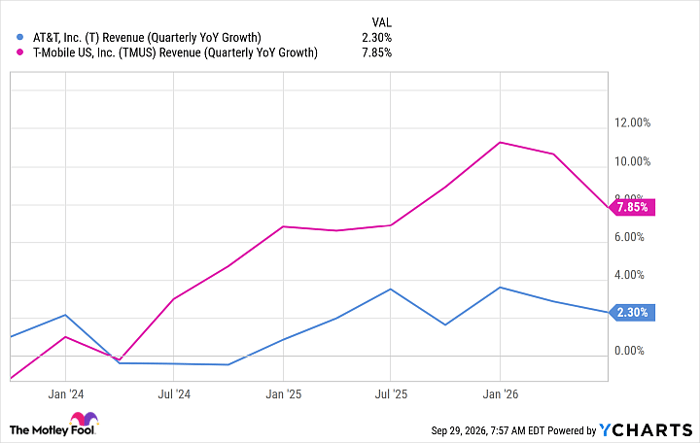
T Revenue (Quarterly YoY Growth) data by YCharts
Why I’d go with T-Mobile
Both AT&T and T-Mobile can make for solid income investments to buy today. However, I'd give the edge to T-Mobile. It's growing at a better rate, and a higher valuation is very well justifiable in that case.
While T-Mobile’s yield is lower than AT&T's, the gap is likely to shrink if it continues to increase its dividend, as it might given its strong free cash flow. Its decline has been more significant over the past year, but it was also trading at a far higher premium. From here on out, I believe it's in a good position to outperform AT&T.
Should you buy stock in AT&T right now?
Before you buy stock in AT&T, consider this:
The Motley Fool Stock Advisor analyst team just identified what they believe are the 10 best stocks for investors to buy now… and AT&T wasn’t one of them. The 10 stocks that made the cut could produce monster returns in the coming years.
Consider when Netflix made this list on December 17, 2004... if you invested $1,000 at the time of our recommendation, you’d have $383,680!* Or when Nvidia made this list on April 15, 2005... if you invested $1,000 at the time of our recommendation, you’d have $1,382,954!*
Now, it’s worth noting Stock Advisor’s total average return is 937% — a market-crushing outperformance compared to 214% for the S&P 500. Don't miss the latest top 10 list, available with Stock Advisor, and join an investing community built by individual investors for individual investors.
See the 10 stocks »
*Stock Advisor returns as of September 29, 2026.
David Jagielski, CPA has no position in any of the stocks mentioned. The Motley Fool recommends T-Mobile US. The Motley Fool has a disclosure policy.
Recommended Articles


