

USD/JPY (USDJPY) Moved Sharply on Sep 30: Are Central Bank Expectations Shifting?

Source Tradingkey

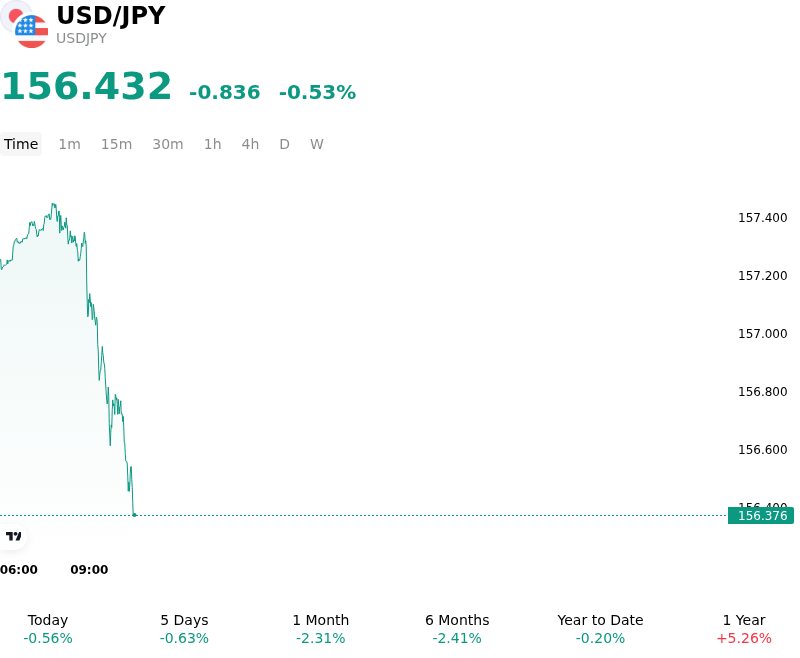
USD/JPY (USDJPY) is down 0.53% at Sep 30 22:30(ET), now at $156.432, with a 7-day down of 1.17%.
SummaryOverview

What is driving USD/JPY (USDJPY)’s stock price down today?

The decline in USD/JPY was primarily driven by heightened intervention risk and escalating verbal warnings from Japanese monetary authorities, supported by explicit policy alignment with U.S. financial officials. Joint messaging from Japan’s Ministry of Finance and the U.S. Treasury highlighting shared concerns regarding the undervaluation of the Japanese yen significantly raised the perceived probability of official currency intervention. Market participants reevaluated downside risks for the pair, triggering long-dollar unwinding and protective yen buying.

Underpinning the exchange-rate movement is a broader structural repricing of policy expectations between the Bank of Japan and the Federal Reserve. Institutional investors continue to discount a narrowing U.S.-Japan interest-rate differential, reinforced by the Bank of Japan's tightening trajectory. Increased domestic bond market stability and resilient demand in Japanese government bond auctions have further bolstered confidence in Japanese yields, reducing the relative yield advantage previously favoring the U.S. dollar and disincentivizing carry-trade allocations.

Additionally, month-end and quarter-end institutional portfolio rebalancing flows amplified downward momentum in the spot rate. Global asset managers adjusted capital allocations to hedge foreign currency exposure amidst shifting risk sentiment, accelerating short-term dollar liquidation. While broader macroeconomic fundamentals and U.S. yield dynamics continue to offer underlying support for the dollar, heightened official surveillance and narrowing policy differentials suggest that USD/JPY rallies will remain capped by structural intervention threats in the near term.

Technical Analysis of USD/JPY (USDJPY)

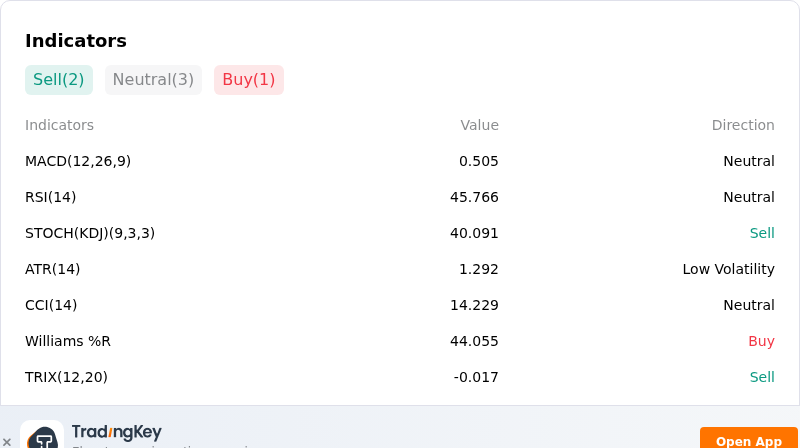
Technically, USD/JPY (USDJPY) shows a MACD (12,26,9) value of 0.505, indicating a neutral signal. The RSI at 45.766 suggests neutral condition and the Williams %R at 44.055 suggests buy condition. Please monitor closely.
IndicatorAnalysis

More details about USD/JPY (USDJPY)

Recent Events and Risks:

  • MoF Foreign Exchange Intervention Threat: Persistent jawboning from Japanese monetary authorities near the 158.00–160.00 psychological threshold, alongside the publication of official Ministry of Finance FX intervention data, creates severe tail risks of unannounced yen-buying interventions that could trigger sharp intraday sell-offs in USD/JPY.
  • JGB Yield Surge and Carry Trade Liquidation: Rapid upward momentum in long-end Japanese Government Bond yields following the Bank of Japan's policy rate hike to 1.25% threatens to narrow the U.S.-Japan yield differential, increasing the vulnerability of crowded USD/JPY carry positions to abrupt liquidation.
  • Quarter-End and Month-End Rebalancing Squeezes: Institutional portfolio rebalancing and corporate hedging flows tied to the September 30 month- and quarter-end close present heightened downside slippage risks and elevated intraday volatility due to fragmented liquidity.
  • U.S. Yield Repricing from Macro Economic Releases: Critical U.S. macroeconomic data releases, including PCE inflation and non-farm payrolls, expose USD/JPY to sudden downside risk if softer-than-expected figures trigger a swift pull-back in benchmark U.S. Treasury yields.
Disclaimer: For information purposes only. Past performance is not indicative of future results.
placeholder
October hike odds climb toward 60% as Goldman and BofA both flip — what Warsh's "dose of accommodation" really changedRate futures now price roughly 55% to 62% for a 25bp hike at the October 27-28 FOMC, up from about 30% before Chair Warsh's post-meeting framing that the Fed is merely "removing some accommodation." Goldman Sachs has added an October hike to its forecast and Bank of America now sees moves in both October and December. Here is the repricing, the language behind it, and the two data points that decide it.
Author  Irene Q.
Sep 23, Wed
Rate futures now price roughly 55% to 62% for a 25bp hike at the October 27-28 FOMC, up from about 30% before Chair Warsh's post-meeting framing that the Fed is merely "removing some accommodation." Goldman Sachs has added an October hike to its forecast and Bank of America now sees moves in both October and December. Here is the repricing, the language behind it, and the two data points that decide it.
placeholder
Four jobs reports in five days: what JOLTS, ADP, claims and the September payrolls mean for the October Fed decisionThe US labour market faces its densest data week of the month. JOLTS job openings land Tuesday (7.2 million expected), ADP on Wednesday (70,000 expected), initial claims on Thursday and the September non-farm payrolls on Friday (100,000 expected, down from 162,000). Markets price a 64%-70% chance of another quarter-point Fed hike on October 28. The dollar index sits at 100.77 and the S&P 500 at 7,729.8.
Author  Mitrade
Sep 28, Mon
The US labour market faces its densest data week of the month. JOLTS job openings land Tuesday (7.2 million expected), ADP on Wednesday (70,000 expected), initial claims on Thursday and the September non-farm payrolls on Friday (100,000 expected, down from 162,000). Markets price a 64%-70% chance of another quarter-point Fed hike on October 28. The dollar index sits at 100.77 and the S&P 500 at 7,729.8.
placeholder
Nvidia's $150 billion buyback landed — and the AI sector fell anyway. That's the signal worth tradingNvidia closed up 1.68% at $228.86 on 28 September after announcing a $150 billion share repurchase authorisation, the largest single corporate buyback on record, while the rest of the AI complex sold off: AMD -3.6%, Micron -2.6%, Meta -4.8% and the Philadelphia Semiconductor Index -1.61%. The divergence is not noise. Capital is rotating toward cash-flow certainty, not abandoning the AI theme. With Micron reporting after the close on 30 September, here is what the split means.
Author  Irene Q.
Sep 29, Tue
Nvidia closed up 1.68% at $228.86 on 28 September after announcing a $150 billion share repurchase authorisation, the largest single corporate buyback on record, while the rest of the AI complex sold off: AMD -3.6%, Micron -2.6%, Meta -4.8% and the Philadelphia Semiconductor Index -1.61%. The divergence is not noise. Capital is rotating toward cash-flow certainty, not abandoning the AI theme. With Micron reporting after the close on 30 September, here is what the split means.
placeholder
【Daily Brief】The dollar ground higher for six days — and the AUD fell 2% in the very week the RBA hiked to a 15-year highThe dollar index held above 101 while the Australian dollar slid to a two-month low of 0.6976, a 2.02% six-session loss, even though the RBA raised rates to 4.60% and Australian CPI printed 4.0%. The yen is the only major currency gaining, ahead of Japan's monthly intervention tally at 7pm JST.
Author  Irene Q.
18 hours ago
The dollar index held above 101 while the Australian dollar slid to a two-month low of 0.6976, a 2.02% six-session loss, even though the RBA raised rates to 4.60% and Australian CPI printed 4.0%. The yen is the only major currency gaining, ahead of Japan's monthly intervention tally at 7pm JST.
placeholder
【Daily Brief】30-year Treasury tops 5.59%, S&P 500 slips to 7,670 and gold holds $4,180 — PCE lands tonightThe 30-year Treasury yield closed at 5.59%, its highest since June 2002, and the Dow fell 131.59 points to 51,349.92. US consumer confidence dropped to 81.9, a 12-year low, and JOLTS job openings fell to 7.1 million. August PCE and Q3 GDP both land at 8:30am ET tonight.
Author  Suzie
18 hours ago
The 30-year Treasury yield closed at 5.59%, its highest since June 2002, and the Dow fell 131.59 points to 51,349.92. US consumer confidence dropped to 81.9, a 12-year low, and JOLTS job openings fell to 7.1 million. August PCE and Q3 GDP both land at 8:30am ET tonight.
goTop
quote