


Not Palantir. Not Micron. The $325 Billion Nvidia Partner That Jim Cramer Just Called a "Must Buy" Stock
Key Points
Jensen Huang says cybersecurity is the next major use case for artificial intelligence.
Cybersecurity is one of the more compute-intensive uses of AI because the inference workloads must run continuously.
CrowdStrike brings its powerful Falcon platform to the partnership, while Nvidia brings accelerated computing and its Nemotron family of models.
- 10 stocks we like better than CrowdStrike ›
Investors have spent the last two years defaulting to the same stocks as proxies for the artificial intelligence (AI) trend. Palantir Technologies (NASDAQ: PLTR) has emerged as a dominant force in enterprise software, while memory names like Micron Technology (NASDAQ: MU) have come to represent the ongoing infrastructure build-out.
The more precise setup may be a bit narrower. At a Goldman Sachs technology conference in San Francisco, Nvidia (NASDAQ: NVDA) CEO Jensen Huang asserted that cybersecurity is the next major use case for AI, and identified CrowdStrike (NASDAQ: CRWD) as the chipmaker's primary cybersecurity partner. Shortly afterward, Jim Cramer called CrowdStrike a "must buy" stock after its CEO, George Kurtz, detailed how autonomous attacks are now moving at machine speed, underscoring the importance of protecting against AI-driven cyberattacks.
Missed AI’s "Act 1"? Act 2 Could Be 15x Bigger. Most investors think they missed the AI boat because they didn't buy Nvidia in 2005. But according to our analysts, we’re only at the end of "Act 1"—the R&D phase. "Act 2" is the global rollout. Continue »
The question is not whether AI will be used across more software platforms. It's whether defensive systems can operate on the same cycle time as offensive threat automation, and how well CrowdStrike is truly positioned to capture a share of the market for that defense across the AI value chain.

Image source: Getty Images.
Huang's demand thesis
Early on in the AI revolution, generative models learned how to automate software creation, given how easily the output can be tested: Programs either run or they crash. The next logical capability to explore was discovering the defects in the software these models create. From a commercial perspective, the larger opportunity will involve integrating continuous protection within production environments from hostile actors, because AI-generated code and AI-directed intrusions shrink the time between malicious code's deployment and its exploitation.
For cybersecurity specifically, the AI workloads don't abate after a model is trained. Agents that monitor endpoints, identities, cloud platforms, and other agents must remain active around the clock. Huang describes this necessity as one of the more compute-intensive uses of AI because the inference workloads must run continuously. For Nvidia, this means cybersecurity is a lucrative opportunity for recurring GPU and model demand. For CrowdStrike, AI offers a unique chance to push its existing customer relationships toward that demand.
How do CrowdStrike and Nvidia work together?
CrowdStrike contributes high-volume telemetry from its Falcon platform and the underlying threat intelligence produced by that data. Meanwhile, Nvidia brings accelerated computing and its open-source Nemotron family of models, which are used to train and run specialized defensive systems.
The most visible product of this partnership so far is SafeMind, an agentic AI system in which one side maps the attack path while the other side generates detections. The output is designed to land back inside Falcon rather than sit externally in a separate assistant.
The division of labor here is complementary, where CrowdStrike owns the enterprise security graph and Nvidia supplies the model foundation. Together, CrowdStrike and Nvidia can attach proprietary defensive data to compute to act on that data at machine speed.
Is CrowdStrike stock a buy?
CrowdStrike estimates that its total addressable market (TAM) at the moment is $149 billion. By 2030, as AI becomes further embedded across the cybersecurity value chain, the company expects its TAM to expand to $325 billion. CrowdStrike already sells Falcon across endpoint, cloud, identity, analytics, and threat intelligence environments. That architecture allows the company to sell protection services at the foundation layer while partners like Nvidia are now propelling CrowdStrike toward AI factories and cloud platforms where frontier models are trained and served.
In my view, CrowdStrike is worthy of being a core holding in an AI-themed stock portfolio. Huang's endorsement, the SafeMind launch, and its expanding addressable market all support the bull case that the company can continue acquiring incremental market share so long as defending against autonomous cyberattacks remains a budget priority for enterprises.
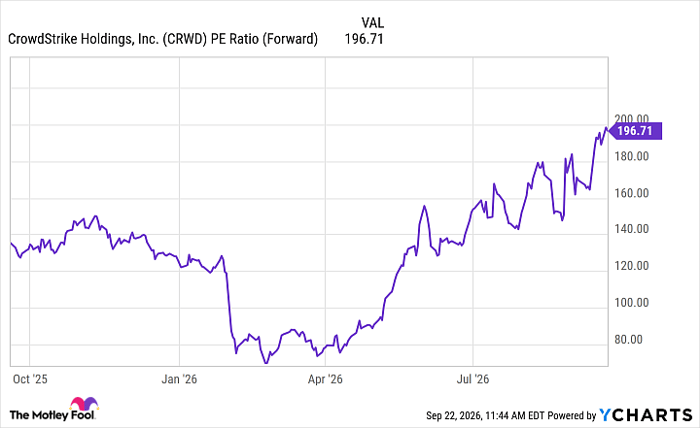
CRWD PE Ratio (Forward) data by YCharts.
To be clear, this is not the same as suggesting you buy CrowdStrike at any price just because Jim Cramer says it's a stock that growth investors should own. The company's momentum and valuation expansion clearly display sentiment that is pricing in a good deal of expected durable growth and platform expansion. With that in mind, I would suggest that investors who do not own this stock should accumulate shares on pullbacks, not during the sessions after a viral call on social media.
Should you buy stock in CrowdStrike right now?
Before you buy stock in CrowdStrike, consider this:
The Motley Fool Stock Advisor analyst team just identified what they believe are the 10 best stocks for investors to buy now… and CrowdStrike wasn’t one of them. The 10 stocks that made the cut could produce monster returns in the coming years.
Consider when Netflix made this list on December 17, 2004... if you invested $1,000 at the time of our recommendation, you’d have $389,154!* Or when Nvidia made this list on April 15, 2005... if you invested $1,000 at the time of our recommendation, you’d have $1,406,303!*
Now, it’s worth noting Stock Advisor’s total average return is 949% — a market-crushing outperformance compared to 214% for the S&P 500. Don't miss the latest top 10 list, available with Stock Advisor, and join an investing community built by individual investors for individual investors.
See the 10 stocks »
*Stock Advisor returns as of September 23, 2026.
Adam Spatacco has positions in Nvidia and Palantir Technologies. The Motley Fool has positions in and recommends CrowdStrike, Micron Technology, Nvidia, and Palantir Technologies. The Motley Fool has a disclosure policy.
Recommended Articles


