


The 3 Charts That Show Rivian Could Soar
Key Points
Rivian exited the second quarter with much more liquidity than investors might realize.
When it comes to shareholder dilution, Rivian has avoided rival Lucid's levels of dilution.
Rivian has also made substantial and consistent progress in gross profitability.
- 10 stocks we like better than Rivian Automotive ›
After a rather quiet and unremarkable 2025, Rivian Automotive (NASDAQ: RIVN) investors have plenty to be excited about. The R2, the company's highly anticipated mass-market vehicle launch, continues to accelerate its production and deliveries. Rivian launched its R2 Performance variant just this spring and will begin shipping a lower-priced R2 Premium late this year before finally rolling out the R2 Standard version in the first half of 2027.
The strategy will deliver higher-margin variants first, before the most affordable versions have a larger impact on total delivery volume -- it's a big year. Investors considering a long-term investment in Rivian must weigh the risk, but here are three must-see graphs that bode well for the company's long-term future and near-term investor interest.
Missed AI’s "Act 1"? Act 2 Could Be 15x Bigger. Most investors think they missed the AI boat because they didn't buy Nvidia in 2005. But according to our analysts, we’re only at the end of "Act 1"—the R&D phase. "Act 2" is the global rollout. Continue »

Image source: Rivian.
Hidden liquidity
One of the most important things to dig into when considering young companies is the runway of cash, as these companies are often bleeding cash and will need multiple capital raises that could come at shareholders' expense in the form of dilution. Rivian has done an excellent job managing its cash pile from its large IPO and has leveraged its software and in-house technology to create a joint venture with Volkswagen that has provided capital and loans and is splitting costs for project development.
With Rivian, investors are a bit lucky that it has resisted excessive shareholder dilution, and it also boasts transparent liquidity going forward. Rivian ended the second quarter with about $5.3 billion in cash and cash equivalents (not including a revolving credit facility), but there's more capital on the way without shareholder dilution.
All in all, when considering further investment from Uber Technologies coming in the future, Rivian's renegotiated Department of Energy loan, and its credit facility, the automaker has closer to $14 billion in liquidity to fund its operations without diluting shareholders.
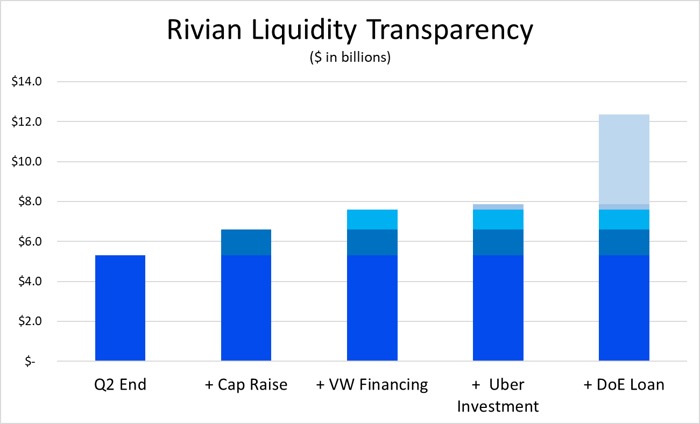
Data source: Rivian. Chart by author.
This is a great segue into the next must-see graph regarding shareholder dilution.
Night and day
As previously mentioned, Rivian has done an excellent job avoiding shareholder dilution, and it becomes more clear when comparing the young electric vehicle (EV) maker to rival Lucid Group (NASDAQ: LCID). Lucid had a smaller cash pile following going public via SPAC merger, and has had more difficulty reducing costs, building scale, and executing launches. It continues to dilute shareholders more often than Rivian. When viewing both automakers' shares outstanding long-term, you can see the vast difference.
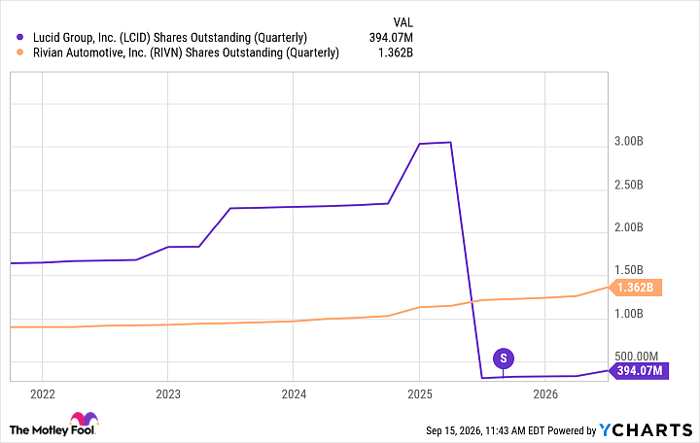
LCID Shares Outstanding (Quarterly) data by YCharts
Let's break this graph down. You can see Lucid's pool of shares outstanding consistently climb higher, while Rivian's remained nearly the same. First, you'll likely notice the drastic and abrupt change in Lucid's shares outstanding. That's because the automaker had shed so much value since its IPO the stock price was in the low single digits. Lucid then executed a 1-for-10 reverse stock split, which takes 10 shares and turns it into 1, and boosted its stock price at the time from about $2 to near $20. The change enables more institutional investors and funds to own the stock and lowers the possibility of Lucid being removed from Nasdaq exchange in the near term.
Shareholder dilution 101 tells you that as a company issues new shares, yet has the same earnings power as it did prior, the earnings are simply split among more shares and the value for individual investors declines. Buying shares of a young company can often come with the drawback of being diluted until the business is self-sustaining. Not only has Rivian proven capable of raising capital without diluting shareholders -- by taking loans from Volkswagen, investment from companies like Uber Technologies, or drawing on its credit facility, among others -- it has a much longer runway of cash to continue avoiding shareholder dilution than rival example Lucid.
Last, but not least
Another critical factor in a young company such as Rivian becoming a valuable long-term investment is its ability to reach profitability and become self-sufficient as a business. The first step for achieving this is gross profitability, which is simply revenue minus the cost of goods sold. As companies slowly build volume and scale, reduce costs, and improve production efficiency, they should consistently make progress on gross profitability. Rivian checks this box, while Lucid has struggled.
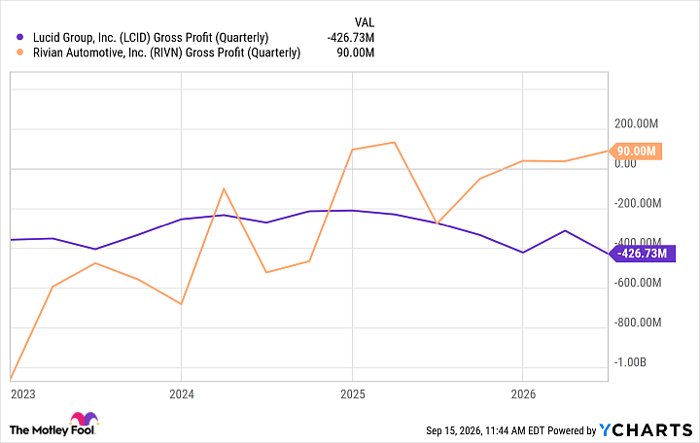
LCID Gross Profit (Quarterly) data by YCharts
Rivian has improved both segments that feed into its gross profitability: automotive, and software and services. Currently, Rivian's software and services segment is benefiting from Volkswagen payments to develop vehicles and use Rivian's software stack in its vehicles. Those payments boosted Rivian's gross profitability into positive territory for the full year 2025, and while automotive is still reporting a negative gross profit, it's improving quickly and is poised to contribute to gross profits soon with the R2 drastically improving scale over the coming year.
The last word
What this all means for potential Rivian investors is simple: While Rivian is a young EV maker that comes with ample risk, especially as the U.S. EV market is developing more slowly than anticipated, it has a long runway of liquidity transparency, a history of not diluting its shareholders, and has made consistent progress on gross profitability. All of these factors are incredibly important and favorable for investors.
Should you buy stock in Rivian Automotive right now?
Before you buy stock in Rivian Automotive, consider this:
The Motley Fool Stock Advisor analyst team just identified what they believe are the 10 best stocks for investors to buy now… and Rivian Automotive wasn’t one of them. The 10 stocks that made the cut could produce monster returns in the coming years.
Consider when Netflix made this list on December 17, 2004... if you invested $1,000 at the time of our recommendation, you’d have $412,074!* Or when Nvidia made this list on April 15, 2005... if you invested $1,000 at the time of our recommendation, you’d have $1,314,319!*
Now, it’s worth noting Stock Advisor’s total average return is 932% — a market-crushing outperformance compared to 209% for the S&P 500. Don't miss the latest top 10 list, available with Stock Advisor, and join an investing community built by individual investors for individual investors.
See the 10 stocks »
*Stock Advisor returns as of September 17, 2026.
Daniel Miller has no position in any of the stocks mentioned. The Motley Fool recommends Uber Technologies. The Motley Fool has a disclosure policy.
Recommended Articles


