


Amazon vs. Microsoft: Which Cloud Computing Behemoth Is the Better Artificial Intelligence (AI) Buy Today?
Key Points
Microsoft was the fastest-growing company up until the most recent quarter.
Valuing these two stocks is difficult.
- 10 stocks we like better than Amazon ›
Amazon (NASDAQ: AMZN) and Microsoft (NASDAQ: MSFT) are two of the biggest names in artificial intelligence (AI). Both of these companies have taken a similar path, choosing to integrate AI into their own products but utilize other providers' models instead of creating their own. They each also have a thriving cloud computing business, benefiting from rising AI workloads.
But which one of these two makes for the better buy? Let's take a look at the fourth- and fifth-largest companies in the world, and see which makes the most sense for your investment dollars.
Missed Nvidia in 2009? This Rare Signal Is Flashing Again. In 2009, a "Double Down" signal flashed for a little-known chipmaker called Nvidia. For the first time in years, that same "Total Conviction" signal is flashing for a company 1/100th the size of Nvidia. Continue »

Image source: Getty Images.
Both companies have a wide-ranging business
Microsoft's business is quite broad, ranging from business productivity software to gaming hardware and software to cloud computing. Microsoft has an iron grip in many of the industries that it's in and a massive number of clients that cannot afford to cut Microsoft's software even if times get bad. This makes Microsoft a pretty safe business to invest in, as it will likely be OK regardless of economic conditions.
Amazon is in a similar boat, as its commerce business has become the most popular online shopping destination, and it has countless devoted clients that utilize its services every day.
Both Microsoft and Amazon have rock-solid cloud computing businesses too that are thriving in the AI build-out, and each of them is spending hundreds of billions of dollars to increase capacity to meet demand.
While each business has its ups and downs, nothing points to Microsoft's or Amazon's base business being better than the other. As a result, I'm scoring this category as a tie.
Winner: Tie.
Both companies are growing at a similar pace
From a revenue growth standpoint, Microsoft has long enjoyed a lead over Amazon, but that changed during the most recent quarter.
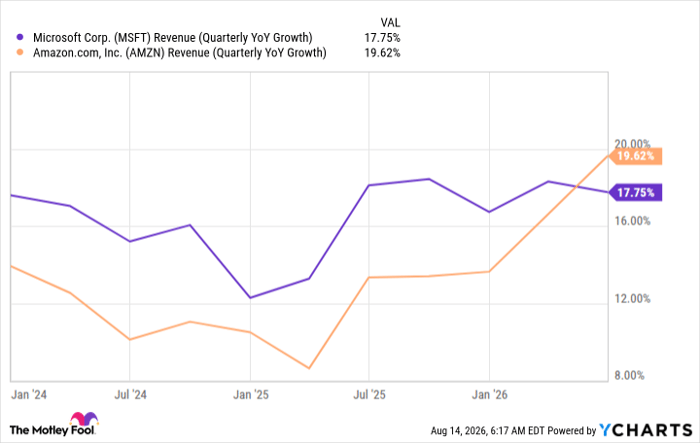
MSFT Revenue (Quarterly YoY Growth) data by YCharts.
This boost is primarily because Amazon's cloud computing division, Amazon Web Services (AWS), is starting to really accelerate its growth, posting a 37% pace in the third quarter after several years of delivering growth in the 20% or so range. Considering we've just seen the tip of the iceberg in AI spending and cloud computing growth due to that spending, I wouldn't be surprised if Amazon maintains that lead moving forward.
Another item where Amazon has the edge is operating profit growth. Each company has significant investments in private AI companies (Microsoft is heavily invested in OpenAI, and Amazon is invested in Anthropic), which skews earnings results. Instead, I'll use operating profit growth, which doesn't include these gains. Amazon's lead starts to really open up here, mainly because of cloud computing's higher-margin profile than its base commerce business.
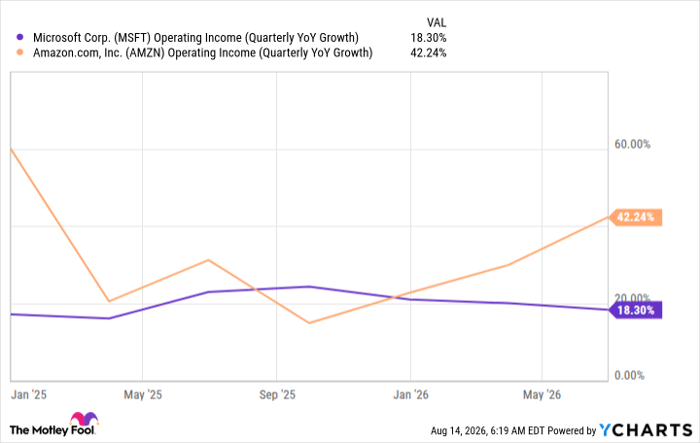
MSFT Operating Income (Quarterly YoY Growth) data by YCharts
This cements Amazon's win in the growth category.
Winner: Amazon.
Microsoft is the cheaper stock by one measure
I'll value the stock using their operating profits for the same reason that I looked at operating income growth versus earnings-per-share growth.
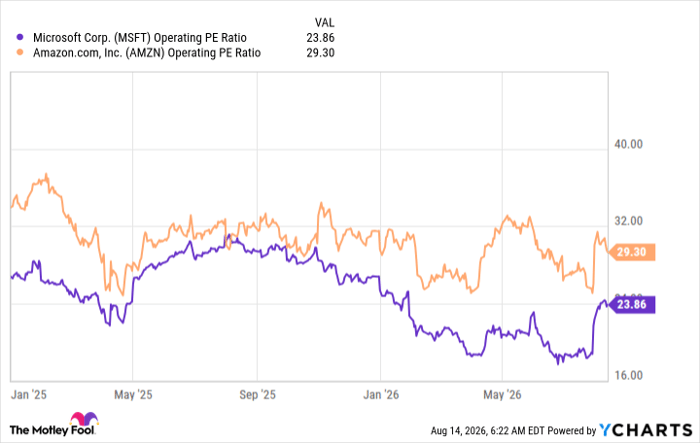
MSFT Operating PE Ratio data by YCharts.
Microsoft stock is far cheaper from this perspective, but that makes sense considering Amazon's growth rate, which deserves a premium.
If we look at forward earnings projections, that filters out some of the growth associated with past gains from rising investments. From this perspective, Amazon actually looks cheaper.
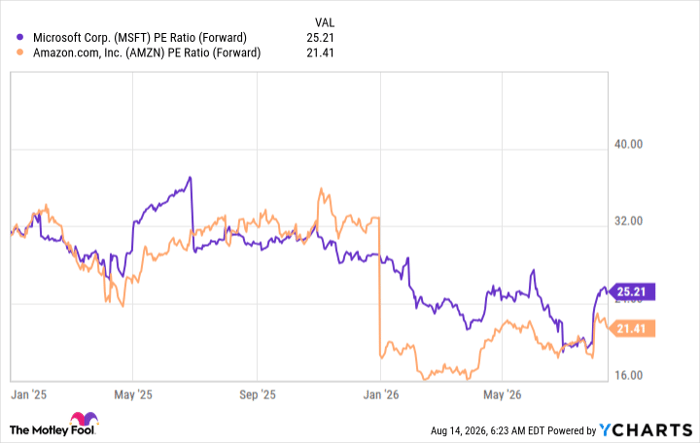
MSFT PE Ratio (Forward) data by YCharts.
Amazon's superior profit growth rate keeps pushing it to the top, so I think it's pretty easy to declare Amazon the winner both in this category and overall.
Winner: Amazon.
Does that mean you need to go out and sell all of your Microsoft shares? Absolutely not. I think Microsoft is still a great investment with plenty of upside. However, with AWS set to grow much faster than it has in the past, Amazon looks like it has more upside in the near term.
Should you buy stock in Amazon right now?
Before you buy stock in Amazon, consider this:
The Motley Fool Stock Advisor analyst team just identified what they believe are the 10 best stocks for investors to buy now… and Amazon wasn’t one of them. The 10 stocks that made the cut could produce monster returns in the coming years.
Consider when Netflix made this list on December 17, 2004... if you invested $1,000 at the time of our recommendation, you’d have $421,511!* Or when Nvidia made this list on April 15, 2005... if you invested $1,000 at the time of our recommendation, you’d have $1,381,960!*
Now, it’s worth noting Stock Advisor’s total average return is 981% — a market-crushing outperformance compared to 216% for the S&P 500. Don't miss the latest top 10 list, available with Stock Advisor, and join an investing community built by individual investors for individual investors.
See the 10 stocks »
*Stock Advisor returns as of August 16, 2026.
Keithen Drury has positions in Amazon and Microsoft. The Motley Fool has positions in and recommends Amazon and Microsoft. The Motley Fool has a disclosure policy.
Recommended Articles


