


Today’s Market Recap: Dow and S&P 500 Hit Fresh Record Highs, Tech Stocks Lead Gains, Palantir Surges 29%, ARM Rises Over 17%


Tracking the Market Trend
TradingKey - Global risk appetite rebounded significantly, with major asset classes strengthening in tandem. Driving factors included the decline in risk premiums following the easing of U.S.-Iran geopolitical tensions, cooling inflation expectations, and the continued strengthening of the AI capital return narrative, supported by earnings from tech giants.
All three major U.S. stock indices rose. At the close, the Dow Jones Industrial Average gained 1.71% to 54,084.99 points; the Nasdaq Composite rose 2.59% to 26,584.99 points; and the S&P 500 gained 1.79% to 7,736.52 points.
By sector, technology and semiconductors led the gains, with the Philadelphia Semiconductor Index rising more than 7% in a single day. Among individual stocks, ARM (ARM) surged 17.36%, Intel (INTC) and SanDisk (SNDK) rose more than 10%, and SK Hynix (SKHY) gained more than 8%; Following earnings releases, Palantir (PLTR) surged 29%, while SpaceX (SPCX) fell more than 6% in after-hours trading, and AMD (AMD) dropped more than 8% in after-hours trading.
In the bond market, falling oil prices eased concerns over Fed rate hikes, causing U.S. Treasury yields to decline across the board. The 10-year yield fell 5.08 basis points, and the 2-year yield dropped 4.15 basis points.
In the foreign exchange market, the U.S. Dollar Index remained largely unchanged, while the yen stabilized at elevated levels after several consecutive days of gains, edging down 0.38% during the session.
Precious metals showed mixed performance. Spot gold briefly broke through the $4,100 mark during the session but failed to hold onto its gains, ultimately closing at around $4,070, up about 0.5%. Spot silver rose 2.35%, touching $60 at one point during the session.
Market Headline
The U.S. plans to tighten restrictions on technology exports to China, with optical modules likely to be the next target of these restrictions. According to China News Service, citing sources familiar with the matter, the U.S. government is drafting a ban that would prohibit the import of new models of Chinese optical transceiver modules, with the aim of protecting the critical infrastructure that underpins the development of AI. U.S. officials hope to announce and implement the ban by the end of 2026, though the FCC may still amend or shelve it later. In response, the Chinese Embassy in the U.S. urged the U.S. side to stop smearing Chinese companies and emphasized that it will take all necessary measures to counter any harm to China’s interests.
SpaceX’s first earnings report since its IPO showed revenue up 92%, exceeding expectations, but its stock price fell nearly 9% at one point in after-hours trading. Second-quarter EBITDA nearly tripled year-over-year, exceeding analysts’ expectations by 75%. By business segment, the connectivity business (Starlink) saw revenue rise 66% year-over-year and operating profit increase 79%, with the user base doubling; the space business saw revenue grow 29%, but its operating loss widened by 47%, during which time two test flights of the third-generation Starship were completed; Revenue from the AI segment rose nearly 250%, while the operating loss narrowed by 18% to $1.26 billion—still accounting for about half of revenue but 47% lower than expected. New cloud service contract sales reached $14.1 billion, and AI capital expenditures totaled $15.8 billion, with the company expecting to maintain this level over the next two quarters. Additionally, StarShield secured a multi-year U.S. government contract worth over $6 billion.
AMD’s Q2 revenue and profits both exceeded expectations and set new records, but the stock fell more than 8% in after-hours trading as its Q3 guidance failed to meet the expectations of aggressive investors. Quarterly revenue rose 50% year-over-year to $11.536 billion, exceeding the expected $11.3 billion; the data center business performed particularly well, with revenue reaching $6.7 billion—doubling year-over-year—and its share of total revenue rising to 58%. The company projects a median Q3 revenue of $13 billion, which, while higher than analysts’ previous estimate of $12.5 billion, still fell short of some investors’ higher expectations, triggering a post-market sell-off.
Anthropic has invested $10 billion to secure long-term computing power, signing a six-year agreement with a cloud startup backed by NVIDIA. According to sources familiar with the matter, Anthropic, the developer of Claude, has signed a computing power contract with Volta Infra Holdings Ltd., an infrastructure company established just a few months ago, to utilize the data centers it operates. On the same day, Volta announced a $10 billion, six-year agreement with an unnamed AI lab; the project will be carried out in collaboration with Bitdeer Technologies Group, utilizing its data center facilities in Norway.
Samsung has unveiled a new 3D memory roadmap for zHBM, aiming to achieve a generational lead in the field of AI technology. The company stated that the zHBM system vertically stacks high-bandwidth memory on top of AI accelerators, with performance expected to reach approximately eight times that of the next-generation HBM5. Also launched simultaneously were new storage architectures such as zNAND-O and V10 BV-NAND, designed to create end-to-end infrastructure solutions covering the entire AI value chain.
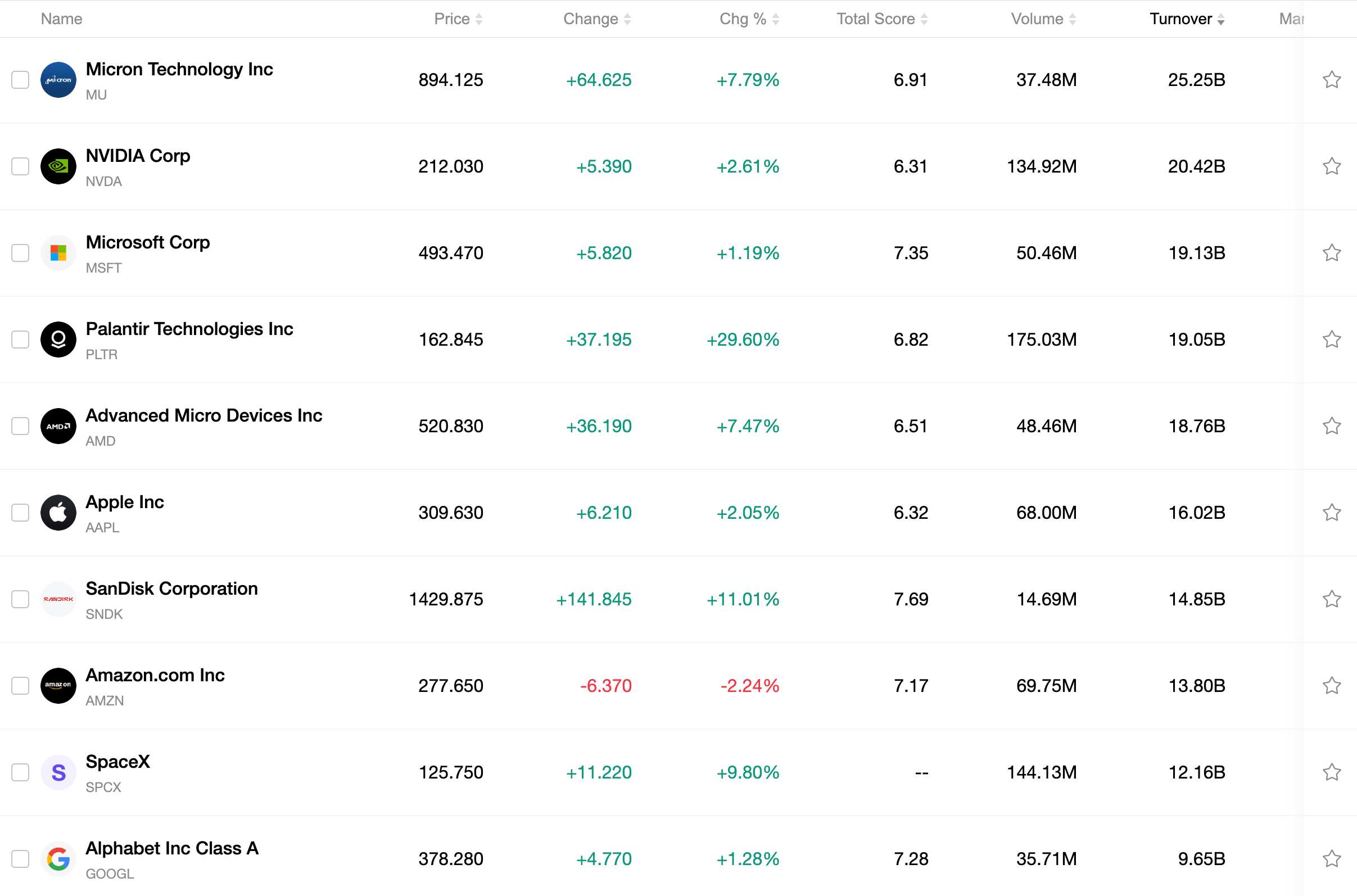
Top 10 Most Traded Stocks
The table below lists the ten most actively traded stocks in the market recently. Backed by massive trading volumes and excellent liquidity, these assets have become key benchmarks for tracking global market dynamics.
Read more
* The content presented above, whether from a third party or not, is considered as general advice only. This article should not be construed as containing investment advice, investment recommendations, an offer of or solicitation for any transactions in financial instruments.


