

Masayoshi Son Double Down: SoftBank Completes $10 Billion Additional Investment in OpenAI, Japan's First Round of 387.3 Billion Yen AI Subsidy Implemented. Noetra

Source Tradingkey

TradingKey - During the Asian session on July 1, SoftBank announced that it has completed an additional $10 billion investment in OpenAI through its Vision Fund II. This marks the second installment of its previously announced $30 billion follow-on investment plan. Under the plan, the final $10 billion investment is scheduled to be completed on October 1.

Including the first installment that closed in February, SoftBank's cumulative investment in OpenAI has now crossed the $60 billion threshold. Based on OpenAI's current valuation of $730 billion, SoftBank's ownership stake is expected to rise to approximately 13% once all three investments are completed.

Just on June 30, according to Japanese media reports, Japan's Ministry of Economy, Trade and Industry (METI) announced that it will allocate 387.3 billion yen in development consignment fees to Noetra, a new company led by SoftBank. This represents the first installment for fiscal year 2026. Noetra boasts a heavyweight lineup of shareholders: SoftBank, NEC, Honda, and Sony Group have joined forces with the goal of building Japan's own proprietary AI foundational model from scratch.

The company does not intend to compete head-on with OpenAI in the general-purpose track, but is instead targeting specific weak points, namely Japanese language comprehension and multimodal recognition. Images, video, audio, and even physical space perception and modeling are all included in the training objectives. The project has already qualified for support from the New Energy and Industrial Technology Development Organization (NEDO) with a planned five-year cycle, and METI's total budget expectation is approximately 1 trillion yen. Noetra plans to officially kick off R&D this month and deliver Japan's largest self-developed AI model by 2027.

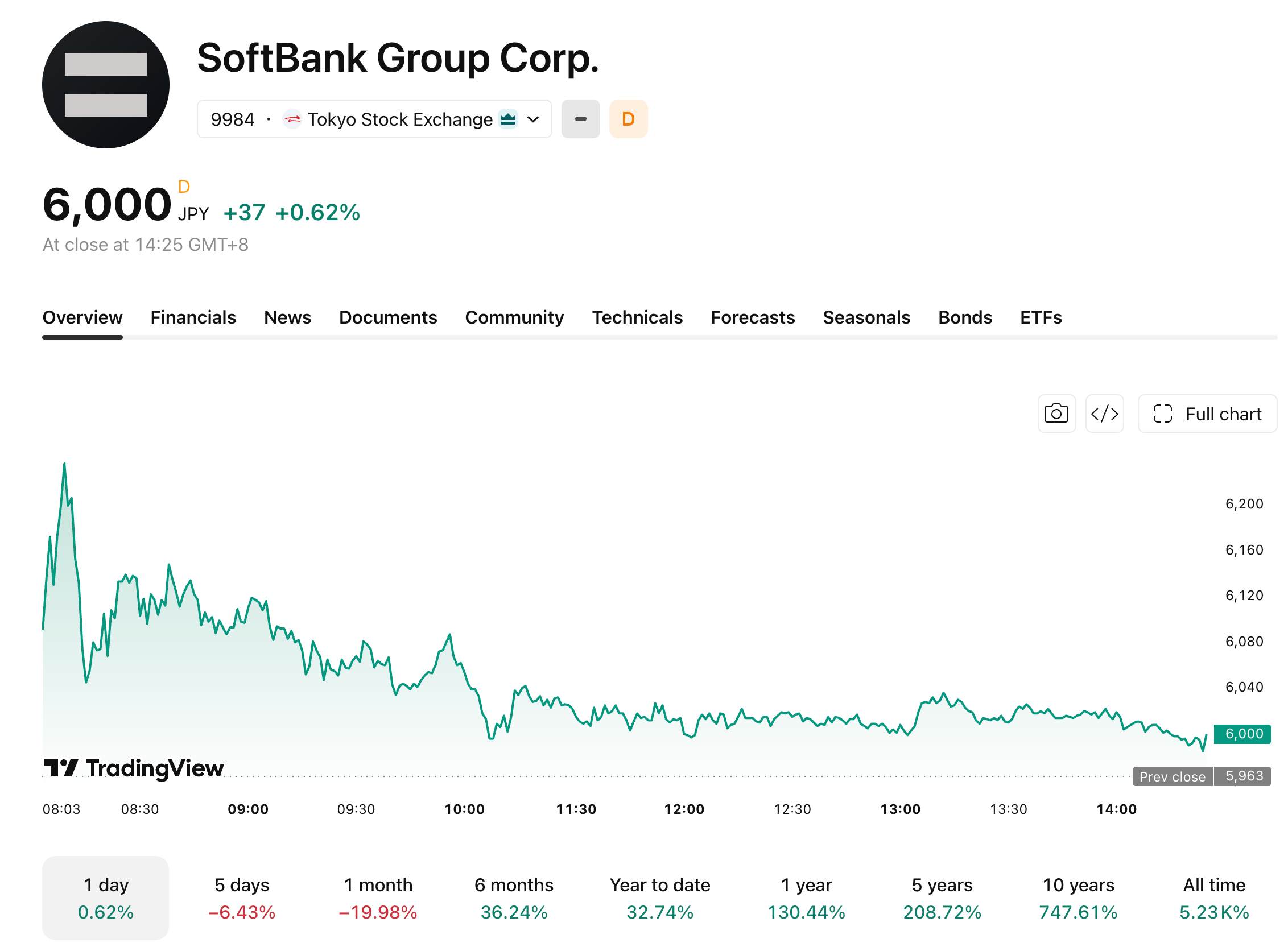
SoftBank Share Price Performance

The capital markets did not respond positively to these two pieces of news. On July 1, the Nikkei 225 Index rose 0.59% to close at 70,474.96 points. Although SoftBank's stock price jumped over 4% in early trading , it quickly pared those gains , closing up only 0.62%.
softbank-701-db72f7ed0d074c5b997055f6fb1b2107

[Source: TradingView]

Just days earlier on June 26, affected by market rumors that OpenAI might delay its IPO, SoftBank's stock price plummeted over 12% that day. The market's sensitivity to OpenAI's listing timeline reflects investors' anxiety over the monetization cycle of SoftBank's massive bets.

Even the slightest rumor regarding the IPO timeline is enough to cause violent fluctuations in SoftBank's stock price. This indicates that the market's pricing logic for this investment has always been predicated on the assumption that "OpenAI will eventually go public." Once this premise is shaken, investors' patience quickly wears thin.

The pressure does not come solely from the stock price. SoftBank had previously planned to use its OpenAI shares as collateral to apply for a $10 billion margin loan from banks, but some financial institutions adopted a conservative stance, forcing the final financing size to be scaled back to $6 billion. According to media reports in June, SoftBank's negotiations with potential lenders for the $6 billion loan had stalled. Under the dual pressures of the interest rate environment and high debt leverage, how SoftBank balances the tension between large-scale AI investments and its financial health is becoming a focus of ongoing market attention.

Delays in OpenAI's Monetization and Netra's Commercialization Challenges

The monetization path for the OpenAI line of investment is relatively clear: once the IPO is completed, shares can be liquidated, and the scale of returns can be directly measured. The real variable lies in the time window, as the timing of the listing remains unclear, leaving the market without a reliable benchmark for judgment. June 26 already caused SoftBank's single-day decline to exceed 12%, providing a clear reference for the price the capital market pays for waiting.

The situation for Noetra is far more complex. The Ministry of Economy, Trade and Industry (METI) has classified the project's intellectual property under the framework of public infrastructure management; while SoftBank participates in the R&D, it does not possess exclusive rights to the results. The profit distribution logic of state-commissioned projects differs fundamentally from private enterprise investments, making it currently impossible to provide even a rough estimate of how much commercial profit SoftBank can ultimately derive from this line of business.

SoftBank is currently betting on two directions simultaneously: the leading global artificial general intelligence (AGI) player, and the local execution of Japan's national AI strategy. The two fronts are independent of each other, neither hedging risks nor guaranteeing one another. A continued delay in OpenAI's listing, or a lack of progress in Noetra's commercialization, would exert pressure on SoftBank's valuation framework in either scenario.

The direction of the situation depends on which of the two milestones is reached first: OpenAI filing its prospectus and establishing market pricing, or Noetra's model moving out of the lab to verify its viability in commercial scenarios. Until then, the gains or losses of any single trading day are merely reflections of the same bet across different temporal cross-sections.

Disclaimer: For information purposes only. Past performance is not indicative of future results.
placeholder
Bitcoin CME gaps at $35,000, $27,000 and $21,000, which one gets filled first?Prioritize filling the $27,000 gap and even try higher.
Author  FXStreet
Aug 22, 2023
Prioritize filling the $27,000 gap and even try higher.
placeholder
Pinduoduo Earnings Incoming: Morgan Stanley Sees Long-Term Profit Potential​Insights – On November 21, Chinese e-commerce giant Pinduoduo (PDD) will release its Q3 2024 earnings.
Author  Mitrade
Nov 20, 2024
​Insights – On November 21, Chinese e-commerce giant Pinduoduo (PDD) will release its Q3 2024 earnings.
placeholder
Bitcoin briefly loses 2025 gains as crypto plunges over the weekend.Bitcoin experienced a sharp decline this weekend, briefly erasing its 2025 gains and dipping below its year-opening value of $93,507. The cryptocurrency fell to a low of $93,029 on Sunday, representing a 25% drop from its all-time high in October. Although it has rebounded slightly to around $94,209, the pressures on the market remain significant. The downturn occurred despite the reopening of the U.S. government on Thursday, which many had hoped would provide essential support for crypto markets. This year initially appeared promising for cryptocurrencies, particularly after the inauguration of President Donald Trump, who has established the most pro-crypto administration thus far. However, ongoing political tensions—including Trump's tariff strategies and the recent government shutdown, lasting a historic 43 days—have contributed to several rapid price pullbacks for Bitcoin throughout the year. Market dynamics are also being influenced by Bitcoin whales—investors holding large amounts of Bitcoin—who have been offloading portions of their assets, consequently stalling price rallies even as positive regulatory developments emerge. Despite these sell-offs, analysts from Glassnode argue that this behavior aligns with typical patterns seen among long-term investors during the concluding stages of bull markets, suggesting it is not indicative of a mass exodus. Notably, Bitcoin is not alone in its struggles, as Ethereum and Solana have also recorded declines of 7.95% and 28.3%, respectively, since the start of the year, while numerous altcoins have faced even steeper losses. Looking ahead, questions linger regarding the viability of the four-year cycle thesis, particularly given the increasing institutional support and regulatory frameworks now in place in the crypto landscape. Matt Hougan, chief investment officer at Bitwise, remains optimistic, suggesting a potential Bitcoin resurgence in 2026 driven by the “debasement trade” thesis and a broader trend toward increased adoption of stablecoins, tokenization, and decentralized finance. Hougan emphasized the soundness of the underlying fundamentals, pointing to a positive outlook for the sector in the longer term.
Author  Mitrade
Nov 17, 2025
Bitcoin experienced a sharp decline this weekend, briefly erasing its 2025 gains and dipping below its year-opening value of $93,507. The cryptocurrency fell to a low of $93,029 on Sunday, representing a 25% drop from its all-time high in October. Although it has rebounded slightly to around $94,209, the pressures on the market remain significant. The downturn occurred despite the reopening of the U.S. government on Thursday, which many had hoped would provide essential support for crypto markets. This year initially appeared promising for cryptocurrencies, particularly after the inauguration of President Donald Trump, who has established the most pro-crypto administration thus far. However, ongoing political tensions—including Trump's tariff strategies and the recent government shutdown, lasting a historic 43 days—have contributed to several rapid price pullbacks for Bitcoin throughout the year. Market dynamics are also being influenced by Bitcoin whales—investors holding large amounts of Bitcoin—who have been offloading portions of their assets, consequently stalling price rallies even as positive regulatory developments emerge. Despite these sell-offs, analysts from Glassnode argue that this behavior aligns with typical patterns seen among long-term investors during the concluding stages of bull markets, suggesting it is not indicative of a mass exodus. Notably, Bitcoin is not alone in its struggles, as Ethereum and Solana have also recorded declines of 7.95% and 28.3%, respectively, since the start of the year, while numerous altcoins have faced even steeper losses. Looking ahead, questions linger regarding the viability of the four-year cycle thesis, particularly given the increasing institutional support and regulatory frameworks now in place in the crypto landscape. Matt Hougan, chief investment officer at Bitwise, remains optimistic, suggesting a potential Bitcoin resurgence in 2026 driven by the “debasement trade” thesis and a broader trend toward increased adoption of stablecoins, tokenization, and decentralized finance. Hougan emphasized the soundness of the underlying fundamentals, pointing to a positive outlook for the sector in the longer term.
placeholder
Markets in 2026: Will gold, Bitcoin, and the U.S. dollar make history again? — These are how leading institutions thinkAfter a turbulent 2025, what lies ahead for commodities, forex, and cryptocurrency markets in 2026?
Author  Insights
Dec 25, 2025
After a turbulent 2025, what lies ahead for commodities, forex, and cryptocurrency markets in 2026?
placeholder
Gold Price Forecast: Does Gold Falling Below $4,000 Mean the Bull Market Is Over? Will It Still Rise in the Second Half of 2026?Heading into the second half of 2026, the gold market has transitioned from a strong-performing asset at the start of the year into one pulling back from its highs. Recently, gold prices
Author  TradingKey
Jun 29, Mon
Heading into the second half of 2026, the gold market has transitioned from a strong-performing asset at the start of the year into one pulling back from its highs. Recently, gold prices
goTop
quote