


If a Stock Market Crash Is Coming, History Says Investors Who Do This 1 Thing Will Win Out
Key Points
Multiple indicators suggest the stock market could be overvalued right now.
Choosing the right stocks is more important than ever.
With a long-term outlook, your portfolio is more likely to survive even a severe downturn.
- 10 stocks we like better than S&P 500 Index ›
The market has been wobbly lately, with the S&P 500 (SNPINDEX: ^GSPC) and Nasdaq Composite (NASDAQINDEX: ^IXIC) dipping by nearly 3% and 6%, respectively, over the past month.
Some stock market indicators are also sounding the alarm. The S&P 500 Shiller CAPE Ratio, which measures whether the index is over- or undervalued, is reaching heights not seen since the dot-com bubble burst. Back then, the ratio reached a record high of around 44. As of this writing, it's just over 41, the second highest point in history.
Missed Nvidia in 2009? This Rare Signal Is Flashing Again. In 2009, a "Double Down" signal flashed for a little-known chipmaker called Nvidia. For the first time in years, that same "Total Conviction" signal is flashing for a company 1/100th the size of Nvidia. Continue »
The Buffett indicator, named after Warren Buffett, is also at record highs. This metric measures the relationship between the total value of U.S. stocks and GDP, and according to Buffett himself, investors are "playing with fire" when it nears 200%. Currently, this metric sits at around 234%.
To be clear, this doesn't necessarily mean that a market crash is imminent or that we're in a bubble that's about to pop. The market is incredibly complex, and trying to predict what will happen in the near term can be costly. Fortunately, there's one move that history says never steers investors wrong.

Image source: Getty Images.
History says this is the best move investors can make
While it's impossible to say when the next downturn will begin, it's bound to happen eventually. And when it does, investors who own a healthy portfolio of quality stocks will win out.
Many stocks have experienced unprecedented growth in recent years, but a soaring stock price doesn't necessarily mean the underlying company is healthy. Some stocks are fueled by hype and speculation, so even if they appear to be thriving on paper, they could be incredibly overvalued and due for a pullback soon.
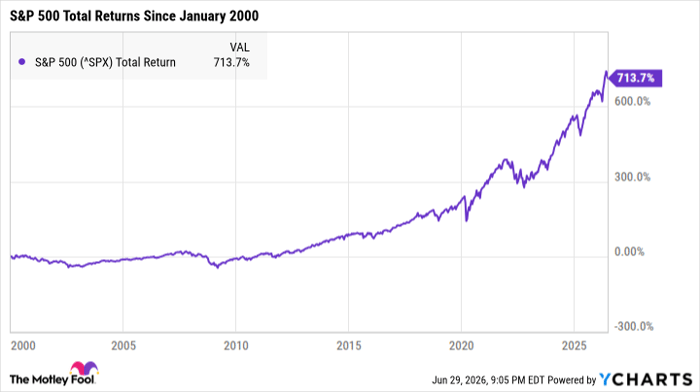
During the dot-com bubble in the early 2000s, for example, hundreds of tech companies crashed and burned. Although many of these high-profile stocks had soared in valuation in the years leading up to the bursting bubble, factors such as unsustainable business models and poor finances made it impossible for them to survive the bear market that followed.
^SPX data by YCharts
Not all tech companies failed during that time, though. Those with solid fundamentals were resilient enough to weather the collapse of the tech sector, and the S&P 500 itself has delivered total returns of more than 700% since 2000.
Right now is a particularly smart time to comb through your portfolio and ensure you're investing only in stocks whose valuations align with their underlying fundamentals. With the market still near record highs, now could be a good moment to sell any stocks that are no longer healthy investments.
A long-term outlook is more important than ever
If a bear market or recession is coming, even strong stocks can take a beating. Investors who hold their stocks for at least a few years, however, will be in the best position for substantial growth.
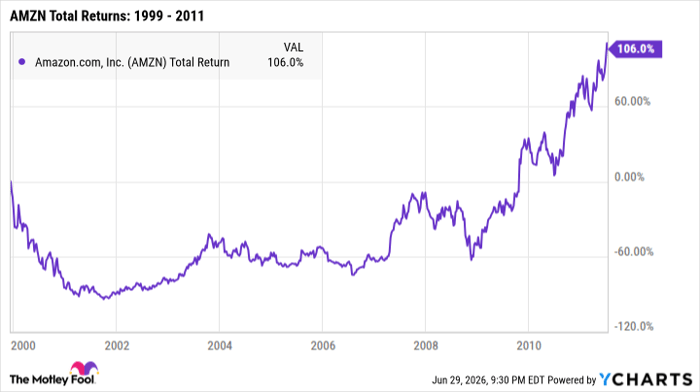
During the dot-com bear market, for instance, Amazon (NASDAQ: AMZN) lost nearly 95% its value. Many investors would have been tempted to jump ship during that time, but those who stayed the course would have doubled their money in a little over a decade. Between 1999 and today, Amazon has earned total returns of more than 4,000%.
AMZN Total Return Level data by YCharts
In the short term, the market can be brutal. But if history proves anything, it's that strong companies have the best shot at surviving volatility and delivering positive total returns over time.
When you're choosing stocks, look for key metrics suggesting a fundamentally sound company. Focusing on factors such as a company's business model, profitability, leadership team, and industry health can make it easier to determine whether a stock will survive a downturn.
No matter what's coming for the market, history says that investing in quality companies and holding them for the long haul will set you up for success.
Should you buy stock in S&P 500 Index right now?
Before you buy stock in S&P 500 Index, consider this:
The Motley Fool Stock Advisor analyst team just identified what they believe are the 10 best stocks for investors to buy now… and S&P 500 Index wasn’t one of them. The 10 stocks that made the cut could produce monster returns in the coming years.
Consider when Netflix made this list on December 17, 2004... if you invested $1,000 at the time of our recommendation, you’d have $397,890!* Or when Nvidia made this list on April 15, 2005... if you invested $1,000 at the time of our recommendation, you’d have $1,196,664!*
Now, it’s worth noting Stock Advisor’s total average return is 902% — a market-crushing outperformance compared to 207% for the S&P 500. Don't miss the latest top 10 list, available with Stock Advisor, and join an investing community built by individual investors for individual investors.
See the 10 stocks »
*Stock Advisor returns as of July 1, 2026.
Katie Brockman has no position in any of the stocks mentioned. The Motley Fool has positions in and recommends Amazon. The Motley Fool has a disclosure policy.
Recommended Articles


