


US-Iran Talks Hit Nonfarm Payrolls Bombshell: Bitcoin Bull-Bear Battle Set to End $60,000 Deadlock?

 Trending Articles
- Gold Price Forecast: Gold Poised to Break $4,200 as Oil Price Slump Eases Inflation Fears
- Gold Price Forecast: Oil Price Breaking $100 Fuels Inflation Concerns, Will Gold Prices Fall Further?
- Gold rallies to over two-week high, eyes $4,150 as traders track US-Iran diplomacy efforts
- Middle East War updates: US-Iran pause strikes as Trump weighs up diplomatic options
- WTI climbs above $87.00 as Middle East conflict threatens key choke points
- Today’s Market Recap: Oil Breaks $100, Fueling Inflation Fears, as AI Capex Faces Scrutiny and Tesla’s 14% Plunge Drags Down Tech Sector

TradingKey - As US-Iran talks and non-farm payrolls approach, Bitcoin's range-bound trend is set to break, with a potential drop to $50,000.
On June 30, Bitcoin ( BTC) remained volatile near $60,000, up slightly by 0.7% today to trade at $59,900. Last Thursday, Bitcoin's price approached $58,000, touching its September 2024 low, and has since fluctuated in a narrow range around the $60,000 mark. With US-Iran negotiations and non-farm payrolls imminent, can Bitcoin's price break this impasse?
Yesterday, U.S. President Trump told media at the White House that the U.S. and Iran are holding talks today (June 30) in Doha, the capital of Qatar. On the eve of the negotiations, both bulls and bears remain cautious. The Trump administration's hardline stance, coupled with Tehran's vacillation, has injected high uncertainty into the talks, keeping global investor sentiment on edge.
Should the negotiations make progress, Bitcoin's price is poised to break through and stabilize above the $60,000 mark. Conversely, if geopolitical tensions flare up again and liquidity tightening drags the price further down, the $58,000 level could be breached. However, compared to the U.S.-Iran talks, the upcoming June non-farm payrolls (NFP) data will likely exert a greater impact on Bitcoin. The core reason is that 'liquidity pricing' has become the primary driver for Bitcoin at this stage, whereas geopolitical relief only offers short-term sentiment repair.
This Thursday (July 2), the U.S. will release June non-farm payroll (NFP) data, with consensus estimates generally ranging from +100,000 to +145,000. An unexpectedly strong print would indicate that the labor market remains highly resilient, which would dampen Federal Reserve rate-cut expectations and push Treasury yields higher. This is a direct negative for non-yielding assets like Bitcoin, and bears would undoubtedly capitalize on the momentum to sell off, potentially pushing Bitcoin down to its next key line of defense.
However, a significantly weak reading, particularly below 100,000, would fuel economic slowdown concerns and force the Federal Reserve to adopt a more dovish stance. This would serve as the 'ultimate catalyst' for bulls to break through the $60,000 impasse and spark a rebound. Naturally, if the data comes in flat, it would still weigh on the currently fragile crypto market, making a further decline in Bitcoin's price hard to avoid.
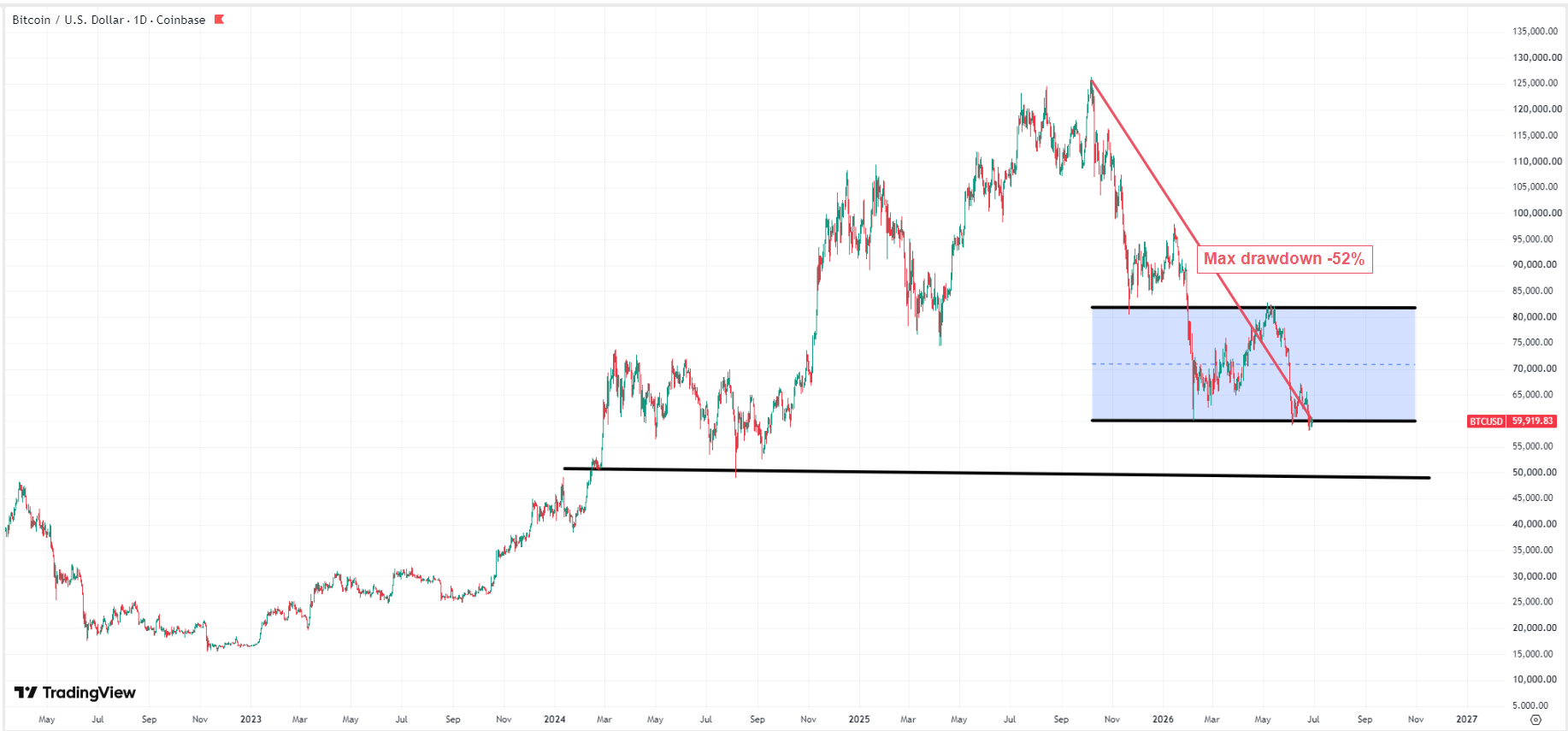 Bitcoin price chart, Source: TradingView
From a technical perspective, $60,000 remains the watershed between bulls and bears. Bulls must reclaim the $60,000-$61,000 range on strong volume to break Bitcoin's bearish daily pattern; otherwise, any rebound will merely be a bull trap. If the macroeconomic environment remains unfavorable for the crypto market, Bitcoin risks falling to its next key defensive level at the psychological $50,000 mark.
Read more
* The content presented above, whether from a third party or not, is considered as general advice only. This article should not be construed as containing investment advice, investment recommendations, an offer of or solicitation for any transactions in financial instruments.


