

Cryptopolitan Newsletter Poll: Nearly 70% of Crypto Investors Would Let an AI Agent Control Their Wallet — With Conditions

Source Cryptopolitan

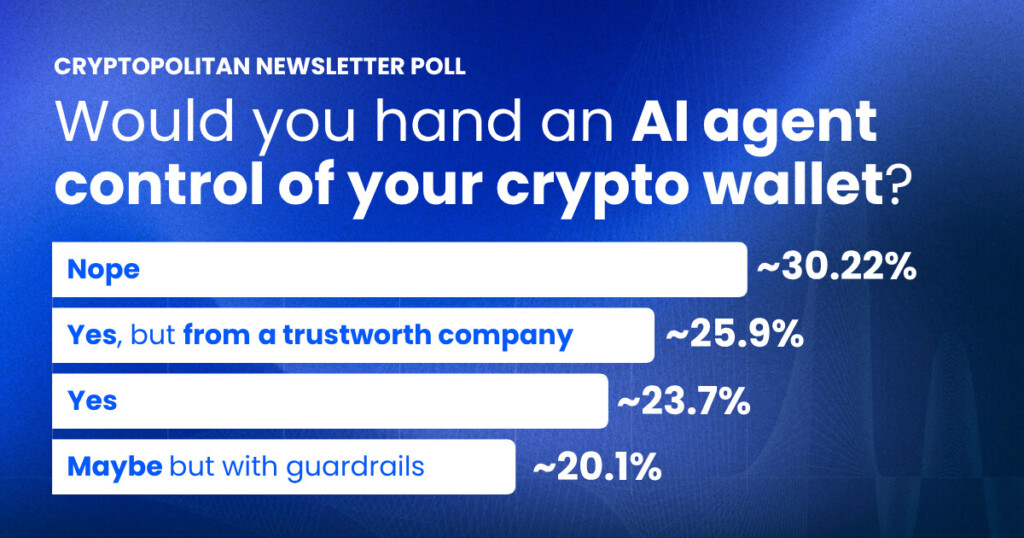
The single most common answer was still “no” (~30%), but the Cryptopolitan Newsletter Poll, June 18, 2026, found that resistance is to trust and execution and not the technology itself.

Nearly 70% of engaged crypto holders said they would let an AI agent control their wallet, according to a Cryptopolitan Newsletter poll published June 18, 2026. However, only ~24% said yes without conditions. 

The remaining respondents attached requirements such as a trusted brand, spending guardrails, or both as conditions that have to be met before a “yes” is given. The data lands as MetaMask, Coinbase, and the x402 protocol bring agent-native wallet infrastructure live.

The four-way split

Cryptopolitan Newsletter subscribers who are engaged crypto holders, run DeFi strategies, and are familiar with self-custody answered the question: “Would you hand an AI agent control of your crypto wallet?” The results broke into four roughly even camps. 

30.22% of the post results were an outright “nope,” which means that the respondents will not hand wallet control to an agent at all.

~25.9% voted “Yes, but only from a trustworthy company,” which is the second largest vote, with them favoring a trusted brand such as MetaMask/Coinbase. 

Third was an unconditional yes at ~23.7%, which was nearly as large as the hard-no group. 

The fourth response was openness with guardrails, such as spending caps, allowlists, two-factor authentication, and insurance at ~20.1%.
Is trust the main deterrent for adoption?

While the single common answer was a hard no from ~30% of the cohort, nearly 70% are open to it in some form. Combining the two conditional-yes groups (~25.9% and ~20.1%) yields approximately 46% of respondents who are open to agent wallet control but need the industry to solve for brand credibility and execution risk first. 

That swing vote is what major wallet providers are now racing to capture.

Which infrastructure is powering agentic payments?

A great deal of active work has gone into enabling AI agents to thrive, and one of them is the x402 protocol, a machine-to-machine payments standard pioneered by Coinbase and now managed by the Linux Foundation. The protocol, backed by Google, Visa, AWS, Circle, Anthropic, Stripe, Cloudflare, and the Solana Foundation, has seen considerable traction since its launch, logging over 480,000 active agents. x402 has also recorded over 165 million transactions with more than $50 million in cumulative volume as of June 2026, with weekly transactions rising roughly 265% since March, per Artemis data. 

Coinbase launched its Agentic Wallets in February 2026, which run on the x402 protocol with private keys held in hardware-isolated Trusted Execution Environments (TEEs).

MetaMask opened early access to its Agent Wallet on June 8, offering a self-custodial setup in which users hold keys and define rules like daily spending limits, permissions, and two-factor authentication. Also, every transaction will be scanned for threats, and if it is deemed safe, it is then guaranteed a $10,000 coverage

Gartner projects 40% of enterprise applications will embed AI agents by the end of 2026. Coinbase CEO Brian Armstrong has described the emerging model as “the agentic economy.”

About the Cryptopolitan Newsletter

The Cryptopolitan Newsletter is a leading crypto and AI newsletter of 2026, delivering research, analysis, and market intelligence to an engaged readership of crypto holders and DeFi practitioners.

About Cryptopolitan

Founded in 2018, Cryptopolitan is a crypto and blockchain media organisation syndicated across Google News, Bing News, MSN, and Binance Square.

Media contact: Adi, contact@cryptopolitan.com

Disclaimer: For information purposes only. Past performance is not indicative of future results.
placeholder
Bitcoin CME gaps at $35,000, $27,000 and $21,000, which one gets filled first?Prioritize filling the $27,000 gap and even try higher.
Author  FXStreet
Aug 22, 2023
Prioritize filling the $27,000 gap and even try higher.
placeholder
Pinduoduo Earnings Incoming: Morgan Stanley Sees Long-Term Profit Potential​Insights – On November 21, Chinese e-commerce giant Pinduoduo (PDD) will release its Q3 2024 earnings.
Author  Mitrade
Nov 20, 2024
​Insights – On November 21, Chinese e-commerce giant Pinduoduo (PDD) will release its Q3 2024 earnings.
placeholder
Bitcoin briefly loses 2025 gains as crypto plunges over the weekend.Bitcoin experienced a sharp decline this weekend, briefly erasing its 2025 gains and dipping below its year-opening value of $93,507. The cryptocurrency fell to a low of $93,029 on Sunday, representing a 25% drop from its all-time high in October. Although it has rebounded slightly to around $94,209, the pressures on the market remain significant. The downturn occurred despite the reopening of the U.S. government on Thursday, which many had hoped would provide essential support for crypto markets. This year initially appeared promising for cryptocurrencies, particularly after the inauguration of President Donald Trump, who has established the most pro-crypto administration thus far. However, ongoing political tensions—including Trump's tariff strategies and the recent government shutdown, lasting a historic 43 days—have contributed to several rapid price pullbacks for Bitcoin throughout the year. Market dynamics are also being influenced by Bitcoin whales—investors holding large amounts of Bitcoin—who have been offloading portions of their assets, consequently stalling price rallies even as positive regulatory developments emerge. Despite these sell-offs, analysts from Glassnode argue that this behavior aligns with typical patterns seen among long-term investors during the concluding stages of bull markets, suggesting it is not indicative of a mass exodus. Notably, Bitcoin is not alone in its struggles, as Ethereum and Solana have also recorded declines of 7.95% and 28.3%, respectively, since the start of the year, while numerous altcoins have faced even steeper losses. Looking ahead, questions linger regarding the viability of the four-year cycle thesis, particularly given the increasing institutional support and regulatory frameworks now in place in the crypto landscape. Matt Hougan, chief investment officer at Bitwise, remains optimistic, suggesting a potential Bitcoin resurgence in 2026 driven by the “debasement trade” thesis and a broader trend toward increased adoption of stablecoins, tokenization, and decentralized finance. Hougan emphasized the soundness of the underlying fundamentals, pointing to a positive outlook for the sector in the longer term.
Author  Mitrade
Nov 17, 2025
Bitcoin experienced a sharp decline this weekend, briefly erasing its 2025 gains and dipping below its year-opening value of $93,507. The cryptocurrency fell to a low of $93,029 on Sunday, representing a 25% drop from its all-time high in October. Although it has rebounded slightly to around $94,209, the pressures on the market remain significant. The downturn occurred despite the reopening of the U.S. government on Thursday, which many had hoped would provide essential support for crypto markets. This year initially appeared promising for cryptocurrencies, particularly after the inauguration of President Donald Trump, who has established the most pro-crypto administration thus far. However, ongoing political tensions—including Trump's tariff strategies and the recent government shutdown, lasting a historic 43 days—have contributed to several rapid price pullbacks for Bitcoin throughout the year. Market dynamics are also being influenced by Bitcoin whales—investors holding large amounts of Bitcoin—who have been offloading portions of their assets, consequently stalling price rallies even as positive regulatory developments emerge. Despite these sell-offs, analysts from Glassnode argue that this behavior aligns with typical patterns seen among long-term investors during the concluding stages of bull markets, suggesting it is not indicative of a mass exodus. Notably, Bitcoin is not alone in its struggles, as Ethereum and Solana have also recorded declines of 7.95% and 28.3%, respectively, since the start of the year, while numerous altcoins have faced even steeper losses. Looking ahead, questions linger regarding the viability of the four-year cycle thesis, particularly given the increasing institutional support and regulatory frameworks now in place in the crypto landscape. Matt Hougan, chief investment officer at Bitwise, remains optimistic, suggesting a potential Bitcoin resurgence in 2026 driven by the “debasement trade” thesis and a broader trend toward increased adoption of stablecoins, tokenization, and decentralized finance. Hougan emphasized the soundness of the underlying fundamentals, pointing to a positive outlook for the sector in the longer term.
placeholder
Markets in 2026: Will gold, Bitcoin, and the U.S. dollar make history again? — These are how leading institutions thinkAfter a turbulent 2025, what lies ahead for commodities, forex, and cryptocurrency markets in 2026?
Author  Insights
Dec 25, 2025
After a turbulent 2025, what lies ahead for commodities, forex, and cryptocurrency markets in 2026?
placeholder
Gold Price Forecast: Does Gold Falling Below $4,000 Mean the Bull Market Is Over? Will It Still Rise in the Second Half of 2026?Heading into the second half of 2026, the gold market has transitioned from a strong-performing asset at the start of the year into one pulling back from its highs. Recently, gold prices
Author  TradingKey
Jun 29, Mon
Heading into the second half of 2026, the gold market has transitioned from a strong-performing asset at the start of the year into one pulling back from its highs. Recently, gold prices
goTop
quote