


Best Altcoins to Buy in 2026
Key Points
Chainlink provides the data feeds that make decentralized finance and asset tokenization actually work.
Render lets AI developers rent GPU capacity from a decentralized network instead of buying expensive hardware.
Both tokens benefit when blockchain adoption grows generally, regardless of which specific platform wins.
- 10 stocks we like better than Chainlink ›
Watching Layer 1 blockchains fight for supremacy has started to feel like rival mall developers arguing about whose food court is superior. Entertaining? Sometimes. Investable? That's getting complicated.
Instead of asking "which blockchain wins?", the more interesting angle is: "What does every blockchain need to actually be useful?" Yes, I require my crypto investments to be useful in the real world. Maybe not right away, but definitely in the long run. So, I look for infrastructure and utility rather than cute mascots and strong marketing messages. My favorite coins are the plumbing of tomorrow's blockchain-based systems.
Will AI create the world's first trillionaire? Our team just released a report on the one little-known company, called an "Indispensable Monopoly" providing the critical technology Nvidia and Intel both need. Continue »
Two digital assets deserve extra attention under this framework: Chainlink (CRYPTO: LINK) and Render (CRYPTO: RENDER).
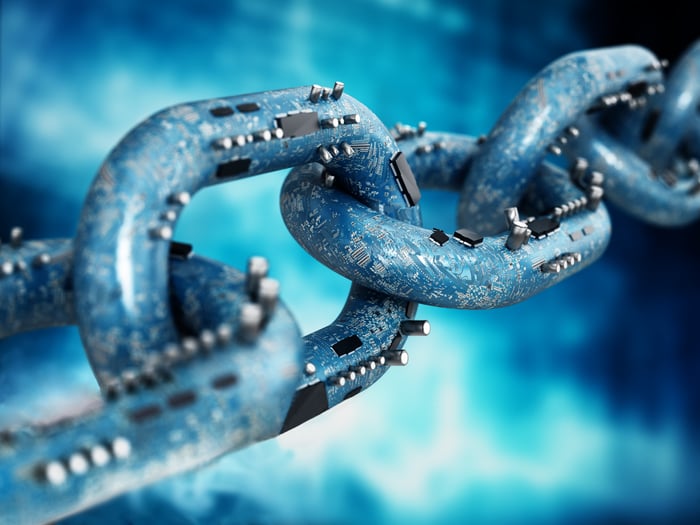
Image source: Getty Images.
Chainlink: Connecting crypto systems to the real world
Here's the thing about most cryptocurrencies: They're basically different spins on the same idea. Publish a transaction ledger publicly, protect it with encryption, and add some bells and whistles. Thousands of tokens compete to do roughly the same job with different logos. Many even use the same encryption and coin-production methods, harking back to the Bitcoin white paper from 2009.
But some projects build on this shared foundation. They're not just another ledger; they're providing services that make the whole ecosystem work better.
Chainlink is a prime example of these value-added cryptocurrencies. As the leading oracle coin, it provides actionable data to smart contracts running on other blockchains. Without Chainlink's data, most decentralized finance (DeFi) systems and non-fungible tokens (NFTs) simply wouldn't work.
Two developments make Chainlink more interesting in 2026.
- Major financial institutions are tokenizing assets, and those assets need reliable data connections. Chainlink has become the default solution.
- Meanwhile, the blockchain space is becoming more fragmented. Chainlink's Cross-Chain Interoperability Protocol provides secure communication between networks.
Render: Decentralized computing power for AI
The artificial intelligence (AI) sector faces a stubborn bottleneck in computing capacity. Demand for number-crunching graphics processing units (GPUs) and AI accelerators is outpacing the available supply by a wide margin. As a result, hardware is getting expensive, and so are the cloud-based AI services that use it.
Render brings a decentralized perspective to the AI fight. Need processing power? Rent it from Render. Have some extra GPU capacity to spare? Contribute it to the blockchain network and earn tokens as a reward.
Using Render in your AI app is like renting warehouse space instead of buying a building. You get the capacity you need, scale up or down based on demand, and avoid the capital expenditure of owning infrastructure that sits idle between projects. Getting access to the right hardware is the network's problem, not the developer's.
Unlike digital assets built on speculative momentum, Render's token economics are directly based on network usage. More AI projects tapping into this alternative processing channel means more demand for the token. Rising usage is good for Render's investors.
The strategic logic
Generally speaking, these crypto assets benefit as blockchain adoption grows. Chainlink and Render don't need a specific platform to win; they just need people and companies to increase their use of blockchain technologies.
Given that institutional finance and AI development are both expanding, the tailwinds will remain reliable. And the crypto world's secure data ledgers will grow more popular over time. These durable trends make Render and Chainlink two of my top crypto picks in 2026.
Should you buy stock in Chainlink right now?
Before you buy stock in Chainlink, consider this:
The Motley Fool Stock Advisor analyst team just identified what they believe are the 10 best stocks for investors to buy now… and Chainlink wasn’t one of them. The 10 stocks that made the cut could produce monster returns in the coming years.
Consider when Netflix made this list on December 17, 2004... if you invested $1,000 at the time of our recommendation, you’d have $433,268!* Or when Nvidia made this list on April 15, 2005... if you invested $1,000 at the time of our recommendation, you’d have $1,259,391!*
Now, it’s worth noting Stock Advisor’s total average return is 935% — a market-crushing outperformance compared to 207% for the S&P 500. Don't miss the latest top 10 list, available with Stock Advisor, and join an investing community built by individual investors for individual investors.
See the 10 stocks »
*Stock Advisor returns as of June 14, 2026.
Anders Bylund has positions in Bitcoin and Chainlink. The Motley Fool has positions in and recommends Bitcoin, Chainlink, and Render. The Motley Fool has a disclosure policy.
Recommended Articles


