


SpaceX Stock Jumps 19% on Day One — What Happens Next After the Historic IPO?
TradingKey - SpaceX (NASDAQ: SPCX) closed Day One at $161.11, a 19% increase from its $135 IPO price, following an intraday trade that saw prices swing as high as $176.52 and as low as $150. The result was exactly what was expected from an IPO that was oversubscribed by a factor of 2x and had a tight 4% float. Day One saw significant volume. Nasdaq President Adena Friedman and SpaceX President Gwynne Shotwell rang the opening bell at the Nasdaq MarketSite, surrounded by a large number of people.
Perpetual futures linked to SpaceX on crypto platforms also saw a price peak of $176, approximately 30% above the IPO price, before moving to around $172. The IPO sent Elon Musk’s total valuation for his companies including SpaceX, Tesla and xAI over $450 billion and once again made him the world’s richest person by a large margin.
So, here is what investors in SPCX need to know as stocks go into their first full week.
Day One in Context — Where $161 Sits in the Pre-IPO Price Scenarios
Close is in the bullish half of Week One’s scenario range that analysts anticipated. This was a case with a range of $140 to $175 as the base and a pop over $180 if retail participation was high. In practice, SPCX intraday highs reached $176.52 before the company came in close at $161.11. This is a typical move for a mega-IPO with a tight float. The float represents an early surge in trading due to the lack of availability of the 4% of shares offered while there are huge buy interests. It also includes an intraday sell off due to early receivers of shares selling off to take their immediate profit. The fact that the closing price held near 20% higher than the IPO price instead of returning back all the way to $135 signals there is significant buy support for the stock and is not just speculation.
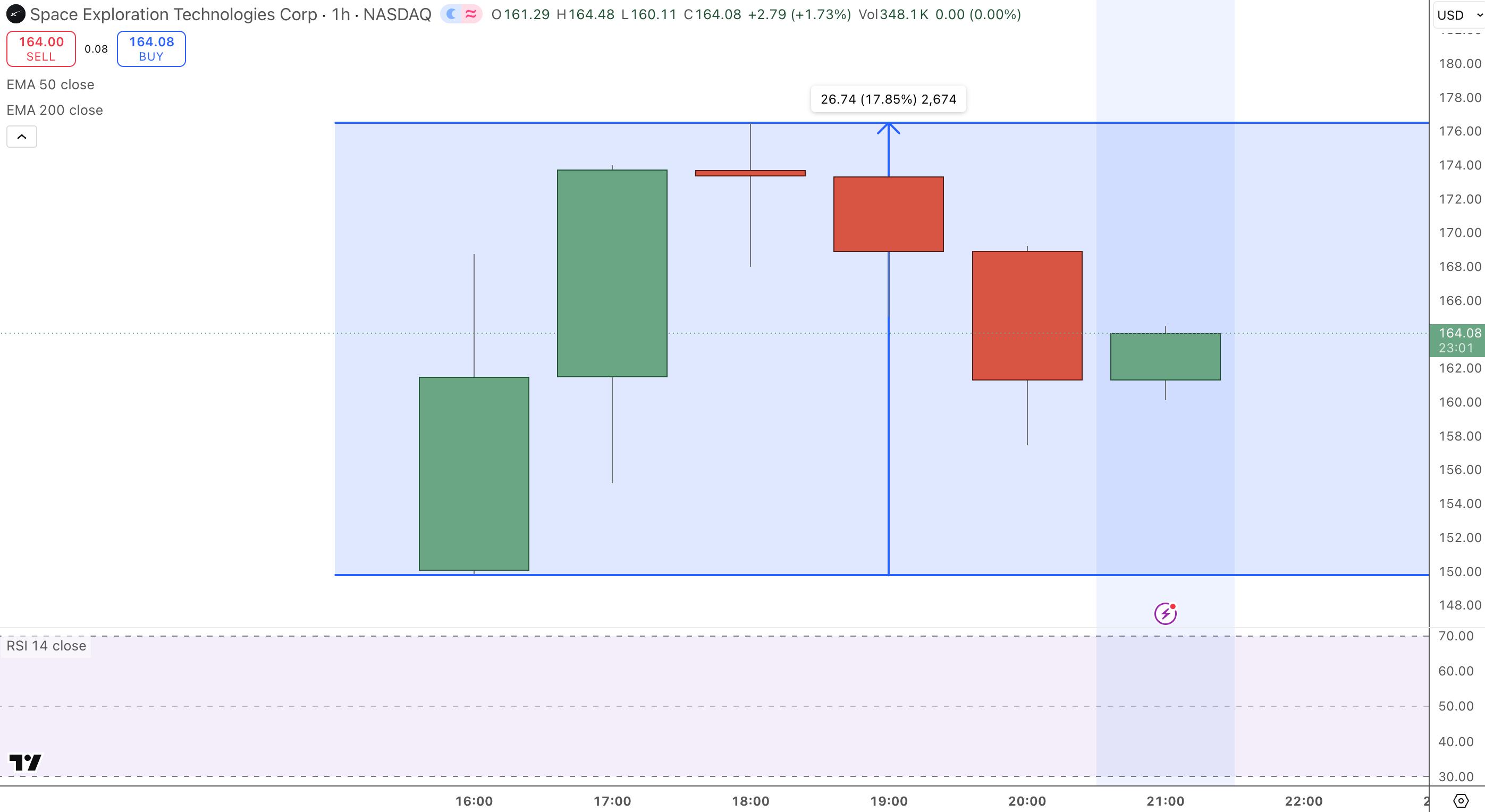
On that front, it is worth pointing out that the space-floated perpetual futures on platforms like Hyperliquid had been pricing a similar move for several days. Contracts traded at $176 on Thursday, up nearly 30% from the $135 IPO price, before trading at around $172 ahead of the actual listing. What’s interesting here is that the pricing of crypto perpetuals on Hyperliquid before the listing tracked quite closely with SPCX’s final Day One Nasdaq close price. That is to say, the markets had a reasonably good idea of how much buying demand there would be on Day One before the bell. This suggests that the IPO was already accurately priced, both in traditional and alternative markets.
What Happens Next — MSCI Inclusion Tomorrow and the Float Mechanics That Follow
And finally, there’s tomorrow. The biggest thing to watch on the near-term SPCX front is that MSCI is putting in place an early inclusion methodology. Come tomorrow, June 13 (or T+1), SpaceX with its valuation of over $1.75 trillion (it may be even higher now since the first-day gain brought the price up close to 19% to near a $2 trillion market capitalization) will be one of the top 10 constituents in the MSCI World Index and MSCI ACWI (All Country World Index). All the mutual funds and ETFs that track these indices will have to buy SPCX stock to match the index’s weighting.
Given there are probably $15 to $20 trillion AUM (Assets Under Management) across all the funds that need to buy SPCX and there is only $70 to $80 billion in float for SPCX at the post-pop prices, this means the mechanical buy orders from funds matching those indices are going to account for a fairly significant share of available supplies in the next couple of days. This will likely support stock prices, at least in the short term, no matter what kind of news comes out on Starship or Starlink.
On that front, there is another mechanical factor to be aware of: the insider stock lockup that comes into effect for 180 days after the IPO. Over the next six months, the only SPCX stock available for sale or purchase is the original 4% float that IPO participants got. Insiders, employees, and investors that acquired shares before the IPO will all have to wait until the lockup expires in December.
This means SPCX volume and price action reflects what happens with a fairly limited number of tradable shares. It also means continued selling activity from early receivers of shares (such activity was probably behind the intraday pullback from $176.52 highs to $161.11 lows) could continue until the lockup expires. Looking ahead, lockup periods for a major IPO like SPCX are often accompanied by volatility due to increased availability of shares for sale. SPCX investors should mark that date on their calendar now.
What Counts Once the IPO Glitz Is Over
Once the immediate trading volatility settles, the metrics that ultimately define SPCX stock performance will be those that the S-1 already flagged. Starlink is the business. Revenue of $11.387 billion in 2025 and $4.423 billion in operating profit, an adjusted EBITDA margin of 63%, growing subscriber base from 4.5m to a little over 10.3m in a year across 164 countries. A subscription growth rate that extends into Q2 2026 is arguably the one best argument for the bulls, regardless of Starship or xAI performance. A $6.355 billion operating loss in xAI, 76% of total group capex in Q1 2026 in AI capex, is arguably one major driver for the bears. Watch any discussion on xAI capex plans in any interview, conference, or disclosure between now and the first public earnings in November 2026.
The cadence of Starship flights is third. The S-1, as well as recent Starship flights, show the business has made material progress in full reusability, and earlier this year SpaceX announced it was aiming for uncrewed lunar launches under the Artemis program in late 2026. Every test flight, or failure to launch, that occurs before the next earnings report will be disproportionately priced relative to revenue impact, as Starship is the vehicle that moves SpaceX from its current profitable but capital-intensive operating profile to the much bigger, longer-duration TAMs, including point-to-point flight, massive-scale orbital infrastructure, and the orbital data center, that give it a $1.75T-plus valuation.
Space Sector Impact: Rocket Lab, Intuitive Machines, And The Rotation
Space stocks immediately experienced a rotation after the SpaceX IPO, with stock declines largely a function of how much of a given company’s equity value is attributed to being a SpaceX proxy. Rocket Lab, the most liquid and fundamentally strongest of the smaller space names, fell just 7.7%. Intuitive Machines and Redwire declined around 14-15%, while Virgin Galactic, the most speculative of the group, fell 24%.
EchoStar (thought to have an ~3% interest in SpaceX) surged 11% as market pricing on its interest rose. AST SpaceMobile (competitor to Starlink’s Direct to Cell) rose after high options volume as market traders began to rotate back into general satellite-based connectivity plays now that SpaceX stock has been publicly traded.
The rotation probably needs to play out over another session or two as portfolio managers move into and out of space stocks as they reevaluate positions, but the trade is a capital flows trade, not a re-rating of business value. In Rocket Lab's case, there's an offsetting mechanical buying catalyst in its Nasdaq-100 inclusion on June 22. It's another reminder that index mechanics have been flowing in both directions across the sector this month.
How Did SpaceX Stock (SPCX) Perform on Day One?
SpaceX closed its first Nasdaq trading day on June 12, 2026, at $161.11. It was a 19% gain over the $135 IPO price and the day saw an intraday high of $176.52, about 31% above the IPO, before backing off to finish at $161.11. It was extremely heavy volume. Crypto-perpetual SPCX futures trades on crypto exchanges ranged from $172 to $176 pre-IPO, in line with what we see. The $161.11 valuation implies a roughly $2 trillion market cap, up from $1.75 trillion post-IPO valuation.
What Is the Next Big Event for SPCX?
MSCI's early-inclusion methodology for SPCX kicked in on June 13, 2026. It was a day after listing. At its post-debut valuation, SpaceX is one of the 10 largest constituents of the MSCI World and MSCI ACWI indices. It is estimated that $15 to $20 trillion of passive funds have to buy SPCX to adjust to the new index weights. This means we get structural, price-insensitive buy pressure with a very tight 4% float of SPCX shares out there. The 180-day insider lockup, which ends in December 2026, is the next big event.
What Should SPCX Investors Be Watching for Going Forward?
Three items.
- Starlink subscriber and revenue in Q2 2026, after reporting 10.3 million subscribers and 63% EBITDA margin in the S-1.
- The capex trajectory for xAI. This group was 76% of group capex in Q1 2026 and the largest source of consolidated net losses in the S-1.
- Starship test flight cadence. This includes progress toward uncrewed lunar missions under NASA's Artemis programme later this year.
SpaceX is expected to release its first publicly audited earnings statement in November 2026. This will be the first time we get the above items in one place and can look at those against the day-one valuation of SPCX.
The Bottom Line
SpaceX closed its debut session up 19% at $161.11. It was up 19% with an intraday high of $176.52. That put the stock in the bullish 50% of IPO price scenarios. It pushed the valuation for Elon Musk over $450 billion. The next catalyst is the MSCI inclusion tomorrow, June 13. There is structural buying of a stock with only 4% of the shares available.
The lockup ending in December 2026 is the next big event on supply. Starlink subscriber growth, xAI's capex, and Starship test cadence are the items to watch for in determining where the SPCX stock will be in the earnings season in November 2026. The sector rotation is hitting Rocket Lab (RKLB), Intuitive Machines (LUNR), and Virgin Galactic (SPCE).
The sector rotation, by definition, is a capital-flow phenomenon and should not be conflated with a change in business outlook or valuation.
Recommended Articles


