


What You Need to Know About Jensen Huang’s South Korea Trip and the AI Bubble?
TradingKey - From June 5 to 8, 2026, NVIDIA ( NVDA) CEO Jensen Huang conducted a four-day visit to South Korea, meeting with the heads of major conglomerates including SK Group, Hyundai Motor, and LG Group. He announced that the next-generation High Bandwidth Memory HBM4 has passed certification by the three major memory chipmakers and signed a multi-year technical cooperation agreement with SK Hynix.
Huang also participated in several public activities during the trip, including appearing at an internet cafe with esports star "Faker," filming a variety show, and throwing the ceremonial first pitch for a professional baseball game, showcasing his significant personal influence. However, during his visit, the South Korean stock market experienced a series of sharp declines.
KOSPI’s Sharp Correction: From the "Jensen Huang Effect" to "Black Monday"
On June 5, the KOSPI index tumbled by more than 5.5%, with Samsung Electronics and SK Hynix sliding 6.40% and 9.92%, respectively. On June 8, the KOSPI dropped over 8% in early trading, triggering a circuit breaker; Samsung Electronics fell more than 10% in a single day, while SK Hynix dropped over 7%.
The "Jensen Huang effect" that the market had anticipated failed to materialize. The catalyst for the plunge came from the U.S.: Broadcom issued AI chip guidance that fell short of expectations, followed by U.S. May non-farm payroll data that significantly exceeded expectations, dampening the prospects for a rate cut. The Nasdaq Composite tumbled 4.18%, causing panic to spread from U.S. equities to South Korea.
Facing market panic, Jensen Huang stated at a Seoul press conference on June 8: "The future of AI is incredibly bright, and we are just getting started. No matter what happens in the stock market, you should be happy because you can now buy at a discount." These remarks quickly lifted market sentiment. On June 9, South Korean stocks rebounded strongly, with the KOSPI index surging over 8%.
Prior to Jensen Huang's arrival in South Korea, the global AI supply chain had already undergone a round of aggressive valuation rerating. Benefiting from the high market concentration of HBM as a critical link in AI computing power, Samsung Electronics and SK Hynix saw their share prices soar, driving the KOSPI to successive record highs. The narrative that "supply will fall short of demand for years" had been deeply priced in.
However, starting in late May, market focus shifted from "who secured the orders" to "whether orders can be converted into profits," as skepticism over AI overheating began to mount. Samsung Electronics had already seen consecutive declines in early June, setting the stage for the subsequent sharp volatility.
Industrial cooperation during Jensen Huang's visit to South Korea
Against the backdrop of a market slump, Jensen Huang's trip to South Korea has entered its most intensive phase of industry engagement.
On June 5, Jensen Huang announced that SK Hynix, Samsung Electronics, and Micron Technology ( MU) have all passed certification to supply HBM4 for Nvidia's AI accelerators, and all three companies have started production to support the Vera Rubin platform. This move demonstrates Nvidia's diversification strategy for its HBM supply chain; however, certification does not equate to order share, and competition over yields and production capacity will remain critical.
On June 7, Jensen Huang and SK Hynix announced a multi-year technical partnership to jointly advance memory technology for AI factories. Huang noted, "There is no end in sight to the current shortage of memory chips, and it will persist for several years."
On June 8, Jensen Huang visited companies including SK Group, LG Group, Hyundai Motor, NAVER, Doosan Group, and Samsung Electronics, announcing multiple collaborations in fields such as AI cloud services, intelligent robotics, autonomous driving, and the HBM supply chain. He also revealed plans to establish an R&D center and recruit talent in South Korea.
On the same day, the South Korean Ministry of Science and ICT announced the procurement of GPUs for national AI projects, including Vera Rubin chips. Huang promised to actively consider hosting Nvidia's GTC conference in South Korea and stated that the relevant collaborations could generate hundreds of billions of dollars in business for the country in the future.
Four Key Highlights of Jensen Huang’s Visit to South Korea
Focus on "Physical AI": South Korea Positioned as an Ideal Implementation Scenario
Jensen Huang views robotics as South Korea's next key industry, aggressively promoting "Physical AI." He believes that South Korea's deep foundation in semiconductors and automotive manufacturing makes it an ideal testing ground for the implementation of Physical AI. However, this statement remains a strategic guideline, and its ability to drive orders for local robotics companies in the short term is limited.
Three Companies Secure HBM4 Certification; NVIDIA Drives Market Share Rebalancing
SK Hynix, Samsung Electronics, and Micron have simultaneously obtained HBM4 certification, enabling them to supply the most advanced high-bandwidth memory chips for NVIDIA's AI accelerators; all three companies have entered production and support the Vera Rubin platform.
Currently, SK Hynix holds approximately 53% of the global HBM market, Samsung Electronics about 38%, and Micron about 9%. Certification itself does not equate to order share; subsequent factors such as yield rates, capacity, and price competition remain critical. By certifying all three companies, NVIDIA is pushing for supply chain diversification, aiming to mitigate risks and promote a rebalancing of market share.
Private Dinner with Chaebol Executives: Strategic Positioning Within South Korea's Industrial Chain
Jensen Huang held private dinners with the heads of companies including SK Group, Hyundai Motor, LG Group, and Naver to discuss future cooperation in frontier fields such as AI infrastructure, data centers, and robotics, and revealed that NVIDIA is considering building a production base in South Korea. Such high-level meetings carry long-term strategic significance, but translating them into concrete revenue will still take considerable time.
Remarks Boost Market Confidence, but Bubble Risks Warrant Caution
Amid a correction in U.S. tech stocks, Jensen Huang publicly stated that the pullback is a "buy-the-dip" opportunity, driving a collective rally in chip stocks. He also recommended Qualcomm ( QCOM) stock, pushing it up about 2% after-hours. It should be noted that Huang's recommendation of Qualcomm likely stems from the ecosystem partnership between NVIDIA and Qualcomm in sectors like automotive and edge computing. Some analysts warn that retail investors may accumulate bubble risks amid exuberant sentiment and high leverage.
AI Bubble Debate: Five Data Points Reveal the Truth
Jensen Huang's trip to South Korea coincides with a correction in AI chip stocks, as the KOSPI index has retraced over 10% from its peak, sparking intense market debate over whether AI is a bubble or a long-term trend?
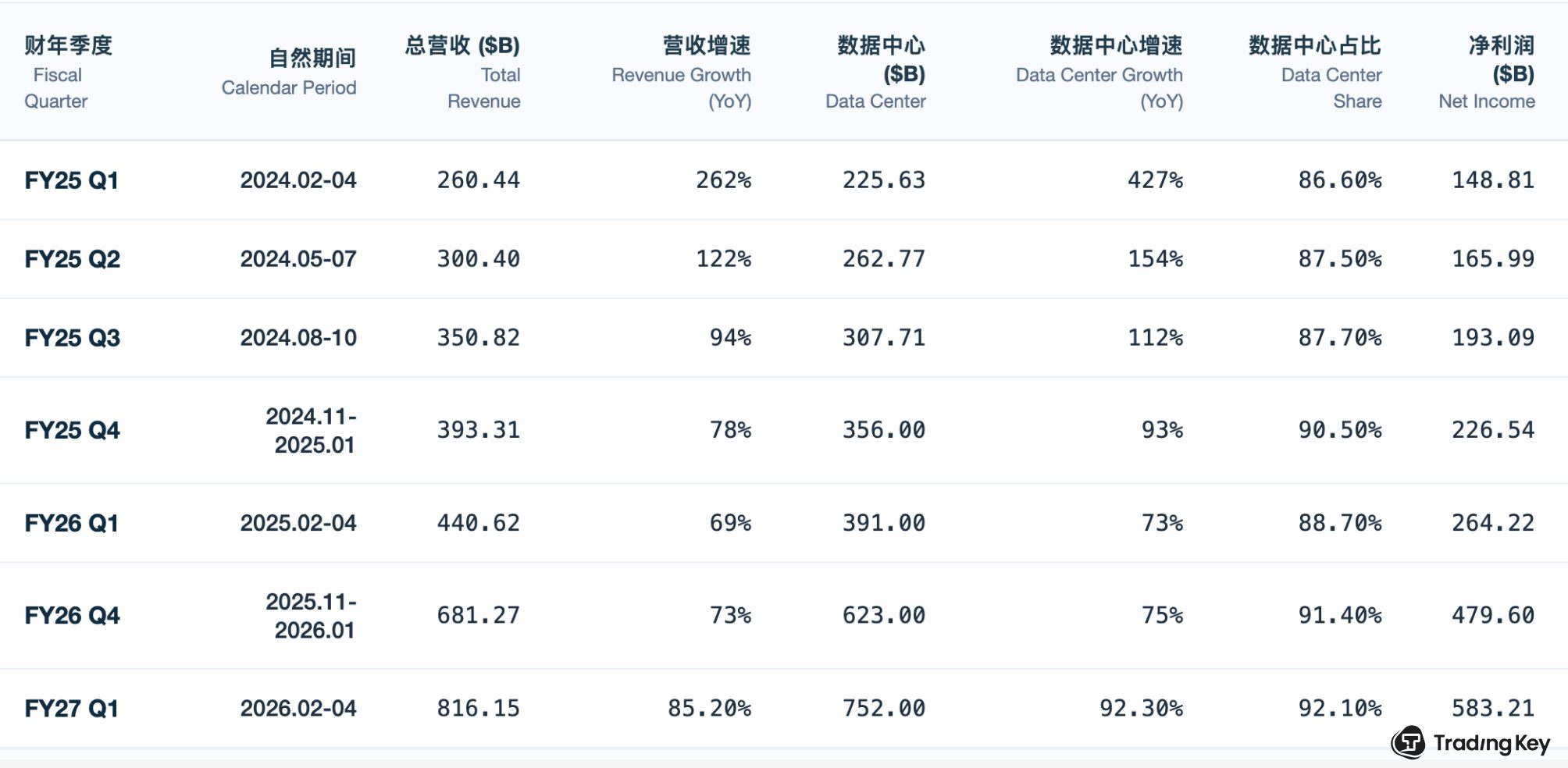
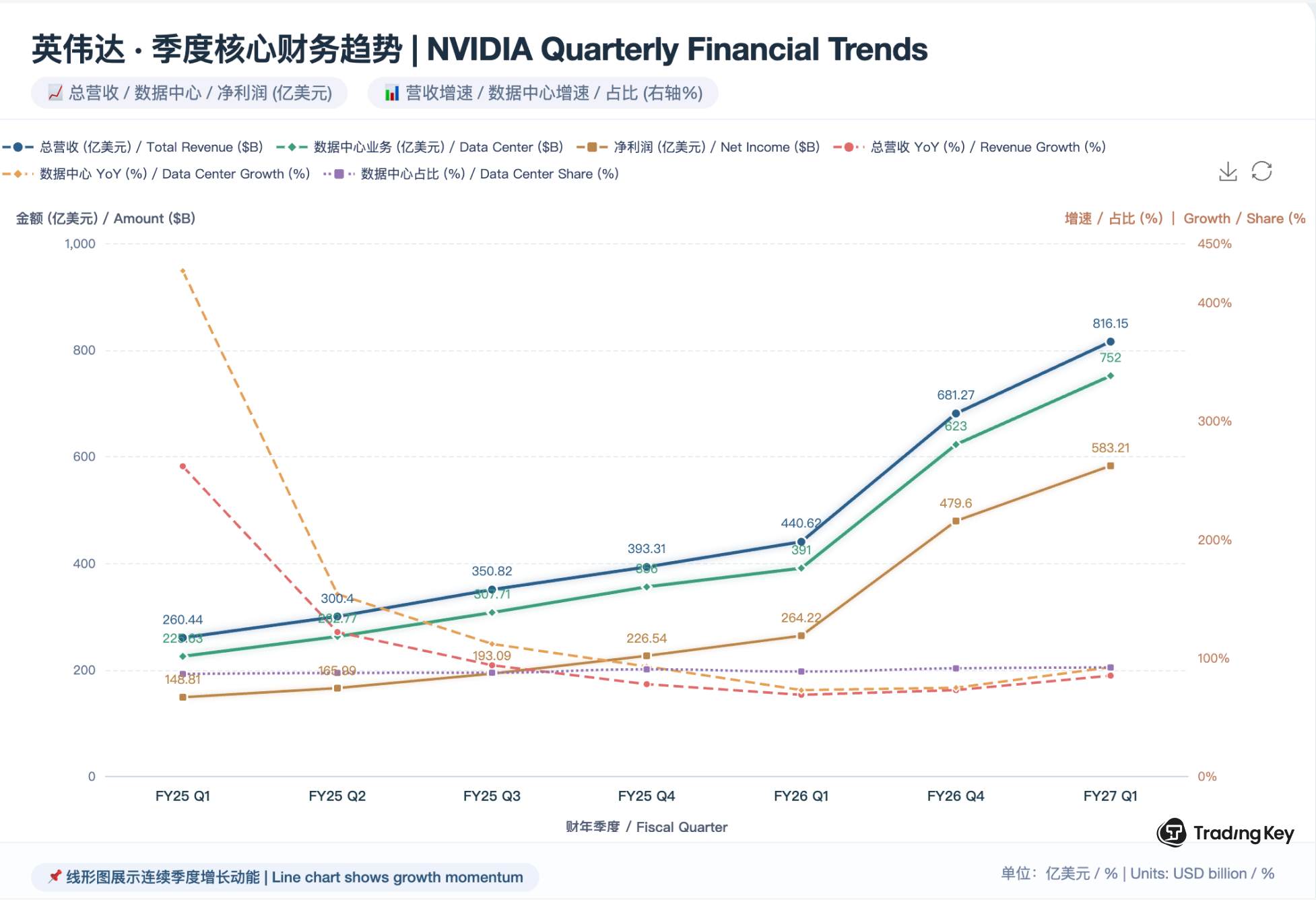
I. NVIDIA's strong data center revenue: AI computing demand is supported by profits
In economics, a "bubble" refers to an irrational surge in asset prices decoupled from intrinsic value and driven solely by speculation. However, NVIDIA's actual financial data shows that the current AI boom has a solid performance foundation, proving that demand for AI computing power is backed by real orders and profits, fundamentally differing from the widespread losses during the 2000 dot-com bubble.
II. Current valuations are far below the 2000 dot-com bubble peak .
At the peak of the 2000 dot-com bubble, the P/E ratio of the Nasdaq Composite Index was approximately 180x, and Cisco ( CSCO) reached 152x; in contrast, the 2026 forward P/E for the Nasdaq is only 35x, with NVIDIA also at 35x. Current valuations are only one-fifth of those during the bubble era.
Back then, tech stocks lacked substantial earnings and were driven to triple-digit P/E ratios purely by concepts; today, giants like NVIDIA and Microsoft ( MSFT) and others are already generating tangible profits from their AI businesses, with high growth effectively absorbing stock prices and keeping overall P/E ratios within a reasonable range of around 35x. Even as the Nasdaq repeatedly hits new highs, its valuation remains far below 2000 levels, indicating that this AI boom has a solid performance base and is not on the eve of a bubble collapse.
2000 Bubble Peak P/E | 2026 Forward P/E |
Cisco 152x | NVIDIA 35x |
Yahoo 108x | Microsoft 32x |
Nasdaq Composite 180x | Nasdaq Composite 35x |
III. AI has generated real revenue
In 2025, annual investment in U.S. data centers is approximately $120 billion, six times that of 2000. Looking back at 2000, broadband penetration was only 6% and e-commerce penetration was less than 1%; today, Microsoft Azure's AI revenue has achieved triple-digit growth for several consecutive quarters, and NVIDIA's quarterly data center revenue exceeds $70 billion. Contracts and orders have replaced concepts and expectations as the true foundation of current AI investment.
IV. Inference demand takes over from training
As global large models have basically completed their initial construction, according to McKinsey's 2026 computing power demand model, the explosive growth rate of "brute-force pre-training" computing power will drop from a historical peak of nearly +280% in 2024 to a normalized growth rate of approximately +22% by 2027.
Additionally, an official Deloitte survey indicates that inference computing power will account for about 66% of total AI computing power in 2026. The focus of computing demand is accelerating its shift from the concentrated explosion phase of "training large models" to a distributed application phase centered on continuous inference. This structural pivot suggests that AI infrastructure development and commercial implementation are deepening in tandem.
Year | Training Computing Power Growth Rate | Inference Computing Power Growth Rate |
2024 | +280% | +150% |
2025 | +120% | +200% |
2026 | +50% | +180% |
2027 (Forecast) | +22% | +140% |
V. Penetration of mainstream AI applications is still climbing
According to the Ramp AI Index released in June 2026 (based on hard invoice data from 50,000 U.S. companies), ChatGPT's enterprise penetration rate is 32.3%, Google Gemini's is 4.7%, and Claude's is 34.4%, suggesting significant room for growth before saturation.
AI Application Name | Enterprise Penetration Rate | 2026 Actual Monthly Active Users (MAU) |
Claude (Anthropic) | 34.4% | Approx. 90 million |
ChatGPT (OpenAI) | 32.3% | Approximately 950 million - 1 billion |
Google Gemini | 4.7% | Approximately 900 million |
Investment Value Analysis of AI-Related Stocks
Company | Ticker | 2026 Forward P/E | Key Risks |
SK Hynix | 000660.KS | 9x | Catch-up by Samsung, HBM price decline |
Samsung Electronics | 005930.KS | 11x | Yield ramp-up, memory cycle fluctuations |
Qualcomm | QCOM | 18x | Weak handset business, low automotive revenue contribution |
LG Electronics | 066570.KS | Approx. 6.8x | Price wars in traditional home appliances, time needed for AI business monetization |
NAVER | 035420.KS | Approx. 15x | Massive ongoing investment required for data center construction |
SK Hynix
In 2025, full-year operating profit reached 47.2 trillion KRW, making it the primary beneficiary of the AI memory cycle. On NVIDIA's Vera Rubin platform, SK Hynix commands 60%-70% of the HBM4 supply. BOCOM International believes the global memory industry is in its strongest upcycle of the century, with prices expected to remain elevated until at least Q1 2027.
Institutional Perspectives: Citi ( C) raised its price target in May 2026 from 1.7 million KRW to 3.1 million KRW and maintained a "Buy" rating, citing a 30% QoQ increase in HBM4 prices in Q4 2026 and a doubling of server DDR5 prices. Goldman Sachs ( GS) raised its price target to 3.5 million KRW, forecasting supply shortages to persist through 2028 and an average HBM price catch-up of approximately 44% in 2027.
Key Risks: Fundamentals remain solid, but market expectations are largely baked in, with the stock price partially pricing in growth for years to come. Samsung's HBM market share has recovered from a low of 17% in Q2 2025 to 35% in Q3, and its plans for mass production of HBM4 in the second half of the year may intensify competition and compress margins.
Samsung Electronics
Goldman Sachs expects operating profit to grow over eightfold year-over-year in 2026, with HBM revenue projected to surge to approximately $44 billion by 2027.
Institutional Perspectives: In May 2026, Citi initiated a 90-day "positive catalyst watch" and raised its price target to 460,000 KRW, forecasting average annual price increases of 200% for DRAM and 186% for NAND in 2026. Goldman Sachs raised its price target to 260,000 KRW (Buy rating).
Key Risks: HBM4 certification is a positive signal, but yield ramp-up remains a critical variable. While the strike sparked by profit distribution issues has subsided, bonus disparities in the wage agreement continue to cause internal friction.
Qualcomm
The company is positioned in AI through custom chips, server CPUs, AI accelerators, and data center interconnect products. J.P. Morgan expects the data center business to contribute over $3 billion by FY2027, rising to $35 billion by FY2031. In the automotive sector, it has collaborated with partners like Volkswagen on smart cockpits and autonomous driving systems; annual revenue from automotive and IoT is projected to reach $17 billion by FY2031, with non-handset business accounting for approximately 70% of revenue.
Institutional Perspectives: J.P. Morgan raised its price target to $265, bullish on the medium-to-long-term data center guidance expected at the June Investor Day. Goldman Sachs initiated coverage with a "Neutral" rating and a price target of $135, citing concerns over market share loss from Apple.
Key Risks: The handset business remains a drag, with memory shortages and price hikes weighing on demand. Apple's faster-than-expected progress in in-house baseband development and the expiration of licensing agreements within a year pose potential threats. While the long-term potential for the data center business is significant, its short-term revenue contribution remains low amid intensifying competition.
LG Group
During Jensen Huang's visit to South Korea, LG Group expanded its collaboration to the entire Physical AI workflow, covering humanoid robots, data center cooling, and modular construction. Institutional data shows LG Electronics' 2026 forward P/E at approximately 6.8x, while the LG Group holding company's 2026 forward P/E is around 6.1x, indicating low valuations. Key risks include intense price competition in traditional home appliances weighing on profitability, and the fact that revenue conversion for new AI businesses will take significant time.
NAVER
NAVER is advancing its "AI Factory" initiative with NVIDIA, expanding the Sejong Data Center. On June 9, several institutions raised their price targets: Kyobo Securities to 390,000 KRW, Daishin Securities to 400,000 KRW, and Kiwoom Securities to 320,000 KRW, all highlighting the valuation re-rating driven by the new AI Factory business.
Market estimates place NAVER's 2026 forward P/E at approximately 14-16x. The primary risk lies in the continuous and massive capital expenditures required for AI data center construction, while uncertainty remains regarding the realization of long-term returns.
Summary: The AI bubble is not in the sector, but in the positioning.
Jensen Huang’s trip to South Korea demonstrates that AI infrastructure development is genuine and enduring, with the supply chain continuing to gain momentum. Nevertheless, investors should distinguish between fundamentals and sentiment. While Huang’s comments as NVIDIA’s CEO provide valuable context, they should not be the sole basis for investment decisions. AI infrastructure is not a bubble, as it is supported by tangible orders, revenue, and user growth. However, the retail frenzy for anything AI-linked, coupled with the inflated valuations of some peripheral concept stocks, does exhibit bubble-like traits.
Huang’s suggestion of "buying at a discount" offers valid encouragement for long-term investors holding core assets; however, for speculators using high leverage to chase "AI concept lotteries," it may instead signal that they are providing the exit liquidity.
Recommended Articles


