


If I Could Tell All Investors 1 Thing About the Stock Market Right Now, It's This
Key Points
Major market indexes are thriving despite plenty of economic turbulence.
Nobody can predict how the market will fare in the short term, but its long-term potential is fantastic.
The right investments are key to surviving future volatility.
- 10 stocks we like better than Vanguard S&P 500 ETF ›
The past year has been a confusing one for many investors, as the stock market has been sending mixed signals.
Despite persistent recession warnings, surging inflation, and the war in Iran disrupting global supply chains, major market indexes are thriving. The S&P 500 (SNPINDEX: ^GSPC) has delivered total returns of around 33% over the last year, as of this writing, with the Dow Jones Industrial Average up roughly 23% (DJINDICES: ^DJI) and the tech-heavy Nasdaq Composite (NASDAQINDEX: ^IXIC) soaring 47%.
Will AI create the world's first trillionaire? Our team just released a report on the one little-known company, called an "Indispensable Monopoly" providing the critical technology Nvidia and Intel both need. Continue »
This has left many investors feeling conflicted about the future, and for good reason. But if I could tell everyone one thing about the stock market right now, it's this: Don't get hung up on the market's short-term performance.
Image source: Getty Images.
Time in the market is more valuable than timing the market
Accurately predicting the market's short-term performance is next to impossible, and the past year has proven that it's typically not worthwhile, either. The market has been especially unpredictable lately, marked by sudden downturns and even more unexpected recoveries.
My best advice to investors, then, is to accept that the market will be unpredictable at times. Rather than focusing on how stocks will perform in the coming weeks or months, be prepared to hold your investments for the long haul. Otherwise, you risk selling at an inopportune time and locking in losses.
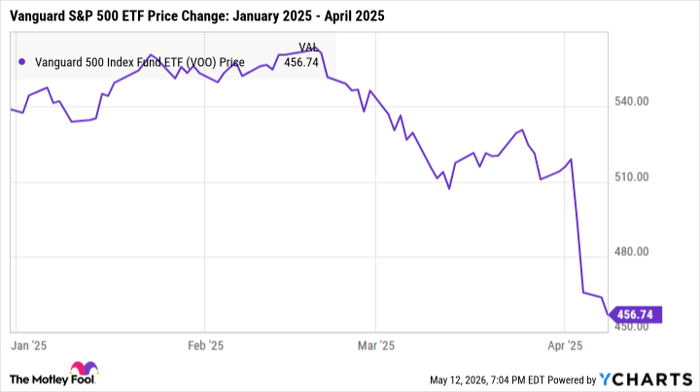
Say, for instance, an investor purchased an S&P 500–tracking fund in January 2025. For simplicity's sake, let's use the Vanguard S&P 500 ETF (NYSEMKT: VOO) as an example. On Jan. 1, 2025, this exchange-traded fund (ETF) cost around $539 per share.
Let's also say this investor sold their ETF in April of that year after the market had plunged amid concern over tariffs. That may have seemed logical at the time, as many investors were worried the market was headed toward a deep downturn.
VOO data by YCharts
By mid-April, though, the Vanguard S&P 500 ETF had dropped to just $457 per share, and selling would have locked in a loss of around $82 per share.
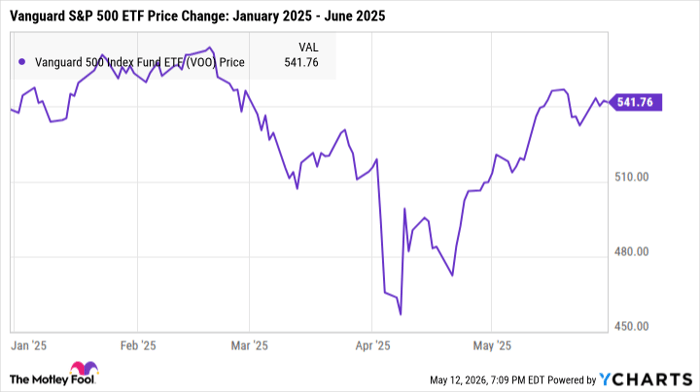
Even worse, say that this investor had decided to reinvest in June, after it was clear the market was recovering. By then, the Vanguard S&P 500 ETF cost around $542 per share. In other words, this investor would not only have locked in substantial losses by selling early, but they'd also been forced to pay a higher price to rebuy the exact same ETF they'd just sold.
VOO data by YCharts
If history shows us anything, it's that the longer you stay invested in the market, the lower your chances of losing money.
Throughout the S&P 500's history, around 33% of its one-year periods have ended in negative total returns, according to research from Capital Group. That figure drops to 7% for five-year periods, and over the last 82 years, zero of the index's 10-year periods have ended in negative total returns.
This means that if you invest in an S&P 500 index fund or ETF and hold it for just one year before selling, there's historically a 33% chance you'll lose money. Hold it for five years, and your chances of losing anything dip to 7%. If you wait 10 years before selling, it's virtually unheard of to lose money with an S&P 500 fund. This doesn't mean it's impossible, but it's highly unlikely.
The secret to long-term growth
Investing in quality stocks with solid foundations is the single best way to ensure your portfolio thrives over time. Stock price alone doesn't always tell the full story, as some stocks are fueled by hype and may crumble when the market falters.
If you study a company's underlying fundamentals -- from its finances to its leadership team to the health of the overall industry -- you will find it easier to separate the strong from the shaky.
Even the healthiest companies will still experience some volatility, but that's normal. With a portfolio full of quality stocks with long-term growth potential, you can rest easier during the next downturn knowing that your investments will likely come out the other side unscathed.
Should you buy stock in Vanguard S&P 500 ETF right now?
Before you buy stock in Vanguard S&P 500 ETF, consider this:
The Motley Fool Stock Advisor analyst team just identified what they believe are the 10 best stocks for investors to buy now… and Vanguard S&P 500 ETF wasn’t one of them. The 10 stocks that made the cut could produce monster returns in the coming years.
Consider when Netflix made this list on December 17, 2004... if you invested $1,000 at the time of our recommendation, you’d have $472,205!* Or when Nvidia made this list on April 15, 2005... if you invested $1,000 at the time of our recommendation, you’d have $1,384,459!*
Now, it’s worth noting Stock Advisor’s total average return is 999% — a market-crushing outperformance compared to 208% for the S&P 500. Don't miss the latest top 10 list, available with Stock Advisor, and join an investing community built by individual investors for individual investors.
See the 10 stocks »
*Stock Advisor returns as of May 15, 2026.
Katie Brockman has positions in Vanguard S&P 500 ETF. The Motley Fool has positions in and recommends Vanguard S&P 500 ETF. The Motley Fool has a disclosure policy.
Recommended Articles


