

OpenAI's new math advisory group gets a say on releases but not on research pace

Source Cryptopolitan

OpenAI has brought in nine preeminent mathematicians to advise on how it presents and releases its AI-generated math results.

The company says the panel has no say in the pace of its research.

Princeton’s Institute for Advanced Study hosts the unpaid panel

The panel is called the Advisory Group on Mathematics and Artificial Intelligence. It’s hosted at the Institute for Advanced Study in Princeton, New Jersey, and lives online at agmai.org.

Per OpenAI’s blog post, the group helps the company appraise the importance of new results and coordinate when and how they are released. It also weighs them against the field’s academic and professional norms, and advises on how to serve working mathematicians with the tools of OpenAI.

It “will not be responsible for advising us on how to pace our internal progress on mathematics,” OpenAI wrote.

OpenAI began training a new internal model on August 28. The company says the model has since solved over 100 long-standing open problems in most branches of mathematics, alongside a claimed solution to the Navier-Stokes Millennium Prize Problem.

The initial members are François Charles of ENS-PSL, Camillo De Lellis of IAS and GSSI, Timothy Gowers of Collège de France and Cambridge, Martin Hairer of EPFL and Imperial College London, and Nikhil Srivastava of Berkeley and the Simons Institute.

The list is rounded out by Oxford and INI’s Ulrike Tillmann, Stanford’s Ravi Vakil, IAS’s Edward Witten and Harvard’s Melanie Matchett Wood.

Several of the members have Fields Medals of their own. OpenAI contacted some of them about an external advisory board, the group said in a guest post on mathematician Terence Tao’s blog, and instead they formed an independent group and invited others to join.

Members take no payment from OpenAI, and they set their own membership.

They can issue unsolicited recommendations. They can comment publicly on the impact of the company.

The group said it would offer the same counsel to any AI lab whose models might reshape the field.

Although we will give advice, we do not have decision making power at any AI company, and the responsibility for the decisions made by any company will rest with that company.

The group said on its website. Its current job is to advise OpenAI on how to release the large batch of results produced by its internal model.
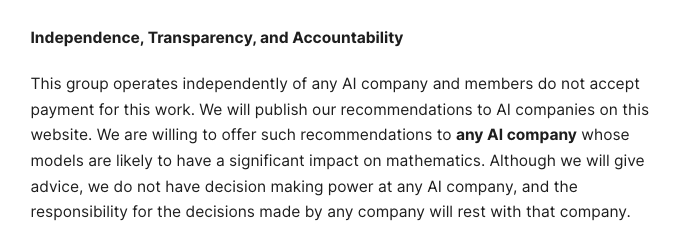
Nine mathematicians will advise on releasing OpenAI's 100-plus math results but cannot slow its pace.
The advisory group’s independence statement on agmai.org, captured September 22, 2026.

25 Fields Medalists warned AI labs on September 11

On September 11, 25 Fields Medal winners launched an open letter called “A Severe Misalignment of AI in Mathematics.” AI labs racing to solve famed problems put mathematicians’ intellectual work at risk, it says.

The declaration now lists 27 medalists and more than 7,800 endorsers.

OpenAI cited the letter directly, framing the criticism as a reason to engage the community more thoughtfully.

Three of the nine advisers are on the declaration. Martin Hairer signed it as a Fields Medalist, and Camillo De Lellis and Ravi Vakil endorsed it.

The advisory group arrives weeks after OpenAI’s math claims turned contentious. As Cryptopolitan reported on September 8, OpenAI said an internal model showed finite-time blow-up for the forced Navier-Stokes equations, verified in the Lean proof-verification language.

A few days earlier, related blow-up results were published by NYU mathematician Tristan Buckmaster and Anthropic researcher Levent Alpöge. But Buckmaster said he was told “very little human input” went into OpenAI’s proof, an account he says fell apart on a call with the company.

Buckmaster wrote that an entire team had worked the problem and that easier cases, Euler included, came first. He added that the prompt shown to him was itself generated by prompting Codex.

Sébastien Bubeck, the OpenAI researcher who was at the center of the exchange, said the allegations were “false and inflammatory.” He denied using the mathematicians’ prompts or proofs.

OpenAI has said that it does not intend to claim the Clay Mathematics Institute prize of $1 million.

Don’t just read crypto news. Understand it. Subscribe to our newsletter. It's free.

Disclaimer: For information purposes only. Past performance is not indicative of future results.
placeholder
Bitcoin falls below $75,000 as the CLARITY Act fails in the Senate — what the vote means for cryptoThe US Senate blocked the Digital Asset Market CLARITY Act in a 49-50 procedural vote, sending Bitcoin briefly below $75,000 — its biggest one-day drop since June. Ethereum fell more than 8%, Coinbase slid 10% and $75 billion of crypto market value evaporated. Here is what the vote was, why it failed, and the levels that matter now.
Author  Suzie
Sep 16, Wed
The US Senate blocked the Digital Asset Market CLARITY Act in a 49-50 procedural vote, sending Bitcoin briefly below $75,000 — its biggest one-day drop since June. Ethereum fell more than 8%, Coinbase slid 10% and $75 billion of crypto market value evaporated. Here is what the vote was, why it failed, and the levels that matter now.
placeholder
Dollar index tops 100 for the first time since July as the Fed's hawkish dot plot sinks inThe U.S. dollar index broke back above 100 for the first time since 31 July after the Fed delivered its first rate hike since 2023, with the dot plot showing 16 of 18 officials expect at least one more increase this year. Here are the levels that matter for DXY, the currencies feeling it most, and what to watch next.
Author  Irene Q.
Sep 17, Thu
The U.S. dollar index broke back above 100 for the first time since 31 July after the Fed delivered its first rate hike since 2023, with the dot plot showing 16 of 18 officials expect at least one more increase this year. Here are the levels that matter for DXY, the currencies feeling it most, and what to watch next.
placeholder
Gold ends three-week slide at the $4,400 line — eight straight days of ETF inflows vs a 5% 10-year and a 100 dollarSpot gold closed Friday at $4,378.39, up 0.84% on the day and about 0.8% for the week — its first weekly gain in four weeks — with the intraday high of $4,399.67 leaving it 33 cents shy of the $4,400 line. Gold ETFs have now logged eight straight sessions of inflows, but with the 10-year back above 5% and the dollar index near 100, here is what decides whether this is a reversal or a bounce.
Author  Suzie
Sep 20, Sun
Spot gold closed Friday at $4,378.39, up 0.84% on the day and about 0.8% for the week — its first weekly gain in four weeks — with the intraday high of $4,399.67 leaving it 33 cents shy of the $4,400 line. Gold ETFs have now logged eight straight sessions of inflows, but with the 10-year back above 5% and the dollar index near 100, here is what decides whether this is a reversal or a bounce.
placeholder
Gold Price Forecast: Gold Eyes Key $4,400 Resistance as Falling Oil Prices Ease Inflation PressureAs of the Asian session on September 21, gold prices (XAUUSD) maintained high-level consolidation intraday today following a strong rebound last week, with the latest price trading around
Author  TradingKey
Sep 21, Mon
As of the Asian session on September 21, gold prices (XAUUSD) maintained high-level consolidation intraday today following a strong rebound last week, with the latest price trading around
placeholder
Dollar holds above 100 near a 3-month high — three Fed speakers and a $69 billion auction land tonightThe dollar index closed at 100.43 on Monday, its highest close since late July, after a weekly gain of about 1% — the best in more than three months — and is holding above the 100.00 handle in Asia. Three Fed officials speak tonight alongside a $69 billion two-year note auction, the first leg of $183 billion of Treasury supply this week.
Author  Suzie
20 hours ago
The dollar index closed at 100.43 on Monday, its highest close since late July, after a weekly gain of about 1% — the best in more than three months — and is holding above the 100.00 handle in Asia. Three Fed officials speak tonight alongside a $69 billion two-year note auction, the first leg of $183 billion of Treasury supply this week.
goTop
quote