


Dow Jones Industrial Average drops from a weekly high as bank shares slide
- DJIA drops from its highest level since September 14 as bank shares slide.
- Trump expects an Iran deal right after the November 3 midterm election.
- The Fed's next rate decision is October 28, six days before the midterms.
The Dow Jones Industrial Average rose to its highest level since September 14 before the opening bell, then turned lower once trading started in New York. It trades near 51,800, below Monday's close. The NASDAQ Composite tested record highs and the S&P 500 is barely changed. Money is moving out of financial companies and into technology, and the Dow has more of the first in it and less of the second compared to the other two indexes.
The smaller bank counts for more in the Dow
Financial shares, from banks to brokers and insurers, are falling across the market. Traders are moving the money into technology on growing interest in artificial intelligence (AI) agents, apps that carry out tasks like booking travel. JPMorgan Chase (JPM), the biggest bank in the country, is falling with the rest. JPMorgan's own analysts raised their rating on Meta Platforms (META) earlier in September because of Meta's new agent, and Meta is one of the stocks the money is going into.
The Dow is calculated from share prices alone, so a $1 change in any of its 30 shares moves the index about 6 points, whatever the size of the company. A $10 fall is 1% of a $1,000 share and 10% of a $100 share, and it takes about 60 points off the Dow either way. The S&P 500 and the NASDAQ Composite are weighted by each company's total stock market value instead, so the biggest technology companies count the most there.
Goldman Sachs (GS) shares cost more than $900, among the most expensive in the Dow, and JPMorgan's cost less than $400. JPMorgan is worth more than three times as much, but a 1% fall in Goldman Sachs takes more than twice as many points off the index. Meta isn't in the Dow at all, which is how a day of selling banks and buying technology leaves the Dow lower and the NASDAQ Composite at a record.
Crude Oil keeps falling on a deal dated after the midterms
Crude Oil is down for a fifth session in a row. Brent, the international benchmark, reached its lowest level since September 8 on reports that Iran has offered to reopen the Strait of Hormuz within seven days. The offer depends on the United States lifting its blockade of Iranian ports, and it hasn't been independently confirmed. A cheaper barrel costs Chevron (CVX), the only energy producer in the Dow, and saves the other 29 money on fuel.
Trump told the United Nations General Assembly he must choose between a deal with Iran and wiping out the Islamic Republic. He expects a deal right after the November 3 midterms and said it would push Crude Oil below its prewar price. Crude Oil rose off its low after the speech, and on his timeline the fall he promised in fuel costs for the other 29 comes after November 3. By his account, Iran is waiting on the result of an American election before it signs.
The Fed decides six days before the midterms
The Fed raised its main reference rate, what banks charge each other to borrow overnight, by a quarter-point to 3.75-4.00% on September 16. It was the first increase since July 2023, and higher fuel prices helped drive it. JPMorgan raised its prime rate, what it charges its most creditworthy borrowers, to 7.00% on September 17, so the increase went straight into what it charges for loans.
Most Fed officials expect at least one more increase before the end of the year, and the next decision is on October 28. Goldman Sachs makes less from lending and more from arranging takeovers and share sales, which are harder to pay for when borrowing costs rise. Another increase would do more for the bank that moves the Dow less.
Levels and bias
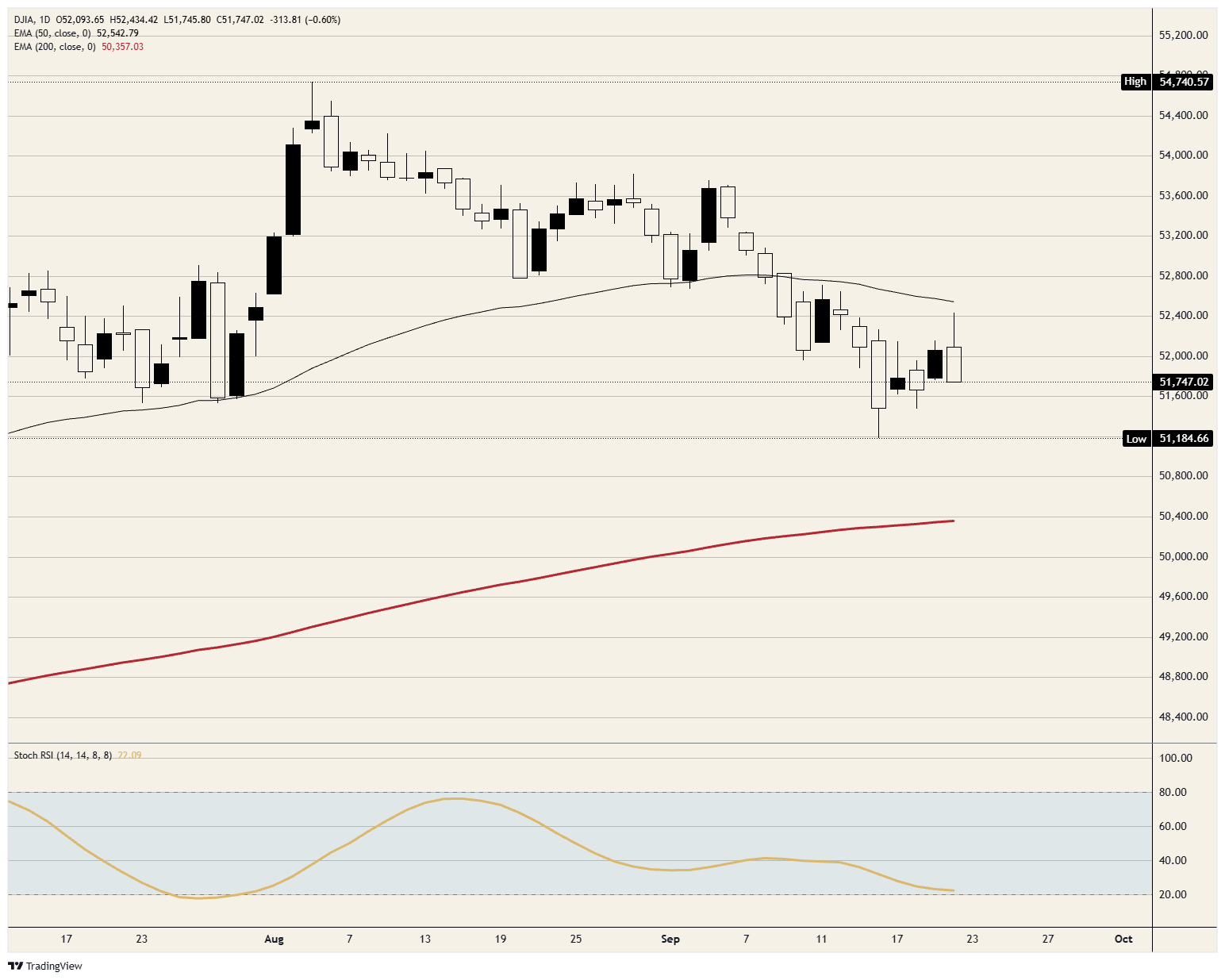
Resistance: The index went through the September 17 and Monday highs just above 52,100 before the open and fell back under them once trading started, which makes that area the first cap. Tuesday's high just above 52,400 is the highest since September 14 and the level the rally ended at.
Support: Tuesday's low just under 51,800 matches Monday's low just above 51,750, the second session in a row the index has stopped there. Below that are the September 18 low just under 51,500 and the September 16 low near 51,200, the lowest since June.
Bias: Bearish below 52,100. The first objective is the September 18 low just under 51,500, and the second is the September 16 low near 51,200. The daily Stochastic Relative Strength Index (Stoch RSI), a momentum gauge, is near 22 and has fallen for two weeks without turning up. The bearish view fails on a daily close above 52,200.
Dow Jones daily chart
Dow Jones FAQs
The Dow Jones Industrial Average, one of the oldest stock market indices in the world, is compiled of the 30 most traded stocks in the US. The index is price-weighted rather than weighted by capitalization. It is calculated by summing the prices of the constituent stocks and dividing them by a factor, currently 0.152. The index was founded by Charles Dow, who also founded the Wall Street Journal. In later years it has been criticized for not being broadly representative enough because it only tracks 30 conglomerates, unlike broader indices such as the S&P 500.
Many different factors drive the Dow Jones Industrial Average (DJIA). The aggregate performance of the component companies revealed in quarterly company earnings reports is the main one. US and global macroeconomic data also contributes as it impacts on investor sentiment. The level of interest rates, set by the Federal Reserve (Fed), also influences the DJIA as it affects the cost of credit, on which many corporations are heavily reliant. Therefore, inflation can be a major driver as well as other metrics which impact the Fed decisions.
Dow Theory is a method for identifying the primary trend of the stock market developed by Charles Dow. A key step is to compare the direction of the Dow Jones Industrial Average (DJIA) and the Dow Jones Transportation Average (DJTA) and only follow trends where both are moving in the same direction. Volume is a confirmatory criteria. The theory uses elements of peak and trough analysis. Dow’s theory posits three trend phases: accumulation, when smart money starts buying or selling; public participation, when the wider public joins in; and distribution, when the smart money exits.
There are a number of ways to trade the DJIA. One is to use ETFs which allow investors to trade the DJIA as a single security, rather than having to buy shares in all 30 constituent companies. A leading example is the SPDR Dow Jones Industrial Average ETF (DIA). DJIA futures contracts enable traders to speculate on the future value of the index and Options provide the right, but not the obligation, to buy or sell the index at a predetermined price in the future. Mutual funds enable investors to buy a share of a diversified portfolio of DJIA stocks thus providing exposure to the overall index.
Recommended Articles


