

CryptoQuant CEO: Bitcoin needs deeper institutional allocation as retail influence declines

Source Cryptopolitan

Bitcoin will need over $1 trillion in fresh institutional capital to recover to a place where price stays in the green for a sustained period, according to CryptoQuant CEO Ki Young Ju.  

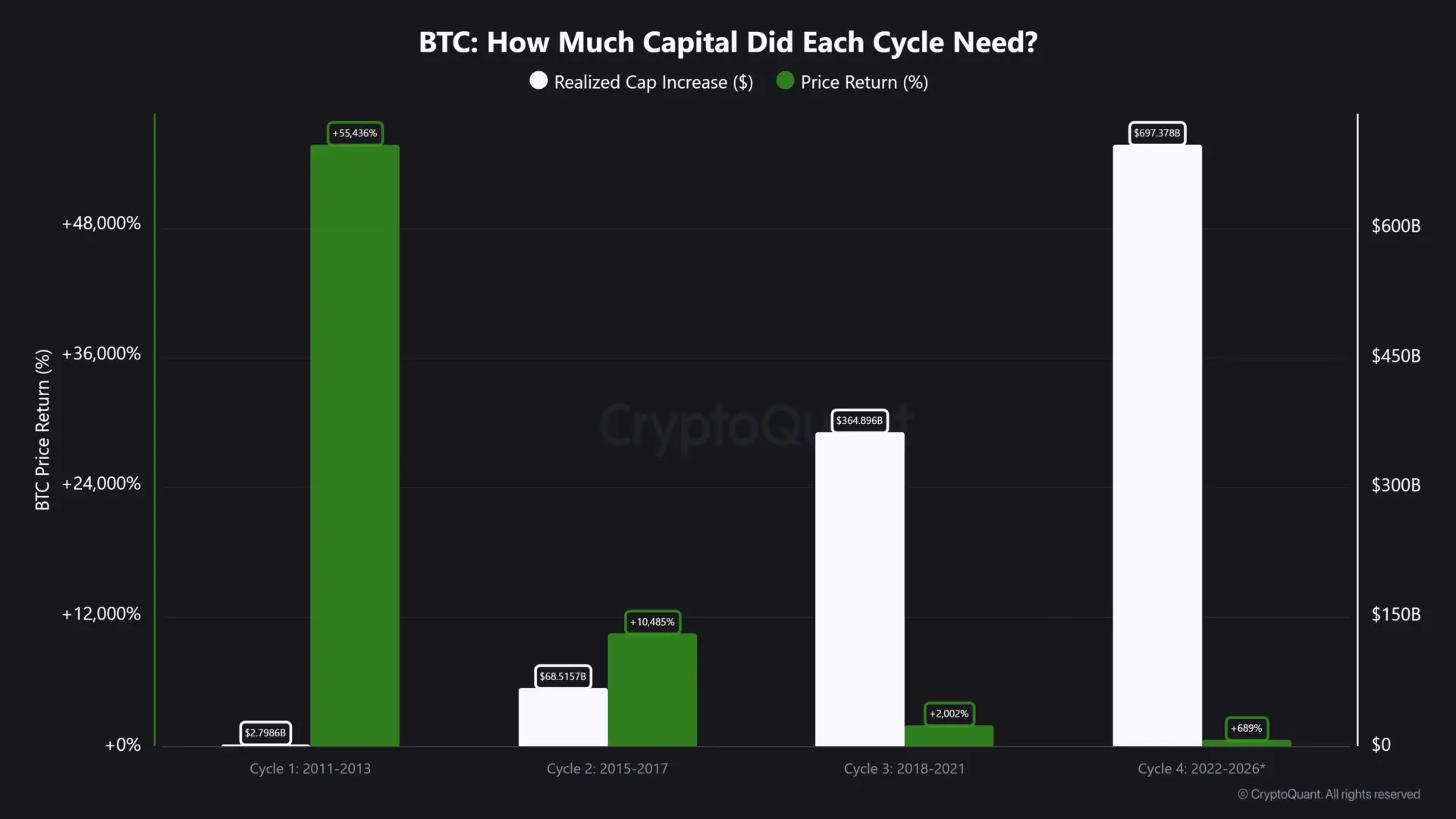
Ju published on-chain data on July 1 showing how much more capital each Bitcoin cycle needs to produce meaningful returns.

While $2.7 billion in net inflows drove a 55,436% price gain in 2011, the current cycle turned $697 billion into a 689% run, as seen on the CryptoQuant dashboard. There has to be around $101 billion in net flows, up from $5 million in 2011, for Bitcoin’s price to double today.

Ju wrote, “The next parabolic bull cycle likely requires deeper institutional portfolio allocation and Bitcoin becoming a core macro asset, not just an ETF trade.” According to him, if Bitcoin can absorb more than $1 trillion in realized capitalization, another parabolic run remains possible, noting gold’s market cap sits at $27 trillion.
Bitcoin needs trillions in new capital, but institutions are chasing AI instead
Bitcoin needs exponentially more capital to replicate past rallies. Source: CryptoQuant

Bitcoin chokes as AI steals the oxygen

The institutional capital Ju says Bitcoin needs is, for now, heading in the opposite direction.

When gold, silver, and Bitcoin sold off together in recent weeks as a hedge trade unwound, proceeds moved into AI stocks rather than back into Bitcoin. Some Bitcoin miners have also redirected their computing capacity toward AI hosting, where contracted payments beat the volatility of mining revenue.

Bitcoin currently trades around $58,800, down more than 45% from its October high above $120,000.

U.S. spot Bitcoin ETFs have been taking a beating too, enduring persistent redemptions in recent weeks. SoSoValue recorded that $222.64 million was pulled out yesterday, June 30, with BlackRock’s IBIT alone hemorrhaging $212.45 million.

On-chain data shows sellers growing more aggressive

On-chain analyst Axel Adler Jr. reported on July 1 that Bitcoin exchange inflows, measured by a 30-day moving average, have risen to 122,000 BTC, which is around 52% above the February level of around 80,000 BTC. The yearly baseline is around 82,000 BTC, and the current reading is approaching the upper standard deviation band at 131,000 BTC.

The Spent Output Profit Ratio, which is a metric that tracks whether coins are being moved at a profit or loss, has held below the breakeven level of 1.0 for 37 of the past 61 days.

Adler pointed out that while February showed a similar loss-realization reading, it came with far lower exchange inflows. This time around, the current correction is more severe, as it faces the combined forces of heavier selling volume and persistent loss-taking.

Where will the new buyers likely come from?

According to Grayscale’s head of research, Zach Pandl, beyond the small group of digital asset treasury firms that have driven most institutional demand this cycle, two cohorts will be responsible for driving the surge.

The first cohort will involve the transfer of wealth from baby boomers and the silent generation, who are estimated to hold $110 trillion in assets. That wealth will move to younger, more crypto-open investors over the coming decades. Pandl estimated that if 2% of that wealth entered crypto, it would create $2.2 trillion in new demand.

The second cohort is corporate treasuries outside the crypto-native world. Pandl pointed to SpaceX, which holds 18,712 Bitcoin worth about $1.4 billion, as a potential catalyst once the company goes public.

However, neither of these cohorts is buying at scale today, and with AI infrastructure commanding the largest capital commitments in a generation, the trillions Ju says Bitcoin needs remain, for now, spoken for.

If you're reading this, you’re already ahead. Stay there with our newsletter.

Disclaimer: For information purposes only. Past performance is not indicative of future results.
placeholder
Bitcoin CME gaps at $35,000, $27,000 and $21,000, which one gets filled first?Prioritize filling the $27,000 gap and even try higher.
Author  FXStreet
Aug 22, 2023
Prioritize filling the $27,000 gap and even try higher.
placeholder
Pinduoduo Earnings Incoming: Morgan Stanley Sees Long-Term Profit Potential​Insights – On November 21, Chinese e-commerce giant Pinduoduo (PDD) will release its Q3 2024 earnings.
Author  Mitrade
Nov 20, 2024
​Insights – On November 21, Chinese e-commerce giant Pinduoduo (PDD) will release its Q3 2024 earnings.
placeholder
Bitcoin briefly loses 2025 gains as crypto plunges over the weekend.Bitcoin experienced a sharp decline this weekend, briefly erasing its 2025 gains and dipping below its year-opening value of $93,507. The cryptocurrency fell to a low of $93,029 on Sunday, representing a 25% drop from its all-time high in October. Although it has rebounded slightly to around $94,209, the pressures on the market remain significant. The downturn occurred despite the reopening of the U.S. government on Thursday, which many had hoped would provide essential support for crypto markets. This year initially appeared promising for cryptocurrencies, particularly after the inauguration of President Donald Trump, who has established the most pro-crypto administration thus far. However, ongoing political tensions—including Trump's tariff strategies and the recent government shutdown, lasting a historic 43 days—have contributed to several rapid price pullbacks for Bitcoin throughout the year. Market dynamics are also being influenced by Bitcoin whales—investors holding large amounts of Bitcoin—who have been offloading portions of their assets, consequently stalling price rallies even as positive regulatory developments emerge. Despite these sell-offs, analysts from Glassnode argue that this behavior aligns with typical patterns seen among long-term investors during the concluding stages of bull markets, suggesting it is not indicative of a mass exodus. Notably, Bitcoin is not alone in its struggles, as Ethereum and Solana have also recorded declines of 7.95% and 28.3%, respectively, since the start of the year, while numerous altcoins have faced even steeper losses. Looking ahead, questions linger regarding the viability of the four-year cycle thesis, particularly given the increasing institutional support and regulatory frameworks now in place in the crypto landscape. Matt Hougan, chief investment officer at Bitwise, remains optimistic, suggesting a potential Bitcoin resurgence in 2026 driven by the “debasement trade” thesis and a broader trend toward increased adoption of stablecoins, tokenization, and decentralized finance. Hougan emphasized the soundness of the underlying fundamentals, pointing to a positive outlook for the sector in the longer term.
Author  Mitrade
Nov 17, 2025
Bitcoin experienced a sharp decline this weekend, briefly erasing its 2025 gains and dipping below its year-opening value of $93,507. The cryptocurrency fell to a low of $93,029 on Sunday, representing a 25% drop from its all-time high in October. Although it has rebounded slightly to around $94,209, the pressures on the market remain significant. The downturn occurred despite the reopening of the U.S. government on Thursday, which many had hoped would provide essential support for crypto markets. This year initially appeared promising for cryptocurrencies, particularly after the inauguration of President Donald Trump, who has established the most pro-crypto administration thus far. However, ongoing political tensions—including Trump's tariff strategies and the recent government shutdown, lasting a historic 43 days—have contributed to several rapid price pullbacks for Bitcoin throughout the year. Market dynamics are also being influenced by Bitcoin whales—investors holding large amounts of Bitcoin—who have been offloading portions of their assets, consequently stalling price rallies even as positive regulatory developments emerge. Despite these sell-offs, analysts from Glassnode argue that this behavior aligns with typical patterns seen among long-term investors during the concluding stages of bull markets, suggesting it is not indicative of a mass exodus. Notably, Bitcoin is not alone in its struggles, as Ethereum and Solana have also recorded declines of 7.95% and 28.3%, respectively, since the start of the year, while numerous altcoins have faced even steeper losses. Looking ahead, questions linger regarding the viability of the four-year cycle thesis, particularly given the increasing institutional support and regulatory frameworks now in place in the crypto landscape. Matt Hougan, chief investment officer at Bitwise, remains optimistic, suggesting a potential Bitcoin resurgence in 2026 driven by the “debasement trade” thesis and a broader trend toward increased adoption of stablecoins, tokenization, and decentralized finance. Hougan emphasized the soundness of the underlying fundamentals, pointing to a positive outlook for the sector in the longer term.
placeholder
Markets in 2026: Will gold, Bitcoin, and the U.S. dollar make history again? — These are how leading institutions thinkAfter a turbulent 2025, what lies ahead for commodities, forex, and cryptocurrency markets in 2026?
Author  Insights
Dec 25, 2025
After a turbulent 2025, what lies ahead for commodities, forex, and cryptocurrency markets in 2026?
placeholder
Gold Price Forecast: Does Gold Falling Below $4,000 Mean the Bull Market Is Over? Will It Still Rise in the Second Half of 2026?Heading into the second half of 2026, the gold market has transitioned from a strong-performing asset at the start of the year into one pulling back from its highs. Recently, gold prices
Author  TradingKey
Jun 29, Mon
Heading into the second half of 2026, the gold market has transitioned from a strong-performing asset at the start of the year into one pulling back from its highs. Recently, gold prices
goTop
quote