

Sandisk and Micron Dominated the First Half of 2026. Which Is the Best Buy Now?

Source The Motley Fool

Key Points

  • Micron and Sandisk have been among the best-performing stocks in the market.

  • The artificial intelligence build-out should drive further demand for their products.

  • 10 stocks we like better than Micron Technology ›

If you purchased shares of Micron Technology (NASDAQ: MU) and Sandisk (NASDAQ: SNDK) stock at the beginning of the year, you look like an absolute genius right now. The stocks have performed remarkably well, with Micron rising 325%, and Sandisk delivering nearly 900% gains. Most investors see those returns over decades, not months.

But there's a growing question investors must answer: Is there room for more, and if there is, which stock is the better one to buy? Let's take a look at these two and see if the roller-coaster ride is peaking or just getting started.

Missed Nvidia in 2009? This Rare Signal Is Flashing Again. In 2009, a "Double Down" signal flashed for a little-known chipmaker called Nvidia. For the first time in years, that same "Total Conviction" signal is flashing for a company 1/100th the size of Nvidia. Continue »

Tech holding a chip.

Image source: Getty Images.

The AI build-out is driving massive growth for these two

Both Micron and Sandisk are memory chip makers. Micron operates on both sides of the market, producing both DRAM and NAND memory, while Sandisk is solely on the NAND side.

NAND memory is non-volatile and can hold information even if it loses power, making it great for long-term data storage. It's utilized in devices like solid-state drives (SSDs), and those are in high demand as data centers are built out across the nation.

DRAM memory is tailored for high-speed, rapid recall purposes and gets deployed alongside powerful computing chips. So, whenever you hear about how many more chips are being sold by companies like Advanced Micro Devices or Nvidia, you can immediately assume that Micron is benefiting as well.

Demand for memory chips has reached unprecedented levels, spurred on by the AI build-out. However, it's unlikely demand will subside anytime soon, as multiple projections indicate that 2026's elevated spending on data is just the start. In fact, Nvidia believes that global data center capital expenditures will rise to $3 trillion to $4 trillion annually by 2030.

That bodes well for the futures of Micron and Sandisk, and even if they can increase production capacity, it doesn't mean that it will be enough to meet demand. As a result, I don't think Micron and Sandisk are in a bubble, and their valuations back that up.

Sandisk and Micron are each strong picks

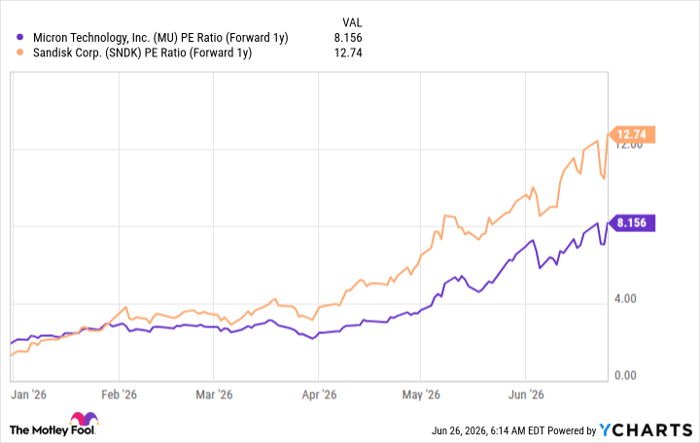
Both Micron and Sandisk operate on odd fiscal years. Sandisk's ends in June, while Micron's ends in August. As a result, I think looking at next year's fiscal year (FY) projections is a smart idea. Wall Street believes that Micron's growth will be 78% next year, while Sandisk's will total 122%. There's clearly more growth ahead for these two, yet their stocks aren't priced at a premium level.
MU PE Ratio (Forward 1y) Chart

MU PE Ratio (Forward 1y) data by YCharts

With Micron trading at 8 times forward earnings and Sandisk at 13, there is still plenty of room for upside, as most tech companies trade in the mid-20s forward price-to-earnings ratio. If both of these two can rise to that level over the next year, then Sandisk stock has the potential to double, and Micron can triple. That's explosive returns that any investor would love to see, and even though it's not the same as the growth each stock has delivered so far in 2026, it's still a great return to achieve in just a year.

As a result, I think each of them is a smart buy, but which one takes the cake? Although the upside may be higher for Micron if the above prediction comes true, I'm more of a fan of Sandisk stock because it's only focused on one segment of the memory chip market and is doing quite well in it. Micron has more to worry about, which still doesn't make it a bad investment, but opens it up to more execution errors if it stumbles in one area.

The memory chip crunch is far from over, and investors can still take advantage of these two stocks.

Should you buy stock in Micron Technology right now?

Before you buy stock in Micron Technology, consider this:

The Motley Fool Stock Advisor analyst team just identified what they believe are the 10 best stocks for investors to buy now… and Micron Technology wasn’t one of them. The 10 stocks that made the cut could produce monster returns in the coming years.

Consider when Netflix made this list on December 17, 2004... if you invested $1,000 at the time of our recommendation, you’d have $397,890!* Or when Nvidia made this list on April 15, 2005... if you invested $1,000 at the time of our recommendation, you’d have $1,196,664!*

Now, it’s worth noting Stock Advisor’s total average return is 902% — a market-crushing outperformance compared to 207% for the S&P 500. Don't miss the latest top 10 list, available with Stock Advisor, and join an investing community built by individual investors for individual investors.

See the 10 stocks »

*Stock Advisor returns as of July 1, 2026.

Keithen Drury has positions in Nvidia. The Motley Fool has positions in and recommends Advanced Micro Devices, Micron Technology, and Nvidia. The Motley Fool has a disclosure policy.

Disclaimer: For information purposes only. Past performance is not indicative of future results.
placeholder
Bitcoin CME gaps at $35,000, $27,000 and $21,000, which one gets filled first?Prioritize filling the $27,000 gap and even try higher.
Author  FXStreet
Aug 22, 2023
Prioritize filling the $27,000 gap and even try higher.
placeholder
Pinduoduo Earnings Incoming: Morgan Stanley Sees Long-Term Profit Potential​Insights – On November 21, Chinese e-commerce giant Pinduoduo (PDD) will release its Q3 2024 earnings.
Author  Mitrade
Nov 20, 2024
​Insights – On November 21, Chinese e-commerce giant Pinduoduo (PDD) will release its Q3 2024 earnings.
placeholder
Bitcoin briefly loses 2025 gains as crypto plunges over the weekend.Bitcoin experienced a sharp decline this weekend, briefly erasing its 2025 gains and dipping below its year-opening value of $93,507. The cryptocurrency fell to a low of $93,029 on Sunday, representing a 25% drop from its all-time high in October. Although it has rebounded slightly to around $94,209, the pressures on the market remain significant. The downturn occurred despite the reopening of the U.S. government on Thursday, which many had hoped would provide essential support for crypto markets. This year initially appeared promising for cryptocurrencies, particularly after the inauguration of President Donald Trump, who has established the most pro-crypto administration thus far. However, ongoing political tensions—including Trump's tariff strategies and the recent government shutdown, lasting a historic 43 days—have contributed to several rapid price pullbacks for Bitcoin throughout the year. Market dynamics are also being influenced by Bitcoin whales—investors holding large amounts of Bitcoin—who have been offloading portions of their assets, consequently stalling price rallies even as positive regulatory developments emerge. Despite these sell-offs, analysts from Glassnode argue that this behavior aligns with typical patterns seen among long-term investors during the concluding stages of bull markets, suggesting it is not indicative of a mass exodus. Notably, Bitcoin is not alone in its struggles, as Ethereum and Solana have also recorded declines of 7.95% and 28.3%, respectively, since the start of the year, while numerous altcoins have faced even steeper losses. Looking ahead, questions linger regarding the viability of the four-year cycle thesis, particularly given the increasing institutional support and regulatory frameworks now in place in the crypto landscape. Matt Hougan, chief investment officer at Bitwise, remains optimistic, suggesting a potential Bitcoin resurgence in 2026 driven by the “debasement trade” thesis and a broader trend toward increased adoption of stablecoins, tokenization, and decentralized finance. Hougan emphasized the soundness of the underlying fundamentals, pointing to a positive outlook for the sector in the longer term.
Author  Mitrade
Nov 17, 2025
Bitcoin experienced a sharp decline this weekend, briefly erasing its 2025 gains and dipping below its year-opening value of $93,507. The cryptocurrency fell to a low of $93,029 on Sunday, representing a 25% drop from its all-time high in October. Although it has rebounded slightly to around $94,209, the pressures on the market remain significant. The downturn occurred despite the reopening of the U.S. government on Thursday, which many had hoped would provide essential support for crypto markets. This year initially appeared promising for cryptocurrencies, particularly after the inauguration of President Donald Trump, who has established the most pro-crypto administration thus far. However, ongoing political tensions—including Trump's tariff strategies and the recent government shutdown, lasting a historic 43 days—have contributed to several rapid price pullbacks for Bitcoin throughout the year. Market dynamics are also being influenced by Bitcoin whales—investors holding large amounts of Bitcoin—who have been offloading portions of their assets, consequently stalling price rallies even as positive regulatory developments emerge. Despite these sell-offs, analysts from Glassnode argue that this behavior aligns with typical patterns seen among long-term investors during the concluding stages of bull markets, suggesting it is not indicative of a mass exodus. Notably, Bitcoin is not alone in its struggles, as Ethereum and Solana have also recorded declines of 7.95% and 28.3%, respectively, since the start of the year, while numerous altcoins have faced even steeper losses. Looking ahead, questions linger regarding the viability of the four-year cycle thesis, particularly given the increasing institutional support and regulatory frameworks now in place in the crypto landscape. Matt Hougan, chief investment officer at Bitwise, remains optimistic, suggesting a potential Bitcoin resurgence in 2026 driven by the “debasement trade” thesis and a broader trend toward increased adoption of stablecoins, tokenization, and decentralized finance. Hougan emphasized the soundness of the underlying fundamentals, pointing to a positive outlook for the sector in the longer term.
placeholder
Markets in 2026: Will gold, Bitcoin, and the U.S. dollar make history again? — These are how leading institutions thinkAfter a turbulent 2025, what lies ahead for commodities, forex, and cryptocurrency markets in 2026?
Author  Insights
Dec 25, 2025
After a turbulent 2025, what lies ahead for commodities, forex, and cryptocurrency markets in 2026?
placeholder
Gold Price Forecast: Does Gold Falling Below $4,000 Mean the Bull Market Is Over? Will It Still Rise in the Second Half of 2026?Heading into the second half of 2026, the gold market has transitioned from a strong-performing asset at the start of the year into one pulling back from its highs. Recently, gold prices
Author  TradingKey
Jun 29, Mon
Heading into the second half of 2026, the gold market has transitioned from a strong-performing asset at the start of the year into one pulling back from its highs. Recently, gold prices
goTop
quote