

Ethereum Network Activity Heats Up As Fees Hit $1.4M In 24H

Source Newsbtc

Ethereum has recently come under selling pressure, pausing the relentless bullish momentum that earlier this year pushed ETH to fresh all-time highs. After an aggressive impulse that began in April, the second-largest cryptocurrency by market capitalization is now showing signs of fatigue, with analysts debating whether this is simply a healthy correction or the early stages of a deeper pullback.

For some, the cooldown is a natural breather after months of parabolic growth, giving the market a chance to reset before its next leg higher. However, the risks of an extended correction are mounting, especially as investors reassess valuations across the broader crypto landscape.

Despite the current uncertainty, key data from Artemis suggests Ethereum’s network activity is far from cooling down. Onchain metrics show rising demand for block space, higher transaction volumes, and consistent activity in decentralized finance (DeFi) and layer-2 ecosystems.

This divergence between price action and underlying usage points to strong fundamentals, even as short-term traders lock in profits. The coming weeks will be critical in determining whether Ethereum stabilizes above key support levels or slides into a deeper correction, with network strength potentially serving as the anchor that keeps long-term bulls confident.

Ethereum Fees Highlight Strength Amid Uncertainty

Ethereum continues to demonstrate its dominance in the crypto ecosystem, even as price action faces pressure from broader market conditions. According to data from Artemis, shared by analyst Ted Pillows, Ethereum generated $1.4 million in network fees yesterday—the highest among all blockchains.

This figure underscores Ethereum’s entrenched position as the most actively used smart contract platform, reinforcing its fundamental strength. Elevated fee generation is often tied to growing demand for block space, DeFi applications, and layer-2 activity, all of which point toward sustained utility regardless of short-term market swings.
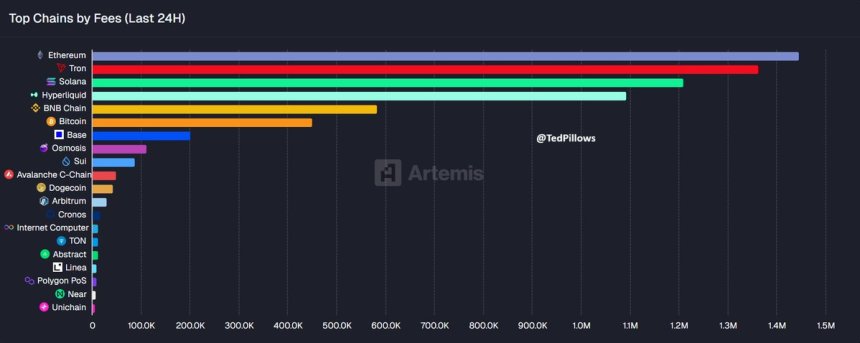
Ethereum leads in daily Chain Fees | Source: Artemis

This consistent fee leadership provides a strong case for Ethereum’s long-term bullish continuation. Even during periods of consolidation, the ability to generate higher revenue than competitors highlights its network’s resilience and entrenched role in crypto’s infrastructure. Investors often view these metrics as signals of enduring value, suggesting Ethereum remains well-positioned for the next wave of capital inflows once market conditions stabilize.

Still, the macroeconomic backdrop influences Ethereum’s immediate trajectory. Hawkish labor data in the United States has injected fresh uncertainty into markets, even as expectations grow that the Federal Reserve will eventually be forced to cut rates due to persistent weakness in the labor market. This policy tug-of-war creates volatility across risk assets, including crypto. For Ethereum, it means fundamentals remain strong, but price action is at the mercy of external economic signals.

Ultimately, Ethereum stands at a critical intersection: its network activity and fee dominance support a bullish outlook, yet macro pressures continue to dictate short-term direction. Whether ETH resumes its uptrend or extends its correction may depend as much on Federal Reserve policy as on its own fundamental momentum.

Price Analysis: Key Resistance Ahead

Ethereum is currently trading at $4,330, consolidating after a sharp rally that carried the price above the $4,800 level earlier this month. The weekly chart shows ETH holding its ground following a strong breakout, with bulls successfully reclaiming key moving averages. The 50-week SMA at $2,931 and the 100-week SMA at $2,874 now sit well below current price levels, reinforcing Ethereum’s bullish structure. Even the 200-week SMA at $2,443 has turned into a distant support, underscoring the strength of the recent move.
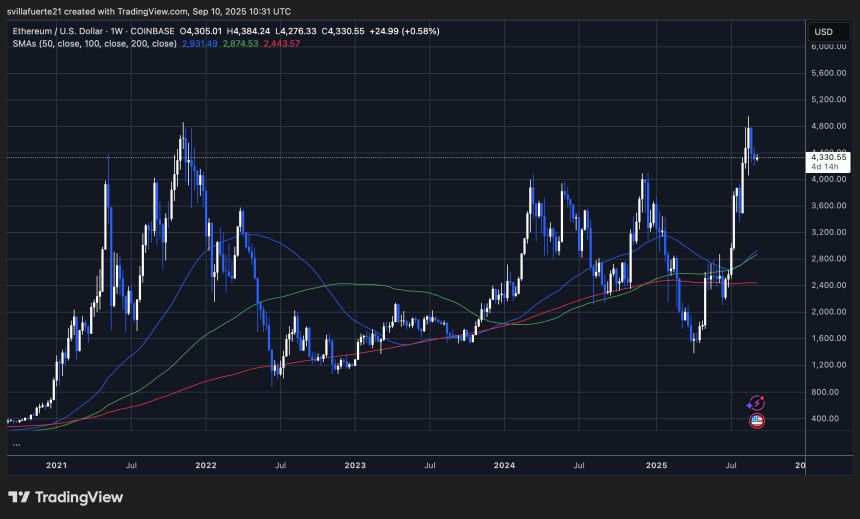
ETH consolidates below ATH | Source: ETHUSDT chart on TradingView

While momentum remains on Ethereum’s side, the chart also signals some caution. The rejection near $4,800 shows sellers are active at higher levels, creating short-term resistance. As long as ETH sustains above $4,000, however, the uptrend remains intact, with consolidation potentially serving as a base for the next attempt higher. A decisive break above $4,800 would open the door to retest the $5,000 psychological barrier and possibly set new all-time highs.

On the downside, losing $4,000 could trigger deeper retracements, with $3,600 emerging as the first key support. Overall, Ethereum is in a strong technical position, but its next major move will depend on whether bulls can muster enough momentum to overcome resistance and extend the rally.

Featured image from Dall-E, chart from TradingView

Disclaimer: For information purposes only. Past performance is not indicative of future results.
placeholder
Bitcoin CME gaps at $35,000, $27,000 and $21,000, which one gets filled first?Prioritize filling the $27,000 gap and even try higher.
Author  FXStreet
Aug 22, 2023
Prioritize filling the $27,000 gap and even try higher.
placeholder
Pinduoduo Earnings Incoming: Morgan Stanley Sees Long-Term Profit Potential​Insights – On November 21, Chinese e-commerce giant Pinduoduo (PDD) will release its Q3 2024 earnings.
Author  Mitrade
Nov 20, 2024
​Insights – On November 21, Chinese e-commerce giant Pinduoduo (PDD) will release its Q3 2024 earnings.
placeholder
Bitcoin briefly loses 2025 gains as crypto plunges over the weekend.Bitcoin experienced a sharp decline this weekend, briefly erasing its 2025 gains and dipping below its year-opening value of $93,507. The cryptocurrency fell to a low of $93,029 on Sunday, representing a 25% drop from its all-time high in October. Although it has rebounded slightly to around $94,209, the pressures on the market remain significant. The downturn occurred despite the reopening of the U.S. government on Thursday, which many had hoped would provide essential support for crypto markets. This year initially appeared promising for cryptocurrencies, particularly after the inauguration of President Donald Trump, who has established the most pro-crypto administration thus far. However, ongoing political tensions—including Trump's tariff strategies and the recent government shutdown, lasting a historic 43 days—have contributed to several rapid price pullbacks for Bitcoin throughout the year. Market dynamics are also being influenced by Bitcoin whales—investors holding large amounts of Bitcoin—who have been offloading portions of their assets, consequently stalling price rallies even as positive regulatory developments emerge. Despite these sell-offs, analysts from Glassnode argue that this behavior aligns with typical patterns seen among long-term investors during the concluding stages of bull markets, suggesting it is not indicative of a mass exodus. Notably, Bitcoin is not alone in its struggles, as Ethereum and Solana have also recorded declines of 7.95% and 28.3%, respectively, since the start of the year, while numerous altcoins have faced even steeper losses. Looking ahead, questions linger regarding the viability of the four-year cycle thesis, particularly given the increasing institutional support and regulatory frameworks now in place in the crypto landscape. Matt Hougan, chief investment officer at Bitwise, remains optimistic, suggesting a potential Bitcoin resurgence in 2026 driven by the “debasement trade” thesis and a broader trend toward increased adoption of stablecoins, tokenization, and decentralized finance. Hougan emphasized the soundness of the underlying fundamentals, pointing to a positive outlook for the sector in the longer term.
Author  Mitrade
Nov 17, 2025
Bitcoin experienced a sharp decline this weekend, briefly erasing its 2025 gains and dipping below its year-opening value of $93,507. The cryptocurrency fell to a low of $93,029 on Sunday, representing a 25% drop from its all-time high in October. Although it has rebounded slightly to around $94,209, the pressures on the market remain significant. The downturn occurred despite the reopening of the U.S. government on Thursday, which many had hoped would provide essential support for crypto markets. This year initially appeared promising for cryptocurrencies, particularly after the inauguration of President Donald Trump, who has established the most pro-crypto administration thus far. However, ongoing political tensions—including Trump's tariff strategies and the recent government shutdown, lasting a historic 43 days—have contributed to several rapid price pullbacks for Bitcoin throughout the year. Market dynamics are also being influenced by Bitcoin whales—investors holding large amounts of Bitcoin—who have been offloading portions of their assets, consequently stalling price rallies even as positive regulatory developments emerge. Despite these sell-offs, analysts from Glassnode argue that this behavior aligns with typical patterns seen among long-term investors during the concluding stages of bull markets, suggesting it is not indicative of a mass exodus. Notably, Bitcoin is not alone in its struggles, as Ethereum and Solana have also recorded declines of 7.95% and 28.3%, respectively, since the start of the year, while numerous altcoins have faced even steeper losses. Looking ahead, questions linger regarding the viability of the four-year cycle thesis, particularly given the increasing institutional support and regulatory frameworks now in place in the crypto landscape. Matt Hougan, chief investment officer at Bitwise, remains optimistic, suggesting a potential Bitcoin resurgence in 2026 driven by the “debasement trade” thesis and a broader trend toward increased adoption of stablecoins, tokenization, and decentralized finance. Hougan emphasized the soundness of the underlying fundamentals, pointing to a positive outlook for the sector in the longer term.
placeholder
Markets in 2026: Will gold, Bitcoin, and the U.S. dollar make history again? — These are how leading institutions thinkAfter a turbulent 2025, what lies ahead for commodities, forex, and cryptocurrency markets in 2026?
Author  Insights
Dec 25, 2025
After a turbulent 2025, what lies ahead for commodities, forex, and cryptocurrency markets in 2026?
placeholder
Gold flatlines near $4,450 on US-Iran uncertainties, US PCE inflation data loomsGold price (XAU/USD) trades on a flat note around $4,455 during the early Asian session on Thursday. The precious metal steadies as US-Iran peace negotiations face uncertainties.
Author  FXStreet
May 28, Thu
Gold price (XAU/USD) trades on a flat note around $4,455 during the early Asian session on Thursday. The precious metal steadies as US-Iran peace negotiations face uncertainties.
goTop
quote