

Are Micron and Sandisk Stocks in a Bubble?

Source The Motley Fool

Key Points

  • Sandisk and Micron are both memory chip producers.

  • Both companies are seeing rapid growth.

  • The stocks don't look overvalued.

  • 10 stocks we like better than Sandisk ›

Two of the most impressive stocks over the past year have been Micron (NASDAQ: MU) and Sandisk (NASDAQ: SNDK). Micron's stock has risen an outstanding 860%, and any investor would be thrilled with a return like that. However, after comparing it to Sandisk's meteoric rise, it looks a bit lacking. Sandisk's stock has risen a jaw-dropping 4,160% over the past year. So, if you had the foresight to invest $10,000 into Sandisk's stock a year ago, that sum is now worth about $425,000.

However, with all of that rise, the word "bubble" is starting to be thrown around more often. This is only natural, as most companies that rise that far that fast are caught up in a bubble. However, after examining a few key parts of each business, I don't think that's the case here. In fact, these two could go even higher over the next few years.

Will AI create the world's first trillionaire? Our team just released a report on the one little-known company, called an "Indispensable Monopoly" providing the critical technology Nvidia and Intel both need. Continue »

A person looks worried while looking at a computer.

Image source: Getty Images.

A memory chip shortage is propelling these two stocks higher

Both Micron and Sandisk make memory chips. There are two primary types of memory chips: DRAM and NAND. DRAM memory can be considered more of the working memory of the device, and is utilized alongside powerful computing chips like GPUs and custom AI chips. It's also the same type of memory utilized in a laptop or phone. NAND memory is a longer-term storage, and is the basis of solid-state drives (SSDs), which are also heavily deployed in data centers. Micron makes DRAM and NAND memory, while Sandisk is only focused on NAND memory. Regardless of which market you're discussing, both companies are seeing a major boom, and both of these components are in short supply.

When a commodity is in high demand with limited supply, simple economic theory dictates that the price will rise. We're seeing an extreme case of that in the memory world, and that shortage is likely to persist. Micron informed investors during its last call that it could only meet about half to two-thirds of medium-term memory demand. On top of that, Micron expects the addressable market for high-bandwidth memory (HBM, a type of DRAM chip) to soar from $35 billion in 2025 to $100 billion in 2028. That's a major rise, and could signal further shortage in the future.

Sandisk is also seeing a fairly tight supply and is seeing strong demand for its core market as well. It projects multiyear data center growth, which will translate into a strong future for it as well.

In their latest quarters, Sandsik reported an impressive 251% year-over-year growth, while Micron's was a tad slower at 196%.
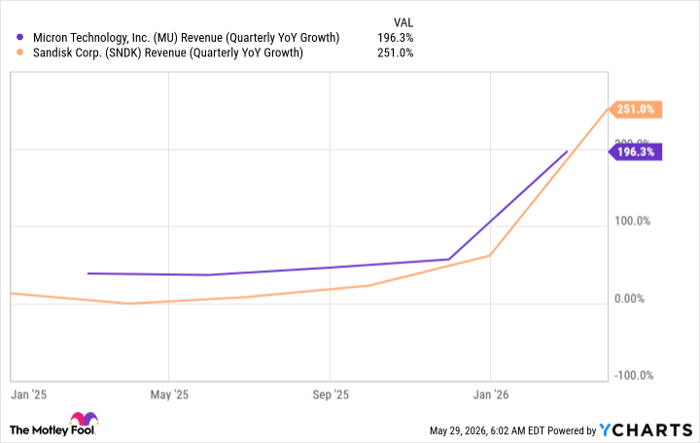
MU Revenue (Quarterly YoY Growth) Chart

MU Revenue (Quarterly YoY Growth) data by YCharts

These are still incredible growth rates and showcase the soaring demand for their products. But are the stocks in a bubble?

The valuations for each company don't appear to be worrisome

Most of the time, when a stock is in a bubble, it is outrageously valued and easy to pinpoint. That's not the case for these two.
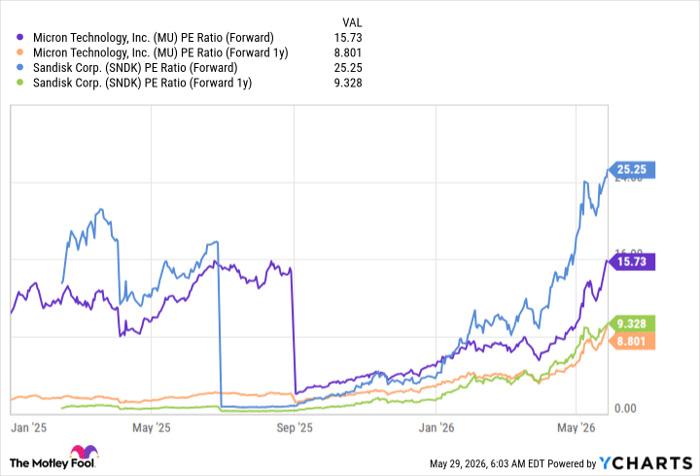
MU PE Ratio (Forward) Chart

MU PE Ratio (Forward) data by YCharts

Both companies trade for a reasonable forward earnings price tag right now, and if you look at next year's earnings, they look cheap again. That eliminates the valuation concern, but there is the cycle threat as well. The memory chip market is notoriously cyclical, and owning a cyclical stock on the downside of a generational boom isn't going to yield good returns. The question is, how long will this up cycle last? If it lasts for a few more years, then these two stocks could continue rising rapidly. However, once it wraps up, it will be time to sell and move on.

It's anyone's guess as to when that will occur. However, with data center build-outs expected to last for several more years, I still think neither of these stocks is in bubble territory, as they're both putting up great growth at a reasonable to low valuation.

Should you buy stock in Sandisk right now?

Before you buy stock in Sandisk, consider this:

The Motley Fool Stock Advisor analyst team just identified what they believe are the 10 best stocks for investors to buy now… and Sandisk wasn’t one of them. The 10 stocks that made the cut could produce monster returns in the coming years.

Consider when Netflix made this list on December 17, 2004... if you invested $1,000 at the time of our recommendation, you’d have $463,900!* Or when Nvidia made this list on April 15, 2005... if you invested $1,000 at the time of our recommendation, you’d have $1,294,401!*

Now, it’s worth noting Stock Advisor’s total average return is 978% — a market-crushing outperformance compared to 211% for the S&P 500. Don't miss the latest top 10 list, available with Stock Advisor, and join an investing community built by individual investors for individual investors.

See the 10 stocks »

*Stock Advisor returns as of May 31, 2026.

Keithen Drury has no position in any of the stocks mentioned. The Motley Fool has positions in and recommends Micron Technology. The Motley Fool has a disclosure policy.

Disclaimer: For information purposes only. Past performance is not indicative of future results.
placeholder
Bitcoin CME gaps at $35,000, $27,000 and $21,000, which one gets filled first?Prioritize filling the $27,000 gap and even try higher.
Author  FXStreet
Aug 22, 2023
Prioritize filling the $27,000 gap and even try higher.
placeholder
Pinduoduo Earnings Incoming: Morgan Stanley Sees Long-Term Profit Potential​Insights – On November 21, Chinese e-commerce giant Pinduoduo (PDD) will release its Q3 2024 earnings.
Author  Mitrade
Nov 20, 2024
​Insights – On November 21, Chinese e-commerce giant Pinduoduo (PDD) will release its Q3 2024 earnings.
placeholder
Bitcoin briefly loses 2025 gains as crypto plunges over the weekend.Bitcoin experienced a sharp decline this weekend, briefly erasing its 2025 gains and dipping below its year-opening value of $93,507. The cryptocurrency fell to a low of $93,029 on Sunday, representing a 25% drop from its all-time high in October. Although it has rebounded slightly to around $94,209, the pressures on the market remain significant. The downturn occurred despite the reopening of the U.S. government on Thursday, which many had hoped would provide essential support for crypto markets. This year initially appeared promising for cryptocurrencies, particularly after the inauguration of President Donald Trump, who has established the most pro-crypto administration thus far. However, ongoing political tensions—including Trump's tariff strategies and the recent government shutdown, lasting a historic 43 days—have contributed to several rapid price pullbacks for Bitcoin throughout the year. Market dynamics are also being influenced by Bitcoin whales—investors holding large amounts of Bitcoin—who have been offloading portions of their assets, consequently stalling price rallies even as positive regulatory developments emerge. Despite these sell-offs, analysts from Glassnode argue that this behavior aligns with typical patterns seen among long-term investors during the concluding stages of bull markets, suggesting it is not indicative of a mass exodus. Notably, Bitcoin is not alone in its struggles, as Ethereum and Solana have also recorded declines of 7.95% and 28.3%, respectively, since the start of the year, while numerous altcoins have faced even steeper losses. Looking ahead, questions linger regarding the viability of the four-year cycle thesis, particularly given the increasing institutional support and regulatory frameworks now in place in the crypto landscape. Matt Hougan, chief investment officer at Bitwise, remains optimistic, suggesting a potential Bitcoin resurgence in 2026 driven by the “debasement trade” thesis and a broader trend toward increased adoption of stablecoins, tokenization, and decentralized finance. Hougan emphasized the soundness of the underlying fundamentals, pointing to a positive outlook for the sector in the longer term.
Author  Mitrade
Nov 17, 2025
Bitcoin experienced a sharp decline this weekend, briefly erasing its 2025 gains and dipping below its year-opening value of $93,507. The cryptocurrency fell to a low of $93,029 on Sunday, representing a 25% drop from its all-time high in October. Although it has rebounded slightly to around $94,209, the pressures on the market remain significant. The downturn occurred despite the reopening of the U.S. government on Thursday, which many had hoped would provide essential support for crypto markets. This year initially appeared promising for cryptocurrencies, particularly after the inauguration of President Donald Trump, who has established the most pro-crypto administration thus far. However, ongoing political tensions—including Trump's tariff strategies and the recent government shutdown, lasting a historic 43 days—have contributed to several rapid price pullbacks for Bitcoin throughout the year. Market dynamics are also being influenced by Bitcoin whales—investors holding large amounts of Bitcoin—who have been offloading portions of their assets, consequently stalling price rallies even as positive regulatory developments emerge. Despite these sell-offs, analysts from Glassnode argue that this behavior aligns with typical patterns seen among long-term investors during the concluding stages of bull markets, suggesting it is not indicative of a mass exodus. Notably, Bitcoin is not alone in its struggles, as Ethereum and Solana have also recorded declines of 7.95% and 28.3%, respectively, since the start of the year, while numerous altcoins have faced even steeper losses. Looking ahead, questions linger regarding the viability of the four-year cycle thesis, particularly given the increasing institutional support and regulatory frameworks now in place in the crypto landscape. Matt Hougan, chief investment officer at Bitwise, remains optimistic, suggesting a potential Bitcoin resurgence in 2026 driven by the “debasement trade” thesis and a broader trend toward increased adoption of stablecoins, tokenization, and decentralized finance. Hougan emphasized the soundness of the underlying fundamentals, pointing to a positive outlook for the sector in the longer term.
placeholder
Markets in 2026: Will gold, Bitcoin, and the U.S. dollar make history again? — These are how leading institutions thinkAfter a turbulent 2025, what lies ahead for commodities, forex, and cryptocurrency markets in 2026?
Author  Insights
Dec 25, 2025
After a turbulent 2025, what lies ahead for commodities, forex, and cryptocurrency markets in 2026?
placeholder
Gold flatlines near $4,450 on US-Iran uncertainties, US PCE inflation data loomsGold price (XAU/USD) trades on a flat note around $4,455 during the early Asian session on Thursday. The precious metal steadies as US-Iran peace negotiations face uncertainties.
Author  FXStreet
May 28, Thu
Gold price (XAU/USD) trades on a flat note around $4,455 during the early Asian session on Thursday. The precious metal steadies as US-Iran peace negotiations face uncertainties.
goTop
quote