

President Xi Jinping Has Promised China Will Buy 200 Boeing 737s. Here Is One More Big Reason the Stock Is a Buy in 2026.

Source The Motley Fool

Key Points

  • China's 200-plane order boosts Boeing's backlog and future revenue.

  • Boeing's ability to deliver profitably remains uncertain due to past operational issues.

  • Boeing's valuation depends on whether current challenges are truly temporary or more persistent.

  • 10 stocks we like better than Boeing ›

The recent confirmation that China would buy 200 737 model jets from Boeing (NYSE: BA) is a positive development in U.S./China trade relations and good news for Boeing. It helps reinforce the investment case for the stock. The key argument supporting buying the stock in 2026 is the considerable upside potential from executing its existing backlog and contracts.

Boeing's backlog

The recent agreement with China will contribute to Boeing's backlog. The existing backlog stood at a record $695 billion at the end of the first quarter. The figure represents the sum total of Boeing's estimated revenue from 2026 to deep into 2031.

Will AI create the world's first trillionaire? Our team just released a report on the one little-known company, called an "Indispensable Monopoly" providing the critical technology Nvidia and Intel both need. Continue »

Most of the backlog is in the commercial airplanes segment (BCA).
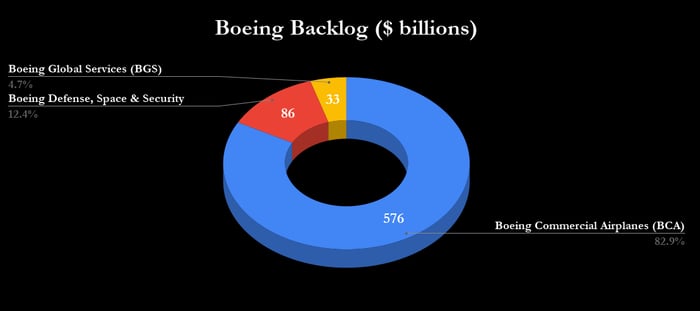
Boeing's backlog.

Data source: Boeing presentations. Chart by author.

Delivering on the backlog

No one doubts that Boeing has great growth prospects on account of its backlog and the ongoing recovery in commercial aerospace, but the question is whether it can deliver on them profitably. It's a valid question after years of high-profile groundings of the 737 MAX; manufacturing quality issues; Federal Aviation Administration (FAA) restrictions on Boeing's production and deliveries of the 737 MAX and 787 airplanes; multibillion-dollar charges on fixed-price development contracts at Boeing Defense, Space & Security (BDS); and certification delays on the new 777X.

These challenges are best seen in Boeing's free cash flow (FCF) generation over the last few years. I've previously discussed Boeing's cash flow and debt issues and how they impact strategic thinking.

How to think about Boeing's cash flow

There are two ways to look at current matters, and management's guidance for FCF of $1 billion to $3 billion in 2026. The higher end of the range would put Boeing at 57.6 times FCF for 2026.

The cautious view is that the valuation reflects ongoing issues at Boeing, and until the company can demonstrate some improvement, that's how investors should value it.

The optimistic approach accepts CFO Jesus Malave's argument, delivered on the January earnings call, that if temporary impacts on Boeing's cash flow are stripped out, its FCF would be in the "high single-digit" billion-dollar range.

A Boeing 737 MAX in flight.

Image source: Boeing.

These impacts include the increased use of cash due to the delay in 777X certification, customer considerations due to prior delays on 737 MAX and 787 deliveries, $1 billion in cash used to support the Spirit AeroSystems integration, a "spike" in capital expenditures in 2026 and 2027 to support reestablishing production on the 737 and 787, and cash impact from previous BDS charges.

Is Boeing stock a buy?

Ultimately, the decision comes down to how much you believe these temporary factors really are "temporary," or whether they are part of an enduring set of issues that will continue to dog Boeing.

A person thinking.

Image source: Getty Images.

On the positive side, CEO Kelly Ortberg (appointed in summer 2024) has increased Boeing's 737 delivery rate, and BDS is addressing its most challenging defense contracts. The investment in Spirit is expected to strengthen Boeing's supply chain, and increased deliveries of the 737 and 787 should improve FCF margins.

Boeing probably deserves the benefit of the doubt here, and its growing backlog and the recent China deal add more opportunity to execute, but it's understandable if more skeptical investors want to see more evidence of operational improvement before buying in.

Should you buy stock in Boeing right now?

Before you buy stock in Boeing, consider this:

The Motley Fool Stock Advisor analyst team just identified what they believe are the 10 best stocks for investors to buy now… and Boeing wasn’t one of them. The 10 stocks that made the cut could produce monster returns in the coming years.

Consider when Netflix made this list on December 17, 2004... if you invested $1,000 at the time of our recommendation, you’d have $463,900!* Or when Nvidia made this list on April 15, 2005... if you invested $1,000 at the time of our recommendation, you’d have $1,294,401!*

Now, it’s worth noting Stock Advisor’s total average return is 978% — a market-crushing outperformance compared to 211% for the S&P 500. Don't miss the latest top 10 list, available with Stock Advisor, and join an investing community built by individual investors for individual investors.

See the 10 stocks »

*Stock Advisor returns as of May 31, 2026.

Lee Samaha has no position in any of the stocks mentioned. The Motley Fool has positions in and recommends Boeing. The Motley Fool has a disclosure policy.

Disclaimer: For information purposes only. Past performance is not indicative of future results.
placeholder
Bitcoin CME gaps at $35,000, $27,000 and $21,000, which one gets filled first?Prioritize filling the $27,000 gap and even try higher.
Author  FXStreet
Aug 22, 2023
Prioritize filling the $27,000 gap and even try higher.
placeholder
Pinduoduo Earnings Incoming: Morgan Stanley Sees Long-Term Profit Potential​Insights – On November 21, Chinese e-commerce giant Pinduoduo (PDD) will release its Q3 2024 earnings.
Author  Mitrade
Nov 20, 2024
​Insights – On November 21, Chinese e-commerce giant Pinduoduo (PDD) will release its Q3 2024 earnings.
placeholder
Bitcoin briefly loses 2025 gains as crypto plunges over the weekend.Bitcoin experienced a sharp decline this weekend, briefly erasing its 2025 gains and dipping below its year-opening value of $93,507. The cryptocurrency fell to a low of $93,029 on Sunday, representing a 25% drop from its all-time high in October. Although it has rebounded slightly to around $94,209, the pressures on the market remain significant. The downturn occurred despite the reopening of the U.S. government on Thursday, which many had hoped would provide essential support for crypto markets. This year initially appeared promising for cryptocurrencies, particularly after the inauguration of President Donald Trump, who has established the most pro-crypto administration thus far. However, ongoing political tensions—including Trump's tariff strategies and the recent government shutdown, lasting a historic 43 days—have contributed to several rapid price pullbacks for Bitcoin throughout the year. Market dynamics are also being influenced by Bitcoin whales—investors holding large amounts of Bitcoin—who have been offloading portions of their assets, consequently stalling price rallies even as positive regulatory developments emerge. Despite these sell-offs, analysts from Glassnode argue that this behavior aligns with typical patterns seen among long-term investors during the concluding stages of bull markets, suggesting it is not indicative of a mass exodus. Notably, Bitcoin is not alone in its struggles, as Ethereum and Solana have also recorded declines of 7.95% and 28.3%, respectively, since the start of the year, while numerous altcoins have faced even steeper losses. Looking ahead, questions linger regarding the viability of the four-year cycle thesis, particularly given the increasing institutional support and regulatory frameworks now in place in the crypto landscape. Matt Hougan, chief investment officer at Bitwise, remains optimistic, suggesting a potential Bitcoin resurgence in 2026 driven by the “debasement trade” thesis and a broader trend toward increased adoption of stablecoins, tokenization, and decentralized finance. Hougan emphasized the soundness of the underlying fundamentals, pointing to a positive outlook for the sector in the longer term.
Author  Mitrade
Nov 17, 2025
Bitcoin experienced a sharp decline this weekend, briefly erasing its 2025 gains and dipping below its year-opening value of $93,507. The cryptocurrency fell to a low of $93,029 on Sunday, representing a 25% drop from its all-time high in October. Although it has rebounded slightly to around $94,209, the pressures on the market remain significant. The downturn occurred despite the reopening of the U.S. government on Thursday, which many had hoped would provide essential support for crypto markets. This year initially appeared promising for cryptocurrencies, particularly after the inauguration of President Donald Trump, who has established the most pro-crypto administration thus far. However, ongoing political tensions—including Trump's tariff strategies and the recent government shutdown, lasting a historic 43 days—have contributed to several rapid price pullbacks for Bitcoin throughout the year. Market dynamics are also being influenced by Bitcoin whales—investors holding large amounts of Bitcoin—who have been offloading portions of their assets, consequently stalling price rallies even as positive regulatory developments emerge. Despite these sell-offs, analysts from Glassnode argue that this behavior aligns with typical patterns seen among long-term investors during the concluding stages of bull markets, suggesting it is not indicative of a mass exodus. Notably, Bitcoin is not alone in its struggles, as Ethereum and Solana have also recorded declines of 7.95% and 28.3%, respectively, since the start of the year, while numerous altcoins have faced even steeper losses. Looking ahead, questions linger regarding the viability of the four-year cycle thesis, particularly given the increasing institutional support and regulatory frameworks now in place in the crypto landscape. Matt Hougan, chief investment officer at Bitwise, remains optimistic, suggesting a potential Bitcoin resurgence in 2026 driven by the “debasement trade” thesis and a broader trend toward increased adoption of stablecoins, tokenization, and decentralized finance. Hougan emphasized the soundness of the underlying fundamentals, pointing to a positive outlook for the sector in the longer term.
placeholder
Markets in 2026: Will gold, Bitcoin, and the U.S. dollar make history again? — These are how leading institutions thinkAfter a turbulent 2025, what lies ahead for commodities, forex, and cryptocurrency markets in 2026?
Author  Insights
Dec 25, 2025
After a turbulent 2025, what lies ahead for commodities, forex, and cryptocurrency markets in 2026?
placeholder
Gold flatlines near $4,450 on US-Iran uncertainties, US PCE inflation data loomsGold price (XAU/USD) trades on a flat note around $4,455 during the early Asian session on Thursday. The precious metal steadies as US-Iran peace negotiations face uncertainties.
Author  FXStreet
May 28, Thu
Gold price (XAU/USD) trades on a flat note around $4,455 during the early Asian session on Thursday. The precious metal steadies as US-Iran peace negotiations face uncertainties.
goTop
quote