

The Japanese Yen weakens as traders pare Bank of Japan October hike bets

Source Fxstreet
  • USD/JPY climbs back above 158.00 to a one-week high as BoJ October hike bets fade.
  • October BoJ hike pricing roughly halved since Monday.
  • Tokyo core inflation due at 23:30 GMT, with a 2.4% forecast above target.

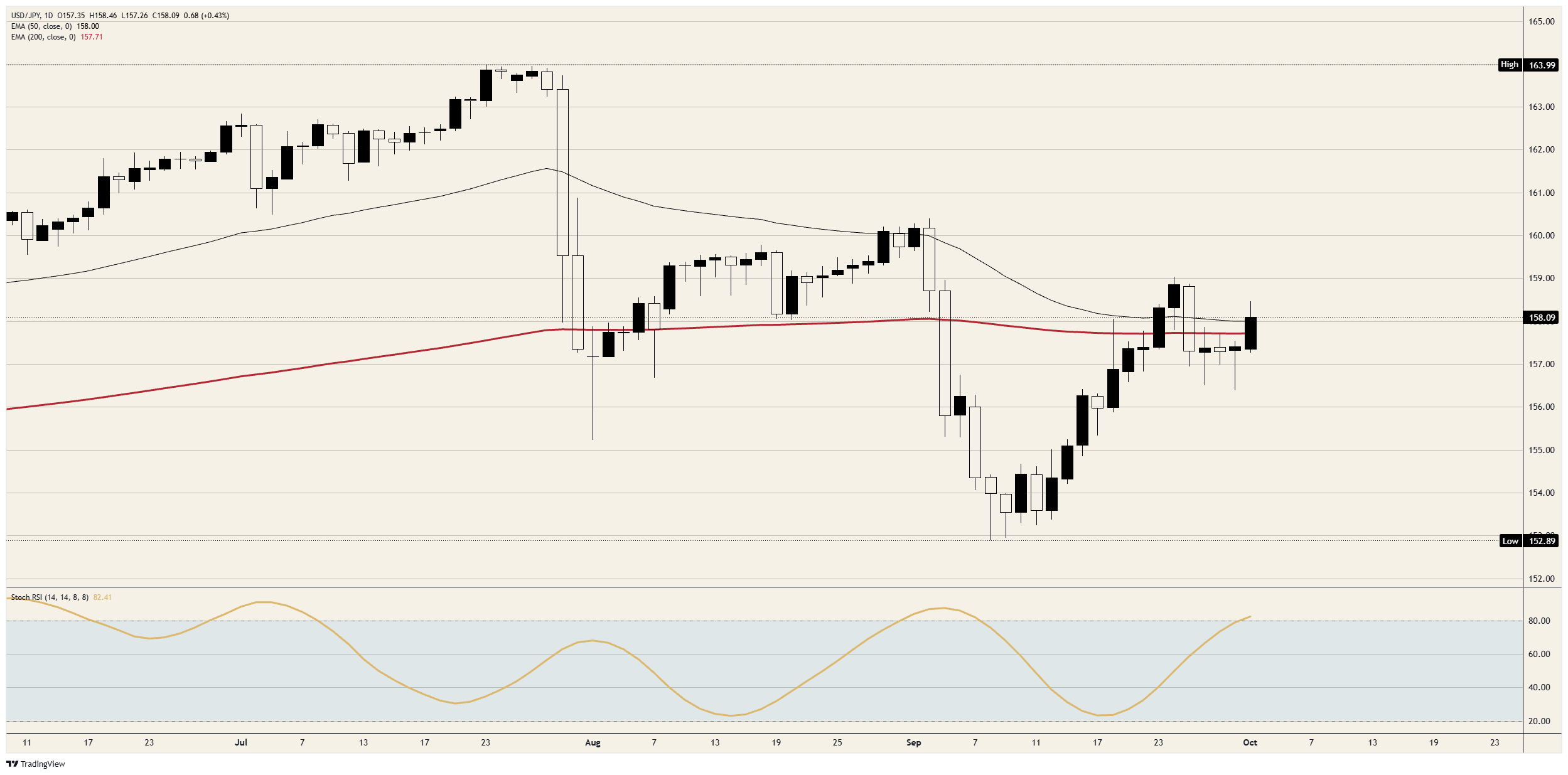
The Yen is falling on the timetable of the Bank of Japan (BoJ) rather than on Japanese inflation. The BoJ published its September meeting summary at 23:50 GMT on Wednesday, and traders cut bets on an October follow-up. Japanese rate markets now price about half the October move they did on Monday, a day before a Tokyo inflation figure forecast well above the BoJ's 2% target. USD/JPY trades just above 158.00 and is heading for its third weekly gain in a row.

A hike in September, a fifth of one priced for October

The BoJ raised its rate to 1.25% on September 18 by a 7-2 vote and said it would keep raising if its outlook holds. Analysts read it as moving every three months, which is a way of saying the next hike comes in December rather than October.

If the BoJ waits that long, the next change in the gap between US and Japanese rates can only come from the Fed on October 28, where futures put the odds of a hike near one in three. USD/JPY's last leg higher on Thursday came on a report of a third US aircraft carrier group heading to the Middle East, and buyers chose the Dollar over the Yen as a haven on the news.

Tokyo's core rate was last above 2% in December 2025

Tokyo's core inflation rate for September, which leaves out fresh food, is due at 23:30 GMT on Thursday, forecast at 2.4% from 1.8%. Tokyo's figures usually lead the national ones by about three weeks. US payrolls follow on Friday at 12:30 GMT.

Japanese wage figures for August, last at 4.7% YoY, come on Tuesday at 23:30 GMT. A hot Tokyo number could bring October back, though the summary of a meeting where the BoJ raised rates was enough to take half of it out.

Levels for the Yen into Tokyo's data

Resistance: Thursday's high came in just short of 158.50, and 159.00 is the September 24 high, where the last push stopped.

Support: 158.00, where the 50-day Exponential Moving Average (EMA) sits, has held since Thursday's last leg higher. 157.50 is next, and Thursday's low sits just above 157.00.

Bias: The lean is long while 157.50 holds on a closing basis, with 158.50 the first objective and 159.00 the second. The daily Stochastic Relative Strength Index (Stoch RSI) is near 82 and still rising, so the move is stretched going into Tokyo's data. A daily close below 157.00 ends the trade.


USD/JPY daily chart
Japanese Yen FAQs

The Japanese Yen (JPY) is one of the world’s most traded currencies. Its value is broadly determined by the performance of the Japanese economy, but more specifically by the Bank of Japan’s policy, the differential between Japanese and US bond yields, or risk sentiment among traders, among other factors.

One of the Bank of Japan’s mandates is currency control, so its moves are key for the Yen. The BoJ has directly intervened in currency markets sometimes, generally to lower the value of the Yen, although it refrains from doing it often due to political concerns of its main trading partners. The BoJ ultra-loose monetary policy between 2013 and 2024 caused the Yen to depreciate against its main currency peers due to an increasing policy divergence between the Bank of Japan and other main central banks. More recently, the gradually unwinding of this ultra-loose policy has given some support to the Yen.

Over the last decade, the BoJ’s stance of sticking to ultra-loose monetary policy has led to a widening policy divergence with other central banks, particularly with the US Federal Reserve. This supported a widening of the differential between the 10-year US and Japanese bonds, which favored the US Dollar against the Japanese Yen. The BoJ decision in 2024 to gradually abandon the ultra-loose policy, coupled with interest-rate cuts in other major central banks, is narrowing this differential.

The Japanese Yen is often seen as a safe-haven investment. This means that in times of market stress, investors are more likely to put their money in the Japanese currency due to its supposed reliability and stability. Turbulent times are likely to strengthen the Yen’s value against other currencies seen as more risky to invest in.

Disclaimer: For information purposes only. Past performance is not indicative of future results.
placeholder
October hike odds climb toward 60% as Goldman and BofA both flip — what Warsh's "dose of accommodation" really changedRate futures now price roughly 55% to 62% for a 25bp hike at the October 27-28 FOMC, up from about 30% before Chair Warsh's post-meeting framing that the Fed is merely "removing some accommodation." Goldman Sachs has added an October hike to its forecast and Bank of America now sees moves in both October and December. Here is the repricing, the language behind it, and the two data points that decide it.
Author  Irene Q.
Sep 23, Wed
Rate futures now price roughly 55% to 62% for a 25bp hike at the October 27-28 FOMC, up from about 30% before Chair Warsh's post-meeting framing that the Fed is merely "removing some accommodation." Goldman Sachs has added an October hike to its forecast and Bank of America now sees moves in both October and December. Here is the repricing, the language behind it, and the two data points that decide it.
placeholder
Four jobs reports in five days: what JOLTS, ADP, claims and the September payrolls mean for the October Fed decisionThe US labour market faces its densest data week of the month. JOLTS job openings land Tuesday (7.2 million expected), ADP on Wednesday (70,000 expected), initial claims on Thursday and the September non-farm payrolls on Friday (100,000 expected, down from 162,000). Markets price a 64%-70% chance of another quarter-point Fed hike on October 28. The dollar index sits at 100.77 and the S&P 500 at 7,729.8.
Author  Mitrade
Sep 28, Mon
The US labour market faces its densest data week of the month. JOLTS job openings land Tuesday (7.2 million expected), ADP on Wednesday (70,000 expected), initial claims on Thursday and the September non-farm payrolls on Friday (100,000 expected, down from 162,000). Markets price a 64%-70% chance of another quarter-point Fed hike on October 28. The dollar index sits at 100.77 and the S&P 500 at 7,729.8.
placeholder
Nvidia's $150 billion buyback landed — and the AI sector fell anyway. That's the signal worth tradingNvidia closed up 1.68% at $228.86 on 28 September after announcing a $150 billion share repurchase authorisation, the largest single corporate buyback on record, while the rest of the AI complex sold off: AMD -3.6%, Micron -2.6%, Meta -4.8% and the Philadelphia Semiconductor Index -1.61%. The divergence is not noise. Capital is rotating toward cash-flow certainty, not abandoning the AI theme. With Micron reporting after the close on 30 September, here is what the split means.
Author  Irene Q.
Sep 29, Tue
Nvidia closed up 1.68% at $228.86 on 28 September after announcing a $150 billion share repurchase authorisation, the largest single corporate buyback on record, while the rest of the AI complex sold off: AMD -3.6%, Micron -2.6%, Meta -4.8% and the Philadelphia Semiconductor Index -1.61%. The divergence is not noise. Capital is rotating toward cash-flow certainty, not abandoning the AI theme. With Micron reporting after the close on 30 September, here is what the split means.
placeholder
【Daily Brief】30-year Treasury tops 5.59%, S&P 500 slips to 7,670 and gold holds $4,180 — PCE lands tonightThe 30-year Treasury yield closed at 5.59%, its highest since June 2002, and the Dow fell 131.59 points to 51,349.92. US consumer confidence dropped to 81.9, a 12-year low, and JOLTS job openings fell to 7.1 million. August PCE and Q3 GDP both land at 8:30am ET tonight.
Author  Suzie
Sep 30, Wed
The 30-year Treasury yield closed at 5.59%, its highest since June 2002, and the Dow fell 131.59 points to 51,349.92. US consumer confidence dropped to 81.9, a 12-year low, and JOLTS job openings fell to 7.1 million. August PCE and Q3 GDP both land at 8:30am ET tonight.
placeholder
Gold falls to near $4,150 as higher Treasury yields, oil prices outweigh softer PCE inflationGold price (XAU/USD) tumbles to near $4,150 during the early Asian session on Thursday, pressured by elevated US Treasury bond yields. Traders await the US September employment data for fresh impetus, which will be released later on Friday. 
Author  FXStreet
Yesterday 01: 26
Gold price (XAU/USD) tumbles to near $4,150 during the early Asian session on Thursday, pressured by elevated US Treasury bond yields. Traders await the US September employment data for fresh impetus, which will be released later on Friday. 
Related Instrument
goTop
quote