


British Pound recovers slight losses against US Dollar, JOLTS data eyed
- The British Pound recovers minor losses against the US Dollar after the DXY retreats from 101.50.
- Market experts see the US Dollar remaining firm due to hawkish Fed expectations.
- Investors keenly await the US JOLTS Job Openings data for August.
The British Pound (GBP) claws back some of its early losses, but is still 0.14% down at around 1.3235 against the US Dollar (USD) during the European trading session on Tuesday. The GBP/USD pair recovers slight gains as the US Dollar Index (DXY) retreats after revisiting its two-month high of 101.50 to near 101.35.
The outlook of the US Dollar remains as traders are increasingly confident that the Federal Reserve (Fed) will deliver more interest rate hikes this year.
Dollar support reinforced as Fed path and energy prices align
Analysts at MUFG/BTMU highlight that, after delivering their first hike this month, the US rate market now expects the Fed to deliver "almost another 100bps of rate hikes in the year ahead," a trajectory that is "reinforcing support for the US Dollar from the positive terms of trade shock for the US economy from higher energy prices." In their view, this combination of tighter Fed policy expectations and elevated energy costs means "the current backdrop is supportive of the US Dollar remaining stronger for longer."
During the day, investors will focus on the US JOLTS Job Openings data for August, which will be published at 14:00 GMT. The US Job Openings report will likely show that US employers posted 7.23 million fresh jobs, marginally lower than 7.271 million in July.
This week, the major trigger for the US Dollar will be the US Nonfarm Payrolls (NFP) data for September, which will be published on Friday. The data is expected to significantly influence Fed’s interest rate expectations.
Meanwhile, the British Pound struggles to gain ground despite hawkish Bank of England (BoE) repricing. Strategists at Brown Brothers Harriman (BBH) highlight that “the swaps curve continues to imply about 100bps of BoE rate hikes in the next twelve months to 4.75%.”
However, BBH argues that the “BoE may not need to tighten as much as markets expect,” given that “the UK economy is already operating below capacity,” the “Bank Rate at 3.75% is near the top of the BoE’s estimated 2% to 4% neutral range.”
GBP/USD Technical Analysis
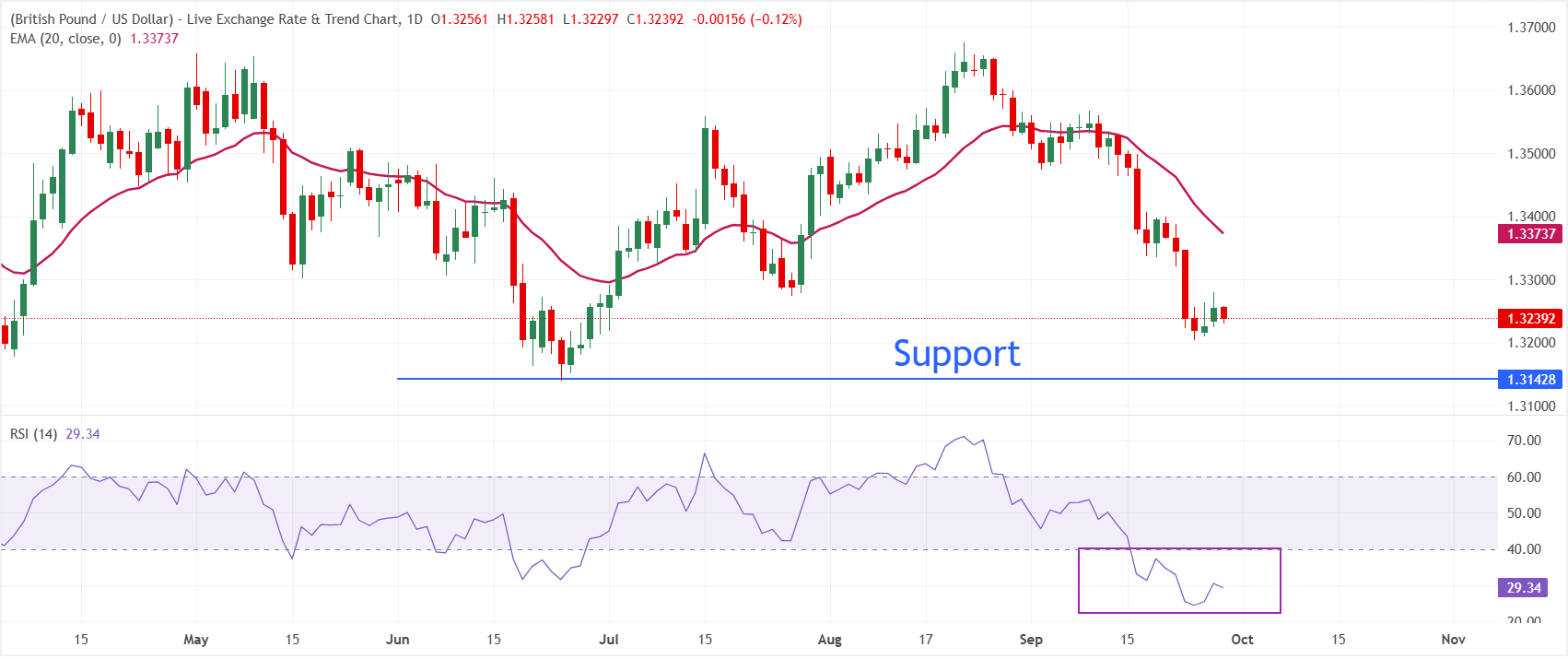
In the daily chart, GBP/USD trades at 1.3239, maintaining a bearish near-term bias as spot holds beneath the 20-period exponential moving average (EMA) at 1.3374. The pair’s inability to reclaim this EMA suggests ongoing topside pressure, while the Relative Strength Index (RSI) at 29.3 hovers near oversold territory, hinting that downside momentum could be stretched but not yet reversed.
On the topside, immediate resistance is located at the 20-period EMA at 1.3374, which acts as the first barrier that bulls would need to clear to alleviate the current bearish tone. With no nearby technical supports derived from the provided dataset, the focus remains on whether GBP/USD can stage a recovery toward this moving average or instead continue to drift lower while the RSI lingers near oversold levels.
(The technical analysis of this story was written with the help of an AI tool. Know more.)
BoE FAQs
The Bank of England (BoE) decides monetary policy for the United Kingdom. Its primary goal is to achieve ‘price stability’, or a steady inflation rate of 2%. Its tool for achieving this is via the adjustment of base lending rates. The BoE sets the rate at which it lends to commercial banks and banks lend to each other, determining the level of interest rates in the economy overall. This also impacts the value of the Pound Sterling (GBP).
When inflation is above the Bank of England’s target it responds by raising interest rates, making it more expensive for people and businesses to access credit. This is positive for the Pound Sterling because higher interest rates make the UK a more attractive place for global investors to park their money. When inflation falls below target, it is a sign economic growth is slowing, and the BoE will consider lowering interest rates to cheapen credit in the hope businesses will borrow to invest in growth-generating projects – a negative for the Pound Sterling.
In extreme situations, the Bank of England can enact a policy called Quantitative Easing (QE). QE is the process by which the BoE substantially increases the flow of credit in a stuck financial system. QE is a last resort policy when lowering interest rates will not achieve the necessary result. The process of QE involves the BoE printing money to buy assets – usually government or AAA-rated corporate bonds – from banks and other financial institutions. QE usually results in a weaker Pound Sterling.
Quantitative tightening (QT) is the reverse of QE, enacted when the economy is strengthening and inflation starts rising. Whilst in QE the Bank of England (BoE) purchases government and corporate bonds from financial institutions to encourage them to lend; in QT, the BoE stops buying more bonds, and stops reinvesting the principal maturing on the bonds it already holds. It is usually positive for the Pound Sterling.
Recommended Articles


