


USD/MXN Price Forecast: Peso rally targets April 2024 low
- USD/MXN trades near two-year lows as Peso strength persists.
- RSI deepens in bearish territory, supporting further downside risks.
- Break below 16.74 exposes 16.52 and 16.26 supports.
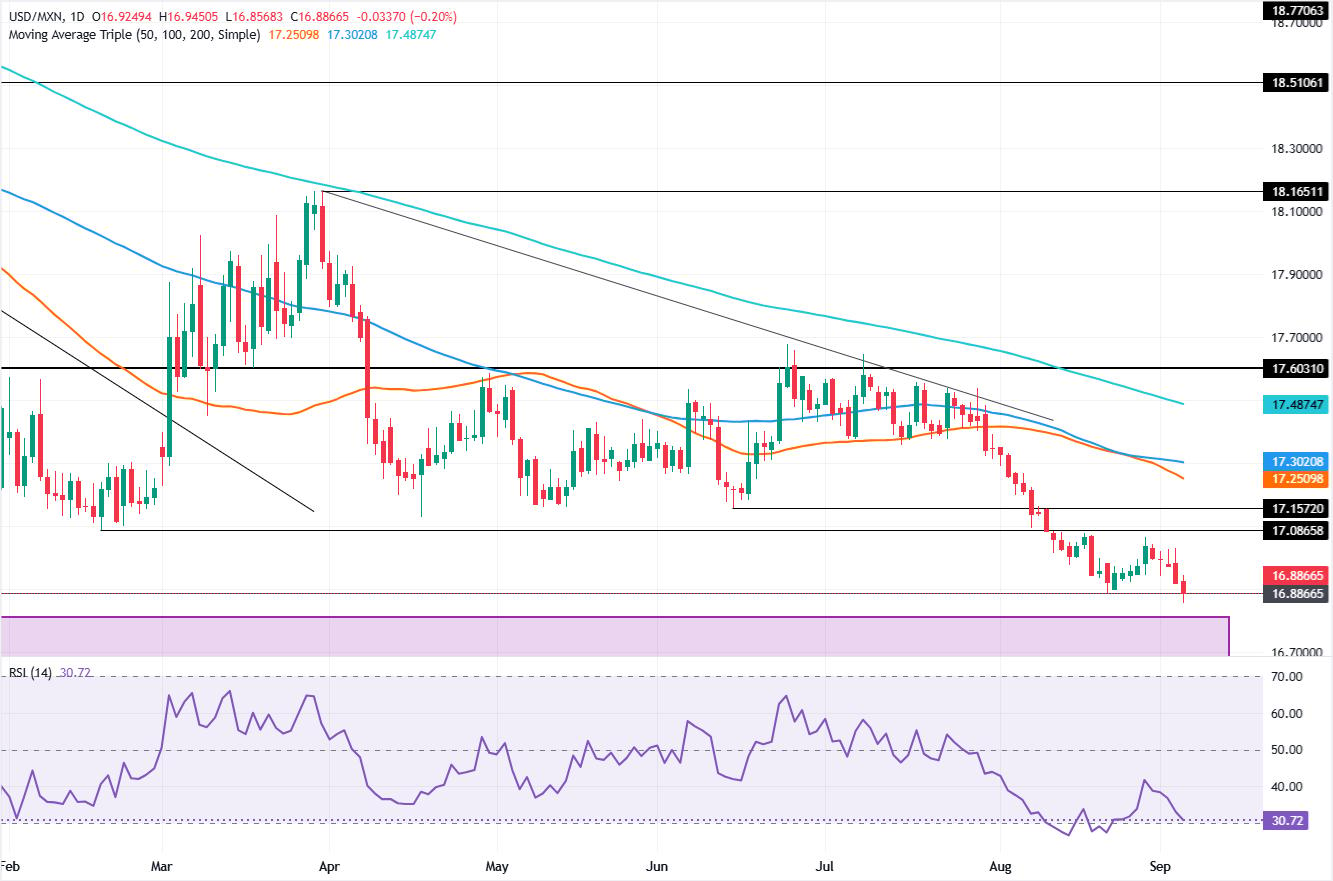
The Mexican Peso appreciates against the US Dollar, testing two-year highs near 16.85 as the USD/MXN sets aside a strong US Nonfarm Payrolls report, which was ignored by the Peso’s bears. At the time of writing, the emerging market pair trades at 16.88, poised to extend its losses and challenge the April 2024 lows at 16.74.
USD/MXN Price Forecast: Technical Outlook
Price action suggests that the downtrend is poised to extend, as USD/MXN approaches two-year lows. Bearish momentum continues to increase as the Relative Strength Index (RSI) dives further into bearish territory.
The first support area is the 16.50-mile milestone. Below the latter, the next stop is May’s 2024 monthly low of 16.52, ahead of a test of the 2024 yearly low of 16.26. Once surpassed, the next area of interest will be the 16.00 figure.
For a bullish reversal, buyers must clear the 17.00 level to remain hopeful of reaching higher prices. Up next, the August 19 high of 17.07 emerges as the next resistance. A decisive breakout will expose the 50-day Simple Moving Average (SMA) at 1725, immediately followed by the 100-day SMA at 17.30. Above sits the 200-day SMA at 17.48.
USD/MXN Price Chart – Daily
Mexican Peso FAQs
The Mexican Peso (MXN) is the most traded currency among its Latin American peers. Its value is broadly determined by the performance of the Mexican economy, the country’s central bank’s policy, the amount of foreign investment in the country and even the levels of remittances sent by Mexicans who live abroad, particularly in the United States. Geopolitical trends can also move MXN: for example, the process of nearshoring – or the decision by some firms to relocate manufacturing capacity and supply chains closer to their home countries – is also seen as a catalyst for the Mexican currency as the country is considered a key manufacturing hub in the American continent. Another catalyst for MXN is Oil prices as Mexico is a key exporter of the commodity.
The main objective of Mexico’s central bank, also known as Banxico, is to maintain inflation at low and stable levels (at or close to its target of 3%, the midpoint in a tolerance band of between 2% and 4%). To this end, the bank sets an appropriate level of interest rates. When inflation is too high, Banxico will attempt to tame it by raising interest rates, making it more expensive for households and businesses to borrow money, thus cooling demand and the overall economy. Higher interest rates are generally positive for the Mexican Peso (MXN) as they lead to higher yields, making the country a more attractive place for investors. On the contrary, lower interest rates tend to weaken MXN.
Macroeconomic data releases are key to assess the state of the economy and can have an impact on the Mexican Peso (MXN) valuation. A strong Mexican economy, based on high economic growth, low unemployment and high confidence is good for MXN. Not only does it attract more foreign investment but it may encourage the Bank of Mexico (Banxico) to increase interest rates, particularly if this strength comes together with elevated inflation. However, if economic data is weak, MXN is likely to depreciate.
As an emerging-market currency, the Mexican Peso (MXN) tends to strive during risk-on periods, or when investors perceive that broader market risks are low and thus are eager to engage with investments that carry a higher risk. Conversely, MXN tends to weaken at times of market turbulence or economic uncertainty as investors tend to sell higher-risk assets and flee to the more-stable safe havens.
Recommended Articles


