


Mexican Peso surges as inflation data weighs on the USD
- US PPI cools, reinforcing softer Fed tightening expectations.
- Middle East tensions keep Oil-linked Dollar risks alive.
- Moody’s downgrade and core inflation temper Peso upside.
The Mexican Peso appreciates against the US Dollar during the North American session, up 0.29% after the latest US inflation reports, easing expectations that the Federal Reserve would raise rates to tackle high inflation. At the time of writing, the USD/MXN trades at 17.38
USD/MXN falls as soft US inflation pressures US Dollar
The Greenback remains pressured as depicted by the US Dollar Index (DXY), which tracks the value of the US currency against six others, and is down 0.45% at 100.45.
US economic data revealed that prices paid by producers —also known as the Producer Price Index (PPI) was 5.5% YoY in June, down from May’s 6% increase and also below estimates for a 6.2% reading. Meanwhile, core PPI came in at 4.7% YoY, up from the previous 4.6% reading but below forecasts.
The report, along with the Consumer Price Index (CPI) released on Tuesday, weighed on the US Dollar. Nevertheless, the Mexican currency could not claim victory, as tensions in the Middle East continue and a rise in Oil prices is usually a tailwind for the Greenback.
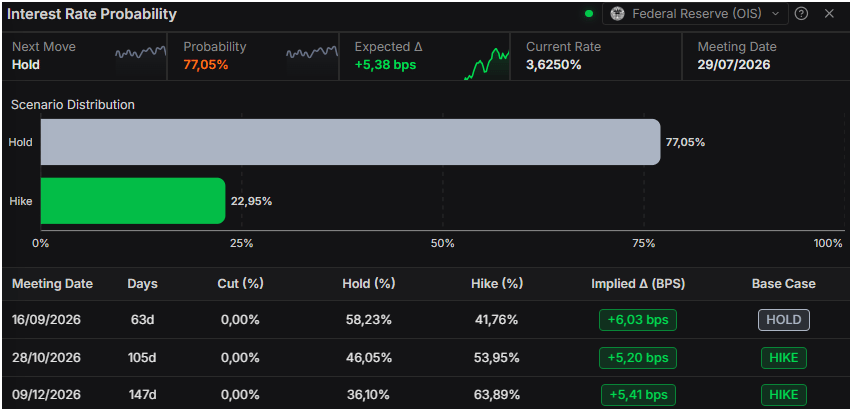
Following the US PPI release, money markets had priced in 22 basis points of Federal Reserve tightening towards the end of the year, as revealed by the Prime Terminal interest rate probability table. For the July meeting, investors expect the Fed to keep rates unchanged, but for the December meeting, the odds are at nearly 64%.
Across the south of the border, the Mexican economic docket remains absent, but Moody’s downgrading Mexico’s credit worthiness to Baa3 suggests that fiscal policy is walking a tight rope.
Last week, Mexican inflation data in June fell for the third straight month, to its lowest print since 2020. Headline inflation rose 3.37% YoY, down from May’ws 3.94%. The underlying print, expanded at a 4.03% YoY, slightly above the Bank of Mexico (Banxico) 3% plus or minus 1% goal.
Banxico welcomed the data, which, at its last meeting, held rates unchanged at 6.5% in a unanimous decision amid high energy prices fueled by the Middle East conflict.
USD/MXN Price Forecast: Technical outlook
In the daily chart, USD/MXN trades at 17.3831. The pair is holding just above the triple simple moving average (SMA) cluster at 17.3761, which now acts as immediate support and keeps the near-term tone broadly neutral rather than decisively bearish. The Relative Strength Index (RSI) at 46 suggests subdued momentum, hinting at consolidation rather than a strong directional move while the broader structure remains capped by descending trend-line resistance overhead.
On the topside, the first structural barrier comes from the nearer downward resistance trend line derived from the 18.1651 peak and projected through recent highs, with additional supply reinforced by the longer-term descending trend line originating at 21.0808, both sitting above current market levels and framing the medium-term bearish backdrop. On the downside, immediate support is located at the triple SMA cluster around 17.3761; a daily close below this floor would open the way for a deeper pullback, while sustained trading above it would keep USD/MXN in a sideways-to-slightly-bid stance within its broader declining channel.
(The technical analysis of this story was written with the help of an AI tool. Know more.)
Mexican Peso FAQs
The Mexican Peso (MXN) is the most traded currency among its Latin American peers. Its value is broadly determined by the performance of the Mexican economy, the country’s central bank’s policy, the amount of foreign investment in the country and even the levels of remittances sent by Mexicans who live abroad, particularly in the United States. Geopolitical trends can also move MXN: for example, the process of nearshoring – or the decision by some firms to relocate manufacturing capacity and supply chains closer to their home countries – is also seen as a catalyst for the Mexican currency as the country is considered a key manufacturing hub in the American continent. Another catalyst for MXN is Oil prices as Mexico is a key exporter of the commodity.
The main objective of Mexico’s central bank, also known as Banxico, is to maintain inflation at low and stable levels (at or close to its target of 3%, the midpoint in a tolerance band of between 2% and 4%). To this end, the bank sets an appropriate level of interest rates. When inflation is too high, Banxico will attempt to tame it by raising interest rates, making it more expensive for households and businesses to borrow money, thus cooling demand and the overall economy. Higher interest rates are generally positive for the Mexican Peso (MXN) as they lead to higher yields, making the country a more attractive place for investors. On the contrary, lower interest rates tend to weaken MXN.
Macroeconomic data releases are key to assess the state of the economy and can have an impact on the Mexican Peso (MXN) valuation. A strong Mexican economy, based on high economic growth, low unemployment and high confidence is good for MXN. Not only does it attract more foreign investment but it may encourage the Bank of Mexico (Banxico) to increase interest rates, particularly if this strength comes together with elevated inflation. However, if economic data is weak, MXN is likely to depreciate.
As an emerging-market currency, the Mexican Peso (MXN) tends to strive during risk-on periods, or when investors perceive that broader market risks are low and thus are eager to engage with investments that carry a higher risk. Conversely, MXN tends to weaken at times of market turbulence or economic uncertainty as investors tend to sell higher-risk assets and flee to the more-stable safe havens.
Recommended Articles


