


Dow Jones Industrial Average falls again after NFP figures undershoot forecasts
- The Dow Jones fell another 400 points on Friday after NFP jobs data missed the mark.
- US job additions continue to underperform, and downside revisions remain a concern.
- Despite the miss in NFP employment, market bets for a 25 bps cut come out on top.
The Dow Jones Industrial Average (DJIA) shed 400 points on Friday after US Nonfarm Payrolls (NFP) came in below expectations, alongside a downard revision to previous figures. Lopsided jobs growth has dropped further signals that the US economy is slowing down, but not slow enough to spark firmer bets of a double cut from the Federal Reserve (Fed) later this month.
According to the Bureau of Labor Statistics (BLS), US NFP employment rose 142K in August, less than the expected 160K but improved from the previous month, which was also revised lower to just 89K from the initial print of 114K. Despite the overall negative tone in jobs figures, US Average Hourly Earnings rose faster than expected, climbing 3.8% YoY in August, beating the expected 3.7% and rising from the previous period’s 3.6%.
The August NFP jobs report showed a weaker-than-expected pickup in the number of hirings for the month, helping to keep rate cut bets buoyed. However, markets had a hard time drawing a bead on where the overall jobs report landed. The headline number of job additions, despite missing forecasts, was still up from the previous period, but the underlying trend within the jobs report showed most of those gains in employment came from leisure and hospitality, and health care and social assistance.
Manufacturing, retail trade, and information sectors all saw declines in headline employment figures, flashing warning signs that the US economy is indeed heading for a slowdown. The contraction in physical business and production sewered the Dow Jones, an index heavily representing physical manufacturing businesses.
Despite the overall miss in employment figures, and even more warning signs that investors have good reason to be concerned about a looming recession in the quarters to come, markets eased back from bets of a double rate cut on September 18. According to the CME’s FedWatch Tool, rate trades now see 75% odds of an initial 25 bps cut from the Fed this month, with only 25% betting on an initial 50 bps rate trim. Odds have recovered from this week’s previous probabilities of a 40-60 split in favor of a double rate trim after markets decided that Friday’s NFP print, despite not being the greatest, also wasn’t the worst.
Dow Jones news
The Dow Jones was thoroughly softened on Friday, with all but five of the equity board’s listed stocks testing into the low end to wrap up the trading week. McDonald’s (MCD) managed to squeeze out a 1.3% gain to $292.00 per share, with Procter & Gamble (PG) rising one half of one percent to $176.35 per share.
American Express (AXP) fell the hardest on Friday, declining 3.3% to $243.60 per share. The payments and card services company was closely followed by Amazon.com (AMZN), which fell around 3.25% to $ 172.00 per share.
Dow Jones price forecast
Friday’s plunge has put the Dow Jones chart on a collision course with the 50-day Exponential Moving Average (EMA) at 40,283, with the major index chalking in another full percentage point loss off the top. The DJIA has now declined a full 3% in just over a week, after hitting a fresh all-time peak of 41,574 just last week.
Despite near-term losses, the Dow Jones continues to trade well into the high side. Price action would need to fall another 4.65% before reaching the 200-day EMA at 38,434, and bidders are set to defend momentum barriers near the 40,000 major price handle.
Dow Jones daily chart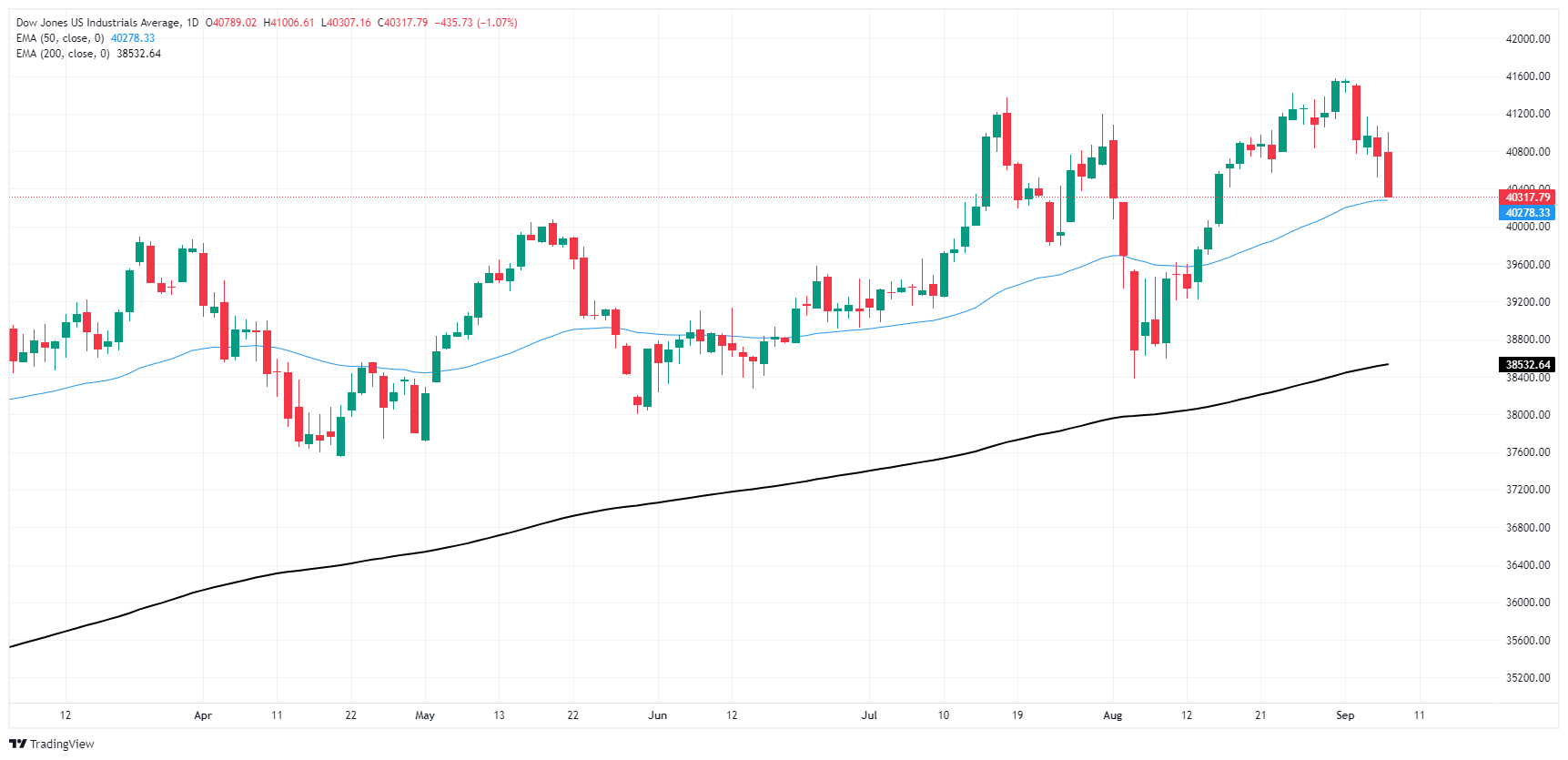
Dow Jones FAQs
The Dow Jones Industrial Average, one of the oldest stock market indices in the world, is compiled of the 30 most traded stocks in the US. The index is price-weighted rather than weighted by capitalization. It is calculated by summing the prices of the constituent stocks and dividing them by a factor, currently 0.152. The index was founded by Charles Dow, who also founded the Wall Street Journal. In later years it has been criticized for not being broadly representative enough because it only tracks 30 conglomerates, unlike broader indices such as the S&P 500.
Many different factors drive the Dow Jones Industrial Average (DJIA). The aggregate performance of the component companies revealed in quarterly company earnings reports is the main one. US and global macroeconomic data also contributes as it impacts on investor sentiment. The level of interest rates, set by the Federal Reserve (Fed), also influences the DJIA as it affects the cost of credit, on which many corporations are heavily reliant. Therefore, inflation can be a major driver as well as other metrics which impact the Fed decisions.
Dow Theory is a method for identifying the primary trend of the stock market developed by Charles Dow. A key step is to compare the direction of the Dow Jones Industrial Average (DJIA) and the Dow Jones Transportation Average (DJTA) and only follow trends where both are moving in the same direction. Volume is a confirmatory criteria. The theory uses elements of peak and trough analysis. Dow’s theory posits three trend phases: accumulation, when smart money starts buying or selling; public participation, when the wider public joins in; and distribution, when the smart money exits.
There are a number of ways to trade the DJIA. One is to use ETFs which allow investors to trade the DJIA as a single security, rather than having to buy shares in all 30 constituent companies. A leading example is the SPDR Dow Jones Industrial Average ETF (DIA). DJIA futures contracts enable traders to speculate on the future value of the index and Options provide the right, but not the obligation, to buy or sell the index at a predetermined price in the future. Mutual funds enable investors to buy a share of a diversified portfolio of DJIA stocks thus providing exposure to the overall index.
Empfohlene Artikel


