


Mexican Peso rebounds as judicial reform faces opposition
- Mexican Peso strengthens as fears of judiciary reform approval fade despite Banxico's dovish stance.
- Opposition from 43 senators reduces chances of judiciary reform approval, easing political concerns in Mexico.
- Banxico’s dovish stance justified by declining inflation, while Business Confidence slightly improves but remains below 50.
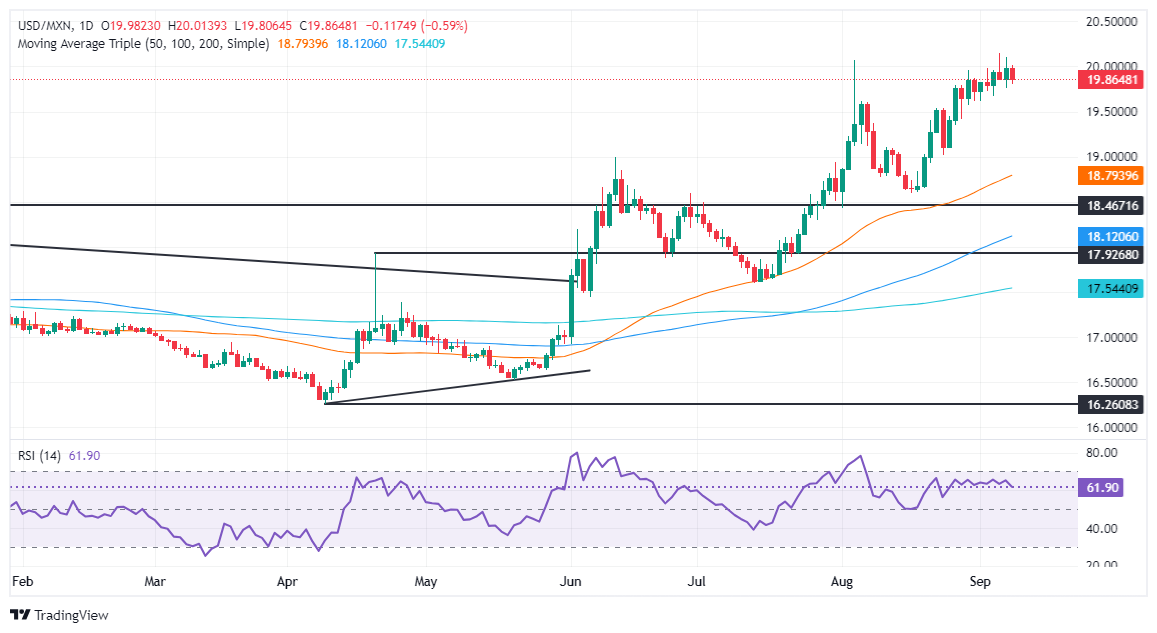
The Mexican Peso staged a comeback against the Greenback on Monday. Fears that the judiciary reform would be approved faded after 43 opposition senators reiterated their vote against it. The USD/MXN trades at 19.86, down by 0.42%.
The USD/MXN pair continues to be driven by political issues. However, the latest inflation report justified the Bank of Mexico's (Banxico) dovish stance as headline and core figures dipped on an annual reading.
Other data showed that Business Confidence improved slightly but remained below the 50 threshold.
In the meantime, Julius Baer warned that rating agencies could change Mexico’s creditworthiness as soon as next year if the judicial reform is approved. Erini Tsekeridou, a fixed-income analyst, said, “Although the economic impact is not yet fully clear, markets are concerned about the potential weakening of the rule of law and the concentration of judicial and executive power, which would reduce oversight and accountability.”
Julius Baer added their name to Morgan Stanley, Bank of America, JP Morgan, Citibanamex and Fitch ratings warnings of the economic and financial impact regarding the approval of judicial reform.
Across the border, the US economic docket revealed the New York Fed’s consumer inflation expectations, which remained unchanged at 3%. However, market players are still eyeing Wednesday's release of August’s Consumer Price Index (CPI).
Daily digest market movers: Mexican Peso recovers ground on judicial reform expected vote
- Mexico’s Inflation in August rose by 4.99% YoY, below estimates of 5.09% and the previous reading of 5.57%. Core Inflation dipped a tenth to 4% YoY.
- Traders expect Banxico to cut interest rates at the upcoming September 26 monetary policy decision.
- Mexico’s economic docket remains light. On Wednesday, September 11, the Senate approved the judiciary reform. Earlier, INEGI will reveal Industrial Production figures.
- September’s Citibanamex Survey showed that Banxico is expected to lower rates to 10.25% in 2024 and to 8.25% in 2025. The USD/MXN exchange rate is forecast to end 2024 at 19.50 and 2025 at 19.85.
- US CPI is expected to dip from 2.9% to 2.6% YoY in August, while core CPI is projected to remain at 3.2%.
- Data from the Chicago Board of Trade (CBOT) suggests the Fed will cut at least 104.5 basis points this year, according to the fed funds rate futures contract for December 2024.
USD/MXN technical outlook: Mexican Peso appreciates as USD/MXN slides below 20.00
The USD/MXN uptrend remains intact despite the ongoing pullback on relief that judicial reform could not be approved. However, this will not be known until September 11.
Momentum shows signs of exhaustion, yet buyers remain in charge even though the Relative Strength Index (RSI) is slightly lower.
If the USD/MXN clears 20.00, the next ceiling level would be the YTD high at 20.22. On further strength, the pair could challenge the daily high of September 28, 2022, at 20.57. If those two levels are surrendered, the next stop would be the swing high at 20.82 on August 2, 2022, ahead of 21.00.
Conversely, if USD/MXN weakens further, the first support would be 19.50. A breach of the latter will expose the August 23 swing low of 19.02 before giving way for sellers eyeing a test of the 50-day Simple Moving Average (SMA) at 18.65.
Mexican Peso FAQs
The Mexican Peso (MXN) is the most traded currency among its Latin American peers. Its value is broadly determined by the performance of the Mexican economy, the country’s central bank’s policy, the amount of foreign investment in the country and even the levels of remittances sent by Mexicans who live abroad, particularly in the United States. Geopolitical trends can also move MXN: for example, the process of nearshoring – or the decision by some firms to relocate manufacturing capacity and supply chains closer to their home countries – is also seen as a catalyst for the Mexican currency as the country is considered a key manufacturing hub in the American continent. Another catalyst for MXN is Oil prices as Mexico is a key exporter of the commodity.
The main objective of Mexico’s central bank, also known as Banxico, is to maintain inflation at low and stable levels (at or close to its target of 3%, the midpoint in a tolerance band of between 2% and 4%). To this end, the bank sets an appropriate level of interest rates. When inflation is too high, Banxico will attempt to tame it by raising interest rates, making it more expensive for households and businesses to borrow money, thus cooling demand and the overall economy. Higher interest rates are generally positive for the Mexican Peso (MXN) as they lead to higher yields, making the country a more attractive place for investors. On the contrary, lower interest rates tend to weaken MXN.
Macroeconomic data releases are key to assess the state of the economy and can have an impact on the Mexican Peso (MXN) valuation. A strong Mexican economy, based on high economic growth, low unemployment and high confidence is good for MXN. Not only does it attract more foreign investment but it may encourage the Bank of Mexico (Banxico) to increase interest rates, particularly if this strength comes together with elevated inflation. However, if economic data is weak, MXN is likely to depreciate.
As an emerging-market currency, the Mexican Peso (MXN) tends to strive during risk-on periods, or when investors perceive that broader market risks are low and thus are eager to engage with investments that carry a higher risk. Conversely, MXN tends to weaken at times of market turbulence or economic uncertainty as investors tend to sell higher-risk assets and flee to the more-stable safe havens.
Empfohlene Artikel


