


Gold Price Analysis (XAU/USD): Gold Falls to 6-Month Low as Inflation Fuels Rate Hike Bets, A Buying Opportunity or a Falling Knife?

Gold Price Today ▼
Gold Price Today in the UAE ▼
Gold closed Thursday’s session at $4,071 per ounce, its weakest close since late November 2025. At the session’s worst, August futures touched $4,046, and the metal finished the week down 6.3%, on pace for its second straight weekly loss and its worst weekly performance since mid-March, when gold shed 9.62%. From its all-time high of $5,602, reached on January 28, the decline now stands at more than 27%.
What makes this selloff striking is the context in which it is happening. Gold is, by reputation, the instrument investors reach for when inflation rises. And inflation is rising. US consumer prices climbed at their fastest annual pace in three years in May, driven largely by surging energy costs tied to the Iran war, now in its fourth month. US producer prices rose 6.5% year-on-year, the highest reading since November 2022.
But rather than driving investors into gold, this data is strengthening the case for the Federal Reserve to raise interest rates before year-end, possibly as soon as December. And gold, which yields nothing, loses its edge when rates rise and Treasury securities become more rewarding.
Regardless, gold is still about 25% higher than it was a year ago. That is because the price continues to receive massive support from central banks, which have emerged as an important fuel for price growth since the freezing of Russia’s foreign exchange reserves in 2022. In a way, that event broke gold’s historical relationship with real interest rates. The result is that gold has now overtaken US Treasuries in the global central bank reserve mix.
Gold Price Technical Analysis for Today, June 12, 2026
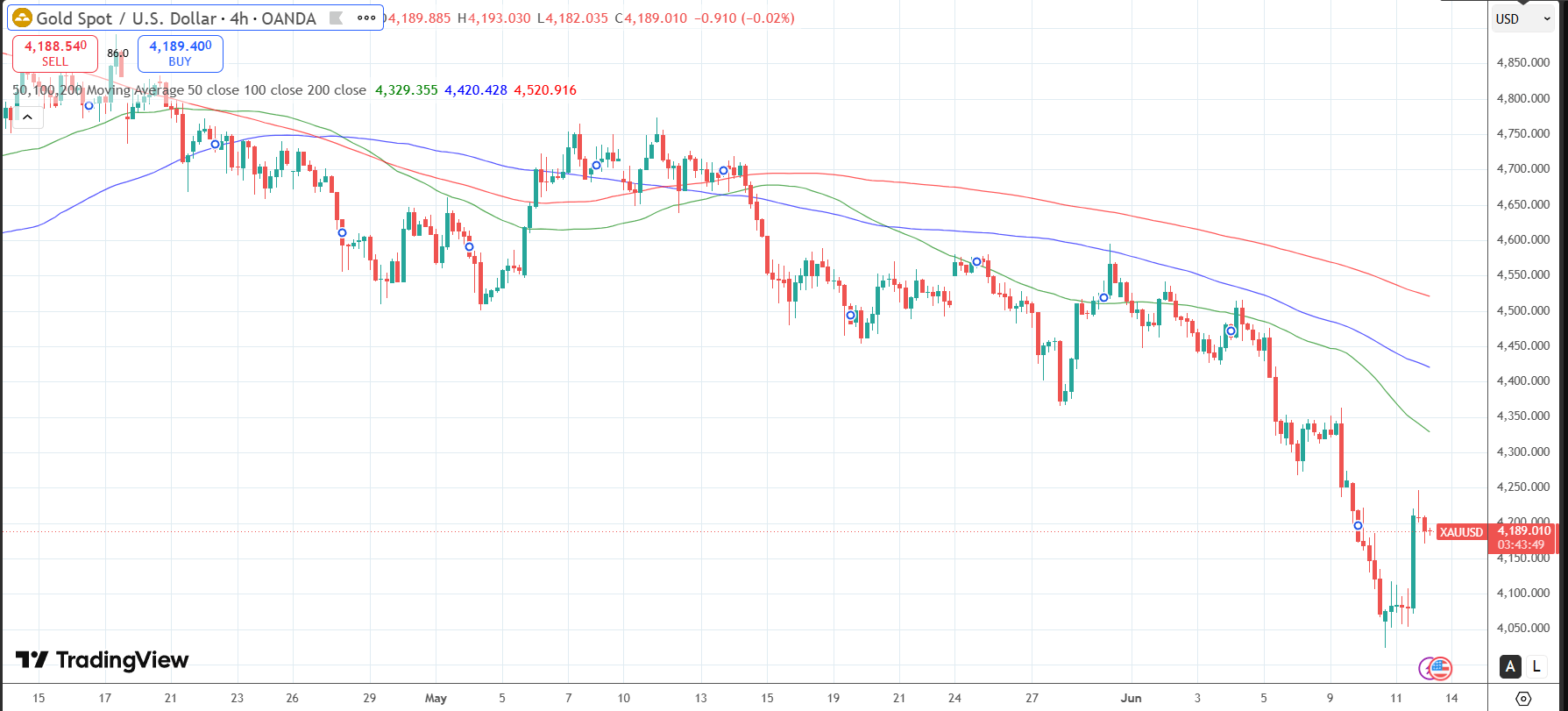
On the 4-hour chart, gold is trading near $4,189, and if you zoom out, it shows a market in a sustained downtrend. For one, all three key averages, that is the 50, 100, and 200, are sitting above the current price and all three are sloping downward, which is a bearish formation.
*Source: TradingView
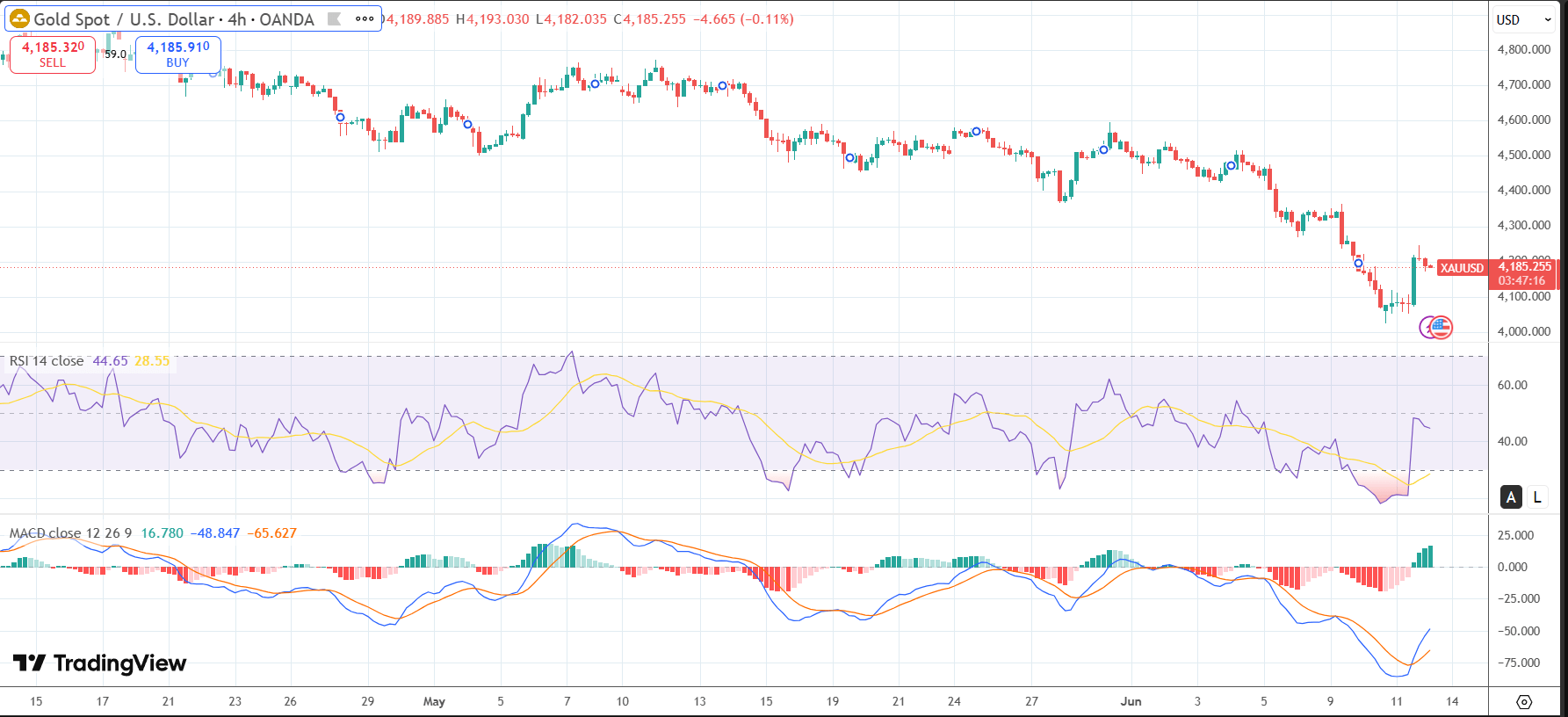
It doesn’t get any better when you look at momentum indicators. For starters, the MACD line is at -48.85 and the signal line at -65.63, both firmly in negative territory. This setup confirms that the dominant downward momentum is still intact.
But the histogram has begun to shrink and is producing early green readings. This is clearly a sign that the sellers are still in control, but they are losing some of the force with which they have been pushing the yellow metal’s price lower. If anything, this suggests that the most aggressive phase of the selloff may be nearing exhaustion.
*Source: TradingView
From another angle, the Relative Strength Index fell into oversold territory during Thursday’s selloff. It then recovered to the current mid-40s, which confirms that the selling exhausted itself at the $4,023 lows and generated the current bounce. But the RSI has not yet crossed above 50, which is the point at which a neutral reading turns into a signal of genuine buying pressure. So until that happens, the current bounce is nothing but a technical relief.
Is It a Good Time to Buy Gold?
The facts before us leave no doubt that the market right now is unfriendly to buyers, especially those who wish to hold onto the precious metal for some time.
But because the most punishing phase of the selloff appears to be waning, there is a narrow window for speculators to capitalize on the current technical relief. This bounce launched from $4,023, and if that support holds and price builds above $4,150 and the RSI breaks and sustains above 50, a speculative long position will be defensible.
And if you extend the horizon, the current market is a great opportunity to accumulate. For starters, the fuel that pushed gold prices from $3,300 just 12 months ago to $5,602 in January hasn’t depleted. That is, central banks are still buying and geopolitics don’t look any better. Add to that the fact that the concerns around sovereign debt and currency debasement that drove retail demand have not been resolved.
The only thing that has changed is the short-term rate environment, and rate environments do change. If, for instance, the Federal Reserve delivers a rate hike in December and gold absorbs it without breaking materially below $4,000, that would be the only signal the market needs to buy more for the long term.


* The content presented above, whether from a third party or not, is considered as general advice only. This article should not be construed as containing investment advice, investment recommendations, an offer of or solicitation for any transactions in financial instruments.


