


How to Invest in the Stock Market in the UAE: 7 Steps to Start Investing in US Stocks

The US stock market is packed with opportunity, but success takes more than just tracking big names like Nvidia or the Magnificent Seven. For many UAE investors, the US market is attractive because it gives access to some of the world’s largest companies, deep liquidity, and products such as stocks, ETFs, and CFDs.
This guide cuts through the noise and gives you 7 practical steps to start: understand the US market, compare US and UAE stocks, choose the right trading method, select a trusted broker, pick stocks, place orders, and review your portfolio.
Step 1: Understand the Basics of the US Stock Market
★ Please Note: before investing in US stocks, UAE investors should understand the key basics of the market, including exchanges, trading hours, trading units, settlement, price movement rules, fees, and taxes.
Step 2: Distinguish US Stocks and UAE Stocks
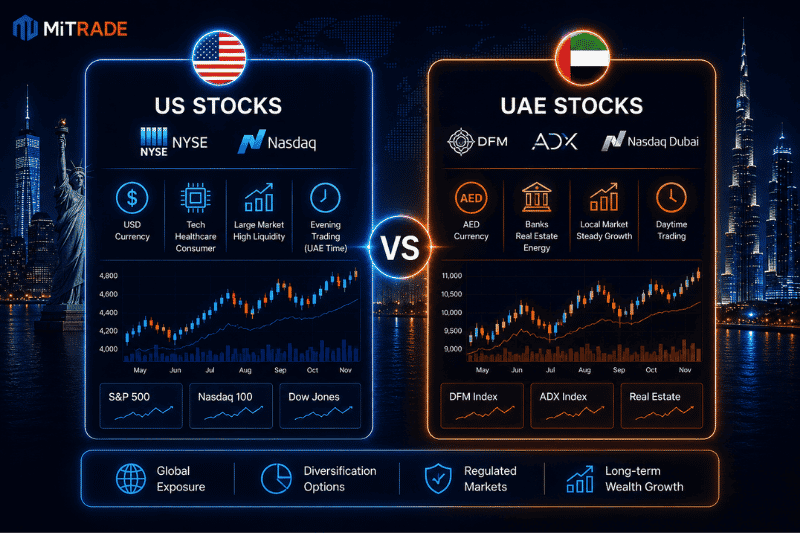
US stocks and UAE stocks both give investors exposure to listed companies, but they are different in market size, currency, trading hours, sectors, access process, liquidity, and tax treatment.
For UAE investors, the US stock market is attractive not only because of famous companies, but also because it offers lower minimum trading barriers, broader global exposure, and deeper liquidity.
Why US Stocks Are Attractive for UAE Investors?
★ US stocks can be easier for small investors to access.
In the US market, the minimum trading unit is usually 1 share, and many modern brokers also support fractional shares.
This means beginners do not always need large capital to start. For example, instead of concentrating most of their money in one expensive position, a UAE investor may start with one US share or a fraction of a high-priced stock if the broker allows it.
★ US stocks offer a wider global selection
The US market gives access to thousands of listed companies across many sectors, including AI, technology, cloud computing, semiconductors, healthcare, finance, energy, consumer goods, and e-commerce.
This allows UAE investors to research global companies such as Apple, Microsoft, NVIDIA, Amazon, Alphabet, ExxonMobil, JPMorgan, and other major international businesses.
By contrast, UAE stocks are more focused on local and regional sectors such as banking, real estate, telecom, utilities, energy, and tourism.
★ US stocks usually have deeper liquidity
The US stock market is one of the largest and most liquid markets in the world. Popular US shares often have high trading volume, many buyers and sellers, and tighter spreads during regular market hours.
This can be useful for both long-term investors and short-term traders because it may make order execution easier compared with smaller or less active markets.
★ US stocks provide international diversification
US stocks can help investors diversify outside the UAE economy and gain exposure to global earnings, international consumers, and major worldwide trends.
But for investors who want exposure to the local economy, AED-linked assets, and regional dividend opportunities, UAE stocks are better than US stocks.
★ Tax rules are different
The UAE currently does not impose personal income tax on individuals, but US-source dividends paid to non-US investors are generally subject to 30% US dividend withholding tax, unless a lower treaty rate applies.
US Stocks vs UAE Stocks: Main Differences
To trade local UAE shares, investors generally need an Investor Number, or NIN, and a trading account with a licensed broker. DFM and ADX both explain that investor numbers are part of the process for buying and selling listed shares.
If you want to create a trading account in the UAE, you might be interested in the article >>> How to Open a Trading Account in the UAE: What to Avoid When Opening a Trading Account?

 $0 Commission, Tight Spreads, Min. Deposit $50Fexible leverage with AED deposit support24*5 customer support serviceOne account to acess global markets

Step 3: Choosing a Trading Method to Start
The best trading method depends on your goal, capital, risk tolerance, and holding period. UAE investors usually access the US market through direct equities, ETFs, or CFDs.
1. Direct Equities
Direct equities mean buying real shares of a company such as Apple, Microsoft, NVIDIA, or ExxonMobil.
Pros:
✅Real ownership in the company
✅Possible dividends and voting rights
✅Suitable for long-term investors
✅UAE investors are generally not taxed by the US on capital gains from US stocks
Cons:
❌Requires research into earnings, valuation, debt, and sector risks
❌Single-company risk can be high
❌US dividends may face withholding tax
❌Broker fees, FX fees, or custody fees may apply
Where to buy US stocks directly: UAE investors can buy US stocks through brokers that provide access to US exchanges. For example, Interactive Brokers GlobalTrader lists US stocks and ETFs at USD 0.005 per share, with a USD 1 minimum per order. Before choosing a broker, compare commissions, currency conversion fees, custody fees, withdrawal fees, and available markets.
2. Exchange-Traded Funds ETFs
An Exchange-Traded Fund, or ETF, is a fund that trades like a stock and holds many assets inside one product. For example, an S&P 500 ETF gives broad exposure to large US companies, while a Nasdaq 100 ETF gives more exposure to technology and growth stocks.
Pros:
✅Easier diversification
✅Lower single-company risk
✅Useful for beginners
✅Often lower cost than active funds
Cons:
❌Still exposed to market or sector declines
❌Expense ratios reduce returns
❌Currency risk applies for UAE investors
❌Some ETFs may have lower liquidity
Where to buy US ETFs directly: US-listed ETFs are available through brokers that provide access to US exchanges. Saxo lists US-listed ETF commissions from USD 1. Investors should check the ETF expense ratio, spread, liquidity, currency exposure, and broker fees.
3. Contracts for Difference (CFDs)
Contracts for Difference, or CFDs, allow traders to speculate on price movements without owning the underlying asset. Traders can open Buy positions if they expect prices to rise, or Sell positions if they expect prices to fall.
Pros:
✅Trade rising and falling markets, better suited for active traders
✅Access several markets from one account
✅Lower starting capital than building a full stock portfolio
✅More flexible capital utilization, leverage ratios can be adjusted like 1:5 or 1:10 based on individual risk preferences to enhance capital efficiency.
Cons:
❌No ownership of the underlying asset
❌Leverage magnifies both profits and losses
❌Overnight fees may apply
Where to Trade US Stock CFDs: Mitrade is a specialized online CFD trading broker regulated by major authorities, including ASIC in Australia and the CMA in the UAE. Trade US stocks, gold, oil, cryptocurrencies, and more with zero commissions and low spreads. The platform is incredibly intuitive, allowing you to trade without downloading or installing any files. Just take a few minutes to register and log in to start practicing risk-free with a $50,000 demo account. When you're ready to go live, Mitrade makes funding seamless with convenient deposits and withdrawals directly in AED, and a low minimum deposit of just $50.
View the Mitrade trading platform and discover popular US stock investment opportunities.>>>
A Comparison of Three Ways to Invest in U.S. Stocks
What are the differences between these three ways of investing in U.S. stocks? Let’s summarize them in the table below.
💡A Trading Tip:
For long-term investors, buying directly through an international broker is usually the best approach.
But for short- to medium-term trading with two-way capabilities (like hedging positions in both directions), US stock CFDs provide much higher flexibility than traditional brokers. These two approaches are not mutually exclusive; many traders utilize multiple channels simultaneously, alternating between them to suit different strategic objectives.
Step 4: Choosing a Trusted Stock Broker and Open a Trading Account
Your broker controls market access, execution quality, fees, deposits, withdrawals, and platform tools. For UAE investors, regulation should come first.
Before trusting a broker, do not rely only on claims on its website. Verify the licence from the official regulator’s public register.
Steps to check a broker licence:
(1) Go to the regulator’s official website.
(2) Search the broker’s legal entity name, not only the brand name.
(3) Confirm the licence number, company name, status, and permitted activities.
(4) Check which legal entity you are registering with.
For example, Mitrade Financial Services LLC is authorised and regulated by the UAE Capital Markets Authority, or CMA, with licence number 20200000397. (Click here to verify)
Before opening an account, check:
Regulation and legal entity
Available products: stocks, ETFs, CFDs, or other markets
Spreads, commissions, custody fees, and conversion fees
Price accuracy and execution quality
Deposit and withdrawal methods
Demo account, platform tools, and support quality
3 Simple Steps to Open an Account on Mitrade
Step 1: Visit the website or download the app
Go to the Mitrade website or app, choose the option to create an account, and enter your basic details. Opening an account itself is quick and simple, you can register using your Gmail, Facebook, or Apple account. You do not need to complete full KYC or upload documents at this stage. You can add these later when you are ready to go live.
Step 2: Explore the platform with a demo account
Once your account is open, you can access the Mitrade platform directly and explore its features, with both demo and live accounts available on the same platform through a switch button. Beginners can start with a $50,000 demo account to test order placement, try different tools, and practise with virtual funds before using real money.
Step 3: Switch to live trading and deposit funds
When you are ready, you can switch directly from demo to live trading within the same interface. Complete your KYC verification, then deposit funds directly from your account. Mitrade's minimum deposit in the UAE starts from $50.
Step 5: Pick a Good Stock to Invest in
There are many ways to pick stocks. A long-term investor may focus on business quality, while a short-term trader may focus more on price action and timing.
Specific Standards for a Good Stock
For long-term investors:
🔸Revenue growth: is the company selling more over time?
🔸Profitability: are margins and earnings stable or improving?
🔸Cash flow: does the company generate enough cash?
🔸Debt level: is debt manageable?
🔸Competitive advantage: does it have strong products, brand, scale, or technology?
🔸Valuation: is the price reasonable compared with earnings and growth?
🔸Sector outlook: is the industry growing or under pressure?
For short-term traders:
🔸Trend direction: is price rising, falling, or ranging?
🔸Support and resistance: where has price reacted before?
🔸Moving averages: is price above or below key levels?
🔸Momentum and volume: is the move supported by participation?
🔸Catalysts: are earnings, Fed decisions, or major news coming?
🔸Volatility and liquidity: can the stock move enough and be traded smoothly?
💡Tips: Although their focus areas differ, top traders often combine both approaches. For instance, they use long-term investing criteria to filter out fundamentally strong stocks (what to buy), and then apply short-term trading metrics to pinpoint the optimal entry point (when to buy). They may also combine both approaches for hedging. For example, an investor holding a long-term position in TSLA stock may open a short-term Sell position using CFDs during a downtrend, while keeping the original long-term position open, aiming to offset potential losses during that period. |
Recommended Stocks
The stocks below are examples for research and education, not personal investment advice.
★ AI-related stocks Recommended Reason: AI demand is increasing the need for chips, cloud platforms, data centers, and enterprise software. Recommended Stocks:
★ Chip and semiconductor stocks Recommended Reason: Semiconductors power AI, smartphones, electric vehicles, and data centers. Recommended Stocks:
★ Energy stocks Recommended Reason: Energy companies are linked to oil, gas, and global demand cycles, which may be familiar to Gulf investors. Recommended Stocks:
★ Technology stocks Recommended Reason: Large tech companies often have global platforms, strong cash flow, and exposure to AI, advertising, devices, and cloud. Recommended Stocks:
★ Consumer stocks Recommended Reason: Consumer stocks give exposure to retail, e-commerce, and everyday spending. Recommended Stocks: |
The goal is to build a clear watchlist, compare opportunities, and avoid buying only because a company is trending online.
Step 6: Place Orders
Choosing an asset is just the beginning. The next step is placing an order, it affects your entry price, risk, and execution quality.
1. Confirm Order types
The main order types are:
Market order: buys or sells immediately at the available market price.
Limit order: buys or sells only at your selected price or better.
Stop-loss order: aims to close a trade when price reaches a loss-control level.
Take-profit order: aims to close a trade when price reaches a profit target.
Stop-limit order: becomes a limit order after a stop price is reached.
💡A Tip for Beginners: a limit order is often easier to control than a market order because it lets you choose the price you are willing to enter a trade. A market order may suit very liquid stocks when speed matters, but it does not guarantee the final execution price.
2. Confirm trade size
Beginners should decide trade size before placing an order. For active trading, a common starting guideline is to risk only 1% to 2% of total capital on one trade. For example, on a $1,000 account, 1% risk means the planned loss should be around $10.
For longer-term investing, beginners should also avoid putting too much money into one stock. Spreading capital across several stocks, ETFs, or sectors can reduce concentration risk.
3. Set a stop-loss and take-profit point
A stop-loss defines the maximum loss you accept if the market moves against you. A take-profit defines the exit point if the market moves in your favour.
Using stop-loss and take-profit orders is important because they help beginners manage risk, reduce emotional decisions, and trade with a plan. For CFD traders, this is even more important because leverage can magnify losses.
Step 7: Regularly Review Your Portfolio and Rebalance
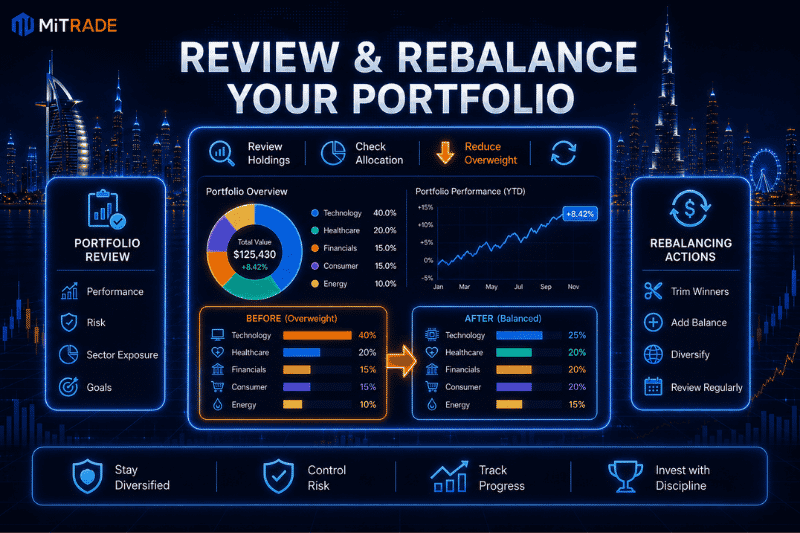
Portfolio review means checking whether your holdings still match your plan. Rebalancing means adjusting when one stock, sector, or asset class becomes too large or no longer fits your risk level.
Investing does not stop after buying a stock. Markets, companies, and your personal goals change over time.
Long-term investors may review monthly or quarterly, while active traders review more often. The key is to decide based on a plan, not fear or excitement.
You may need to rebalance when:
One stock or sector becomes too large compared with the rest of the portfolio.
A company’s earnings or business outlook weakens.
Interest rates or economic conditions change your investment view.
Your goal or risk tolerance changes, or a stock reaches your planned target.
For example, a beginner may start with five stocks, but after a strong rally, one AI stock becomes 50% of the portfolio. Even if the company is strong, this creates concentration risk, and rebalancing can reduce dependence on one company.
Suggestions for Beginners to Invest in the Stock Market
Beginners should focus on learning, risk control, and consistency before chasing fast profits.
🔹Start small: Use money you can afford to risk, not emergency savings or borrowed money. Consider setting a strict budget: fund your account only with capital you are comfortable risking, such as $500–$1,000, while keeping emergency savings completely separate.
🔹Know your style: Investing focuses on ownership and business quality, while trading focuses on price movement, timing, and risk management.
🔹Use a demo account first: Practise order placement, chart reading, stop-losses, take-profits, and position sizing before using real money. Consider placing 20 to 30 practice trades on a demo account first, which can help you comfortably master order types and risk tools before going live.
🔹Avoid hype buying: A famous company can still be overpriced, and a trending stock can still fall sharply.
🔹Diversify: Avoid depending on one company, one sector, or one market idea. To avoid concentration risk, you might want to allocate around 70% of your funds into broad-market ETFs, leaving 30% or less for individual stock or CFD trading.
🔹Check fees: Commission-free does not always mean cost-free. Look at spreads, FX fees, custody fees, ETF expense ratios, and overnight fees. Before executing a trade, it helps to review the platform's spreads and overnight fees, or check that long-term ETFs have an expense ratio below 0.2%.
🔹Keep a journal: Write down why you entered, your risk, your target, and what you learned. Keeping a basic spreadsheet to track your entry reasons, stop-losses, and exit emotions can be highly effective for reviewing your progress each week.
🔹Use risk tools: Stop-loss and take-profit orders help you trade with a plan instead of reacting emotionally. Many successful traders protect their capital by ensuring the stop-loss on any single trade risks no more than 1% to 2% of their total balance.
How to Learn Stock Basics and Level Up the Ability for Beginners?
For those new to US stock investing, in addition to honing trading strategies using a demo account, you can also consult professional books to rapidly build your knowledge base and get up to speed on US stock trading.
Recommended books
The Intelligent Investor by Benjamin Graham
One Up On Wall Street by Peter Lynch
The Psychology of Money by Morgan Housel
We have also compiled a list of US stock websites that investors can check daily to stay updated on the latest news and investment insights.
Recommended financial websites
Recommended stock analysis sites
Conclusion
Successful stock investing begins with the basics: understanding market mechanics, defining your style, whether short-term trading or long-term investing, and selecting the right product, whether direct equities, ETFs, or CFDs.
Before risking capital, you can use Mitrade’s $50,000 demo account to build a clear strategy, practise order execution, set important risk management tools like stop-losses and take-profit orders, and understand how different markets move. The goal is to grow your portfolio step by step based on disciplined research, risk control, and a clear plan, not emotion.
* The content presented above, whether from a third party or not, is considered as general advice only. This article should not be construed as containing investment advice, investment recommendations, an offer of or solicitation for any transactions in financial instruments.


