


2009 was the year the world changed financially with the invention of Bitcoin which is an anonymous and decentralized digital currency. What was once an experiment and a new form of digital currency is now over a trillion dollar market .
To learn cryptocurrency, you first have to learn how Bitcoin works. Understanding Bitcoin will help you have an advantage on other crypto-traders. This guide covers everything from the origins of Bitcoin, how it works and even better ways to trade it.
What is Bitcoin?
Bitcoin is a crypto with no central authority over it so people can make payments without the interference of banks. It has been the leading cryptocurrency since its launch. It runs on blockchain technology. Because it is virtual, there is no physical representation for it like the US dollar or the UAE dirham. Only 21 million BTC will ever exist, making it fundamentally different from these inflationary traditional currencies. This scarcity is one of Bitcoin’s defining features.
The Beginnings of Bitcoin
In 2008, an anonymous writer published a whitepaper laying out the fundamentals of creating an electronic cash system that allowed for peer-to-peer transactions. This whitepaper was called Bitcoin: A Peer-to-Peer Electronic Cash System and listed the author as Satoshi Nakamoto.
The Bitcoin system went live in January of 2009. The technology was in the early stages of development and was largely value-less. Therefore, Bitcoin had no real utility. In 2010 one of the early adopters in the community decided to purchase two pizzas. He used the technology to make a transaction exchanging 10,000 BTC for two pizzas . This event is now famously known as Bitcoin Pizza Day.
Bitcoin then started to gain attention from a lot of people. Some of the main milestones were:
The Goal of Bitcoin
Digital Cash - A completely digital currency that works all over the world and lets you send money from one country to another in seconds.
Scarcity - The fact that Bitcoin is designed to be scarce means no inflation worries like other fiat currencies.
Digital Gold - Many traders think of Bitcoin as being in the same class as the best long-term investment assets such as gold.
Hedge against inflation - Bitcoin is seen as a protection against inflation while also being used as a crypto for day-to-day purchases.
Who is Satoshi Nakamoto? The Effect of Satoshi Nakamoto on Bitcoin

No one knows who Satoshi is. It could be one guy or a group. What we do know about Satoshi is that they are the founder of Bitcoin. They stopped communicating with the community in 2011. There are theories but it is still unknown who they are.
What is known is that their impact on Bitcoin is huge. Satoshi created the first functioning digital currency system that could be used without the need for banks or central control.
Some argue that his anonymity has actually strengthened the decentralization of the currency. With no single person known to be in control, the currency has developed a community led system, rather than a company led system.
It is estimated that Satoshi may hold around 1 million BTC, which adds an even bigger mystery to the history of Bitcoin.
How Does Bitcoin Work?
Bitcoin works through the help of blockchain technology, Proof-of-Work and rewards. These systems enable the network to function.
1. Blockchain
A blockchain is basically a digital notebook that everyone can access and write in that's used to track all the transactions done in Bitcoin. Instead of all the info being on one server, there are copies all over the world on thousands of computers.
Lots of transactions bunch up and form a block. Each block gets verified and then added to the blockchain in order.
The blockchain is all about security. Every transaction done with Bitcoin is written to the blockchain and it stays there forever. This means it is very hard to change the data in the blockchain with all the power that is needed.
2. Proof of Work
Proof of work lets you complete a set of tasks to propose new blocks to be added to the blockchain. Once the tasks are completed the consensus mechanism verifies that you completed the tasks correctly and honestly. This means no data has been done wrong in the process.
Since this process takes up a lot of computing power, it makes changes to past transactions too pricey to attempt. This concept has made proof of work popular among other networks as well not just for Bitcoin.
3. Rewards
The network rewards users for keeping the network smooth and secure. This is done by giving miners new BTC as well as transaction fees. These rewards are given out to you automatically when you validate and add a new block of transactions to the blockchain. The current rate as of May 19, 2026 sits at 3.125 BTC per block.
What is Bitcoin Mining? How to Mine Bitcoin?
Bitcoin mining is how new transactions are confirmed and blocks are added to the blockchain. You have to race against other miners to be the first person to solve a cryptographic puzzle.
Essentially, you make new Bitcoin by mining. By solving the complicated puzzles, transactions on the blockchain are made valid. When the miners verify and confirm a block, they get new BTC as a reward.
In the beginning, Bitcoin mining could easily be accomplished by using your own computer. This changed as time went on since network difficulty and competition spiked. Therefore, mining requires more and more resources. Mining Bitcoin these days requires specialized ASIC hardware and electricity.
The process of mining consists of many stages which are as follows:
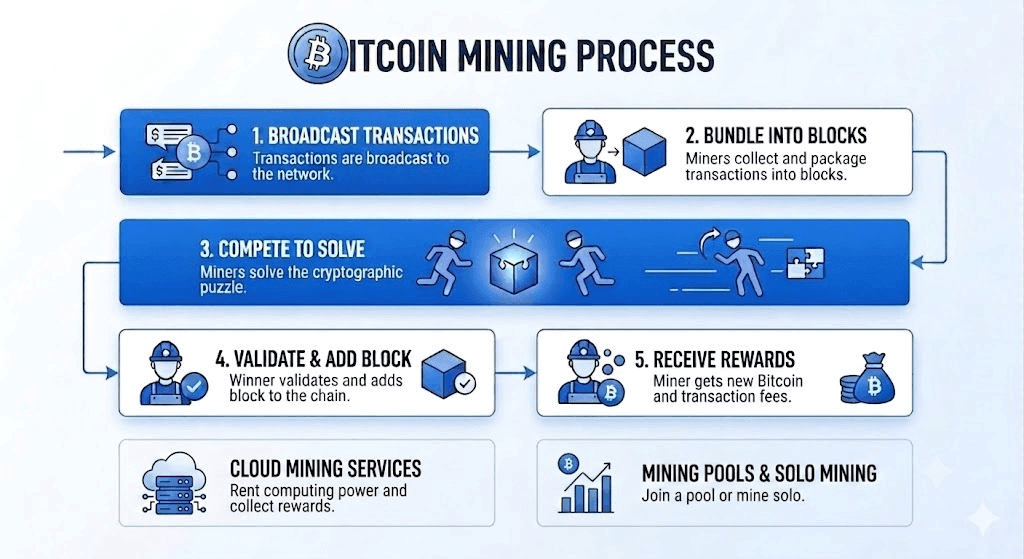
Transactions get sent to the network for miners to see
Miners gather these transactions and make them into a block
Miners race to solve a really difficult puzzle
The first one to solve the puzzle gets to validate the block
Finally, the miner gets to keep the new bitcoin created in this process and the fees for the transactions
| 💡Tips: Mining alone is very hard in 2026 since there are a lot of miners out there. As a result, people have started to join mining pools which share the winnings. There are also “cloud mining services”. These do the same thing, however you have to be super careful because a lot of scams exist there. |
Regulating Bitcoin Globally and in the UAE
Countries are all over the place when it comes to how they regulate Bitcoin. Some countries are very flexible when passing laws that help with crypto innovations and other countries make it hard or even illegal to own crypto.
Internationally, regulators are concerned with Bitcoin taxing and consumer protection. There are talks of Bitcoin legislation in the US right now. Meanwhile, Europe regulates BTC with the help of MiCa. MiCA makes it so crypto exchanges must get licenses, consumers are safe and stablecoins have enough reserves.
The UAE is also regulating Bitcoin. In Dubai, VARA regulates most of the cryptocurrency market. It licenses and watches over all crypto exchanges in Dubai. Meanwhile, the SCA covers the whole country outside of Dubai. Because of the proactive regulations many of the major cryptocurrency exchanges and blockchain companies have set up in the UAE.
You can freely buy, hold or sell Bitcoin without a license. There is also no capital gain tax and no personal income tax on crypto trading. This makes the UAE one of the most crypto-friendly jurisdictions in the world.
What Is Bitcoin Halving and When Does It Happen?
Halving events in Bitcoin happen when the network has processed 210,000 blocks which often happens every four years. This event is hardcoded into Bitcoin’s code and was created because it brings scarcity. It essentially means a 50% drop in the mining rewards for miners. This happens because it brings higher demand and a pump in the BTC price. The disinflationary system allows for the supply of Bitcoin to cap at 21 million BTC.
Halvings in the past usually led to a major bull market cycle due to low supply.
Since the start of the halving events, the BTC rewards that miners get has dropped from 50 BTC to 3.125 BTC.
Bitcoin halving strengthens the scarcity model of Bitcoin. It is one of the reasons investors see BTC as a long-term store of value.
How to Buy and Store Bitcoin Safely
There are plenty of ways to buy Bitcoin.
Bitcoin ATMs - For immediate physical-to-digital Bitcoin buying. They can be found in some of the main cities around the world.
Peer-to-peer (P2P) marketplaces - These marketplaces let you buy Bitcoin directly from some sellers.
Centralized exchanges (CEX) - Probably the safest way to buy BTC. Just sign up on a CEX like Kraken, go through the KYC process, fund your account with fiat and you are free to buy BTC.
Storing Bitcoin Safely
Bitcoin needs safe storage after you buy it. There are two different wallet types: hot and cold.
We believe that the best way to keep your crypto safe and secure is to put your assets in a cold wallet and only use a hot wallet for daily trading.
💡 Some trading platforms, such as Mitrade, offer another way to gain exposure to Bitcoin with less friction — CFDs (Contracts for Difference). CFDs let you trade Bitcoin and other cryptocurrencies without owning the underlying asset. With CFDs, you can enjoy:
✅Zero Wallet Hassle and More Security: CFDs eliminate Bitcoin's blockchain security risk. When dealing in Bitcoin CFDs, you guess the price movements, and thus, you don't own the currency in reality. This cuts out the complex management of your Bitcoin and the risks that come with it.
✅Two-Way Trading Flexibility: With CFD markets, you can make money trading in both market directions. If you think the price is going up, then you can take a long position. If you think the price is going to drop, you can take a short position.
✅Access to Leveraged Capital: CFDs give you margin leverage which means you can open a huge position even if you don't have a lot of cash in your account. This is both a good and a bad thing. While you can win more, you can also lose a lot more.

Risks of Investing in Bitcoin
Only go to invest in Bitcoin if you can manage the risk that comes with Bitcoin. Make sure you do the research and then decide what you’re willing to invest. Here are some risks that you should remember.
Regulation
The debate about whether or not cryptocurrency is legal and where it fits tax-wise is still ongoing and is likely to change a lot in the near future. A certain country may decide to ban Bitcoin one day. If you bought it while being in that country, you could lose access to it. Plus, changes to the way capital gains are taxed can lead to panic selling and aggressive BTC selling by financial institutions.
Volatility
Bitcoin is one of the riskiest cryptos. Price changes happen in just hours. This can be the result of changing economic conditions, posts on social networks or large sell offs. A lot of day traders think these quick changes are good. However, this may be a bad thing for some users who are just getting started.
Security
You are in charge of your own security since Bitcoin works on a decentralized network. On the Bitcoin network itself, there is no customer support. If you get scammed or lose the recovery key of your wallet, your Bitcoin is lost.
💡 As a tip, keep in mind that you need to only invest what you can afford to lose. Plus, do some thorough research before buying BTC.
Conclusion
Bitcoin was the first digital currency and changed the way we do finance with its use of blockchain.
When Bitcoin first developed in 2009, it was an experimental currency on the internet. Now, it is a global asset and has captured the eyes of institutional investors.
Hopefully, our article helped you learn more about Bitcoin. You should now have a better understanding on how it works, as well as its mining and how to buy it.
Remember that there are lots of opportunities to grow with Bitcoin. You can buy BTC directly or go through Mitrade and use CFDs to take advantage of its price changes. But, there are also a lot of risks. So take extra care of your finances when it comes to BTC.
 Forex 丨 Futures 丨 US Shares 丨 Gold 丨 More

 Strictly regulated
 0 commission, low spreads
 Attractive leverage of up to 1:200 & tight spreads
 Exclusive market analysis from Trading Central
 First hand tips and insights
 5/24 multilingual customer service support
 Trade on web or app
How Much Is $1 Bitcoin in US Dollars?
One Bitcoin is worth over $76,800 as of May 19, 2026. You can buy 0.00001263 BTC if you want to spend $1.
Is Bitcoin Still Profitable to Mine in 2026?
For most individuals, no. Bitcoin mining in 2026 is dominated by large-scale operations with access to cheap electricity and industrial-grade ASIC hardware.
Mining from home using a standard PC is completely unprofitable —ASIC mining rigs are very pricey and will use a ton of electricity.
Most beginners interested in Bitcoin are better off buying BTC directly rather than mining it.
How Much Bitcoin Can I Buy?
There’s no limit. Most apps and sites that let you buy BTC let you buy just a small fraction called satoshi. So you can buy Bitcoin for a few dollars.
Is Bitcoin Halal?
Islamic scholars do not have a clear answer about this question. Many believe that Bitcoin can be considered halal as long as it is used in a way that is not harmful. Others are worried about its volatility and the risks. You should consult a qualified religious scholar for a personal ruling.
* The content presented above, whether from a third party or not, is considered as general advice only. This article should not be construed as containing investment advice, investment recommendations, an offer of or solicitation for any transactions in financial instruments.


