


Nvidia and Micron Technology Just Received Some Very Bad News From an Unlikely Place
Key Points
Data center company, Firmus, cancelled its initial public offering on the Australian Stock Exchange last week, citing weak investor demand.
It might be a sign that funding is starting to dry up for artificial intelligence infrastructure companies, which would be bad news for semiconductor suppliers like Nvidia and Micron Technology.
Shares of Nvidia and Micron look cheap right now, but this could be a value trap if semiconductor demand slows.
- 10 stocks we like better than Nvidia ›
Australia is a relatively small country by population, with just 28 million citizens. But it has become a major hub for artificial intelligence (AI) data center projects because of its vast land mass and favorable political climate. In fact, an Australian company called Firmus built a data center in Melbourne that houses the largest cluster of Nvidia's (NASDAQ: NVDA) Blackwell Ultra chips in the entire Southern Hemisphere.
Last week, Firmus was on track for one of the biggest initial public offerings (IPOs) in the history of the Australian stock market, which would've raised approximately $5 billion (U.S. dollars) at a $30 billion valuation. The company was going to use the funds to build more data centers across Australasia in order to expand its customer base, which already includes OpenAI and Meta Platforms.
Missed Nvidia in 2009? This Rare Signal Is Flashing Again. In 2009, a "Double Down" signal flashed for a little-known chipmaker called Nvidia. For the first time in years, that same "Total Conviction" signal is flashing for a company 1/100th the size of Nvidia. Continue »
However, Firmus pulled the plug on its IPO at the last minute due to a lack of investor demand, which suggests funding might be starting to dry up for the AI industry. Mounting losses at some of the world's largest AI labs are an increasing concern, and rising interest rates are giving many investors a risk-free alternative for their money.
Here's why this development could have negative consequences for semiconductor suppliers like Nvidia and Micron Technology (NASDAQ: MU).

Image source: Getty Images.
Yet another crack in the AI boom
According to Nvidia, the top-five hyperscale companies (including Microsoft, Amazon, and Alphabet) are on track to spend around $800 billion on AI data center infrastructure in 2026 and could spend a further $1.3 trillion in 2027. As a result, demand currently outstrips supply for critical chips like the graphics processing units (GPUs) supplied by Nvidia and the accompanying high-bandwidth memory (HBM) supplied by Micron.
Microsoft, Amazon, and Alphabet build this infrastructure to develop their own AI software, but they also rent computing capacity to other businesses via their respective cloud platforms. This practice has become very lucrative, and Microsoft Azure, Amazon Web Services, and Alphabet's Google Cloud each delivered accelerating revenue growth in the quarter ended June 30.
In theory, hyperscalers will continue building more infrastructure as long as they believe there is demand for computing capacity. But cracks are starting to form; to keep up with the soaring costs of chips and components, companies like OpenAI, Anthropic, and even Microsoft have dramatically raised prices for using their AI models and software over the last few months.
OpenAI, for instance, recently introduced a new $500-per-month subscription plan for uncapped use of its flagship models, representing a whopping 150% increase over its $200-per-month plan, which used to be its most expensive offering. A report by the Financial Times last Thursday suggests OpenAI's annualized revenue is now tracking at $50 billion, below the $70 billion previously reported by other outlets. That might be a sign customers are pulling back amid the price hikes.
That isn't surprising, considering companies like Uber Technologies, Walmart, AT&T, and even Amazon have placed AI usage restrictions on their employees this year to prevent budget blowouts. In fact, a recent survey by UBS Group found that 60% of businesses are diverting some AI workloads to cheaper, more efficient models to reduce costs. These models typically consume less computing power than those from labs like OpenAI, which could result in lower demand for chips.
Therefore, Firmus' withdrawn IPO is just one more sign that sentiment toward AI might be shifting, at least temporarily.
Investors might be pricing in weaker semiconductor demand already
Nvidia stock is trading at a price-to-earnings (P/E) ratio of just 29.1 as I write this (Oct. 9), which is less than half its 10-year average of 61.3.
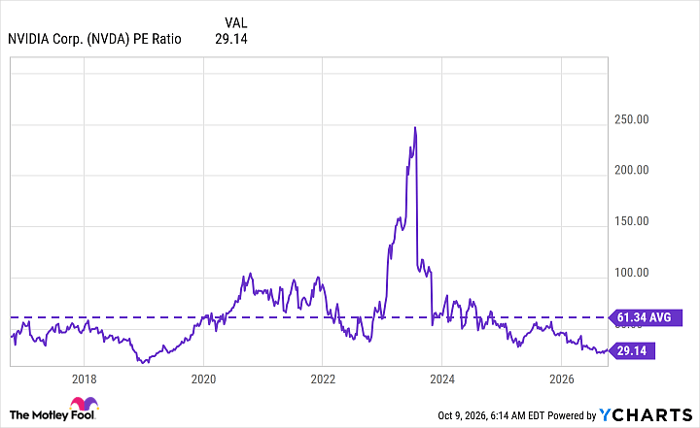
NVDA PE Ratio data by YCharts.
Micron stock is even cheaper. Its P/E ratio is just 13.9, a sizable discount to both the S&P 500 and Nasdaq-100 indexes, which have P/E ratios of 23.3 and 34.6, respectively. With an uncertain demand outlook and more supply scheduled to come online over the next couple of years, it appears Wall Street is betting the data center memory boom will be short lived.
So, what should investors do? Those who already own shares of Nvidia and Micron might want to hold on and take a wait-and-see approach. Over the next month, the hyperscalers will release their operating results for the quarter ended Sept. 30. If they announce a pullback in capital expenditures, a slowdown in semiconductor demand is almost certainly on the horizon, which might be a sign for investors to trim their positions.
Investors who don't already own shares of Nvidia and Micron might want to wait on the sidelines. While they seem cheap at face value, the market is sending a clear message that perhaps these companies won't grow their earnings as fast as initially expected over the next couple of years.
Should you buy stock in Nvidia right now?
Before you buy stock in Nvidia, consider this:
The Motley Fool Stock Advisor analyst team just identified what they believe are the 10 best stocks for investors to buy now… and Nvidia wasn’t one of them. The 10 stocks that made the cut could produce monster returns in the coming years.
Consider when Netflix made this list on December 17, 2004... if you invested $1,000 at the time of our recommendation, you’d have $379,123!* Or when Nvidia made this list on April 15, 2005... if you invested $1,000 at the time of our recommendation, you’d have $1,408,822!*
Now, it’s worth noting Stock Advisor’s total average return is 950% — a market-crushing outperformance compared to 215% for the S&P 500. Don't miss the latest top 10 list, available with Stock Advisor, and join an investing community built by individual investors for individual investors.
See the 10 stocks »
*Stock Advisor returns as of October 12, 2026.
Anthony Di Pizio has no position in any of the stocks mentioned. The Motley Fool has positions in and recommends Alphabet, Amazon, Meta Platforms, Micron Technology, Microsoft, Nvidia, and Walmart. The Motley Fool recommends Uber Technologies. The Motley Fool has a disclosure policy.
Recommended Articles


